- Jun 27, 2026
- Varicose Vein
- 0 Comments
Varicose veins are swollen, enlarged, and twisted veins that usually appear in the legs. They may look like blue or purple bulging lines under the skin, but they are not only a cosmetic problem. Many patients experience leg heaviness, pain, swelling, itching, night cramps, burning sensation, skin darkening, and difficulty standing for long hours.
When symptoms become frequent or visible veins start increasing, patients often wonder: “Which is better for varicose veins — laser treatment or surgery?” The answer depends on the patient’s vein condition, symptoms, Doppler report, age, medical history, and treatment goals.
At VascuCare Diagnostics & Interventions, Dr. Rakesh Kumawat, Best Interventional Radiologist and Pain Management Specialist Doctor In Jaipur, offers advanced diagnosis and minimally invasive treatment options for varicose veins and vascular conditions.
What Causes Varicose Veins?
Varicose veins occur when the valves inside the veins become weak. These valves normally help blood flow upward from the legs toward the heart. When they do not close properly, blood flows backward and collects inside the veins. This increases pressure and causes the veins to become enlarged, twisted, and visible.
Common risk factors include long-standing jobs, sitting for long hours, pregnancy, obesity, family history, aging, lack of exercise, and previous vein problems. If left untreated, varicose veins may lead to skin changes, ulcers, bleeding, or chronic venous insufficiency in some patients.
Why Is Doppler Test Important Before Treatment?
Before choosing laser or surgery, proper diagnosis is necessary. A Doppler ultrasound helps check blood flow, vein valve function, reflux, blockage, and the exact location of diseased veins. It helps the doctor understand which vein is faulty and how severe the condition is.
Without Doppler evaluation, treatment may focus only on visible veins and miss the root cause. This can increase the chance of recurrence. That is why a specialist first studies the complete vein map before recommending treatment.
What Is Laser Treatment for Varicose Veins?
Laser treatment for varicose veins is a minimally invasive procedure also known as endovenous laser treatment. In this procedure, a thin laser fiber is inserted into the faulty vein through a small puncture. Laser energy generates heat inside the vein, causing it to close. After the diseased vein is closed, blood naturally redirects through healthier veins.
The procedure is usually performed under image guidance, commonly ultrasound. This helps the doctor place the laser fiber accurately and treat the diseased vein safely.
Benefits of Laser Treatment
Laser treatment is preferred for many suitable patients because it does not require big cuts or stitches. It is minimally invasive and usually performed as a day-care procedure. Patients often experience faster recovery compared to traditional open surgery.
Other benefits may include less pain, minimal scarring, shorter hospital stay, quicker return to normal activities, and more precise treatment with ultrasound guidance. It is especially useful for patients who want effective treatment without major surgical wounds.
However, laser treatment is not suitable for every patient. The doctor decides suitability after clinical examination and Doppler findings.
What Is Traditional Surgery for Varicose Veins?
Traditional Varicose Vein Surgeon In Jaipur usually involves tying and removing the faulty vein through surgical cuts. This may include procedures such as vein ligation and stripping. Earlier, this was one of the main treatment options for varicose veins.
Surgery may still be required in selected cases where minimally invasive treatment is not suitable, the vein anatomy is complex, or there are other medical reasons. However, recovery from surgery may be longer compared to laser treatment.
Laser vs Surgery: Main Difference
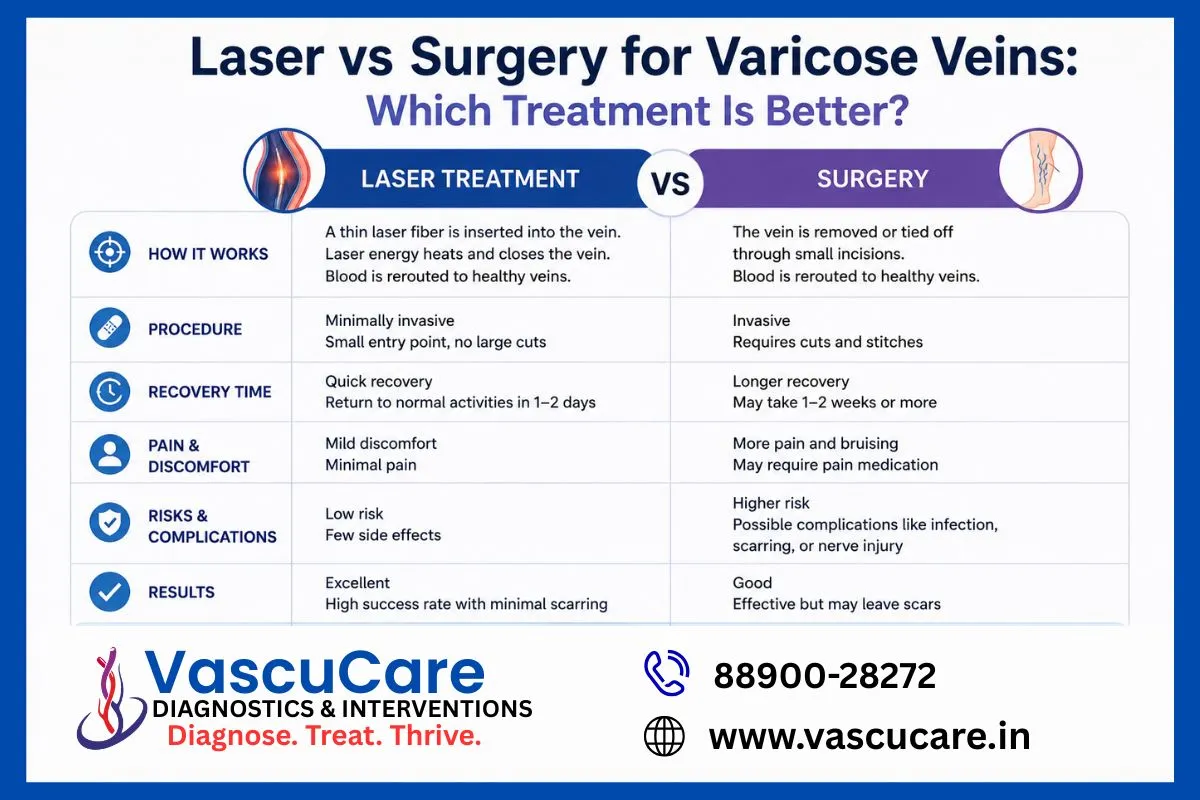
The biggest difference between laser and surgery is the method of treatment. Laser treatment closes the faulty vein from inside using heat energy through a small puncture. Surgery removes or ties the vein through cuts.
Laser treatment is usually less invasive, while surgery is more invasive. Laser treatment generally has a shorter recovery time, less scarring, and less discomfort. Surgery may involve stitches, dressings, and a longer healing period.
Both treatments aim to stop abnormal blood flow through the diseased vein and improve symptoms. The best option depends on the patient’s condition.
Which Treatment Has Faster Recovery?
For many suitable patients, laser treatment offers faster recovery than surgery. Since there are no big cuts, patients may return to routine activities sooner. Compression stockings may be advised after treatment to support healing and improve circulation.
Surgery may require more rest, wound care, and follow-up. Patients may take longer to return to full activity depending on the extent of surgery and overall health.
Which Treatment Is Safer?
Both laser and surgery can be safe when performed by an experienced specialist after proper evaluation. However, laser treatment is generally considered less invasive because it uses a small puncture instead of surgical cuts.
Safety depends on many factors, including accurate diagnosis, Doppler mapping, patient selection, medical history, and post-treatment care. Patients with diabetes, blood thinning medicines, heart problems, or previous clotting history should discuss these details with their doctor before treatment.
Which Treatment Is Better for Varicose Veins?
For many patients, laser treatment is often preferred because it is minimally invasive, image-guided, and offers quicker recovery. It is especially useful for symptomatic varicose veins caused by faulty superficial veins.
Surgery may be considered when laser treatment is not suitable or when the vein condition requires a different approach. Therefore, instead of choosing treatment based only on popularity, patients should consult a specialist and get a Doppler-based treatment plan.
Why Choose VascuCare Diagnostics & Interventions?
VascuCare Diagnostics & Interventions in Jaipur offers advanced evaluation and treatment for varicose veins and vascular conditions. Dr. Rakesh Kumawat, Best Interventional Radiologist and Pain Management Specialist in Jaipur, focuses on image-guided, minimally invasive, and patient-specific treatment planning.
His approach helps identify the root cause of varicose veins and choose the most suitable treatment, whether laser, radiofrequency, sclerotherapy, or another vascular intervention.
Conclusion
Laser treatment and surgery are both treatment options for varicose veins, but they are different in technique, recovery, and patient comfort. Laser treatment is a modern minimally invasive option that can treat many varicose vein cases without big cuts. Surgery may still be needed in selected patients where laser is not suitable.
If you are confused between laser and surgery for varicose veins, the best step is to get a proper Doppler evaluation and expert consultation. For advanced Varicose Vein Laser Treatment In Jaipur, consult Dr. Rakesh Kumawat at VascuCare Diagnostics & Interventions.
FAQs
1. Which is better for varicose veins: laser or surgery?
Laser treatment is often preferred for suitable patients because it is minimally invasive and offers faster recovery. Surgery may be needed in selected cases.
2. Is laser treatment for varicose veins painful?
Laser treatment usually causes less discomfort than open surgery. Local anesthesia or numbing medicine may be used depending on the procedure.
3. Does laser treatment remove varicose veins permanently?
Laser treatment closes the faulty vein. Treated veins usually shrink over time, but new varicose veins can develop if other veins become weak.
4. Is varicose vein surgery still done?
Yes, surgery may still be done when laser or other minimally invasive treatments are not suitable for the patient.
5. How is laser varicose vein treatment done?
A thin laser fiber is inserted into the faulty vein through a small puncture, and heat energy is used to close the vein from inside.
6. Is Doppler test needed before varicose veins treatment?
Yes, Doppler ultrasound is important to check vein reflux, valve function, blood flow, and the exact diseased vein before treatment.
7. Can I walk after laser treatment?
Many patients are encouraged to walk after treatment as advised by the doctor. Activity instructions depend on the patient’s condition.
8. Does laser treatment leave scars?
Laser treatment usually leaves minimal or no visible scarring because it is performed through a small puncture instead of large cuts.
9. Are compression stockings needed after treatment?
Compression stockings may be advised after laser treatment or surgery to support healing and improve circulation.
10. Who is the best doctor for varicose veins treatment in Jaipur?
Dr. Rakesh Kumawat, Best Interventional Radiologist and Pain Management Specialist Doctor In Jaipur, provides advanced varicose veins treatment at VascuCare Diagnostics & Interventions.