

- Sep 24, 2026
- Diagnostics
- 0 Comments
For many men, an enlarged prostate first becomes noticeable not through pain, but through small changes in everyday life. A night’s sleep may be interrupted two or three times for urination. The urinary stream may become slower. Starting urination can take longer, or the bladder may still feel partly full afterward.
These symptoms are commonly associated with Benign Prostatic Hyperplasia (BPH), a non-cancerous enlargement of the prostate that becomes more common with increasing age.
Medicines are often used as an initial treatment. Surgery may be recommended when symptoms are significant or complications develop. But there is now another option for appropriately selected patients: Prostate Artery Embolization Doctor In Jaipur (PAE).
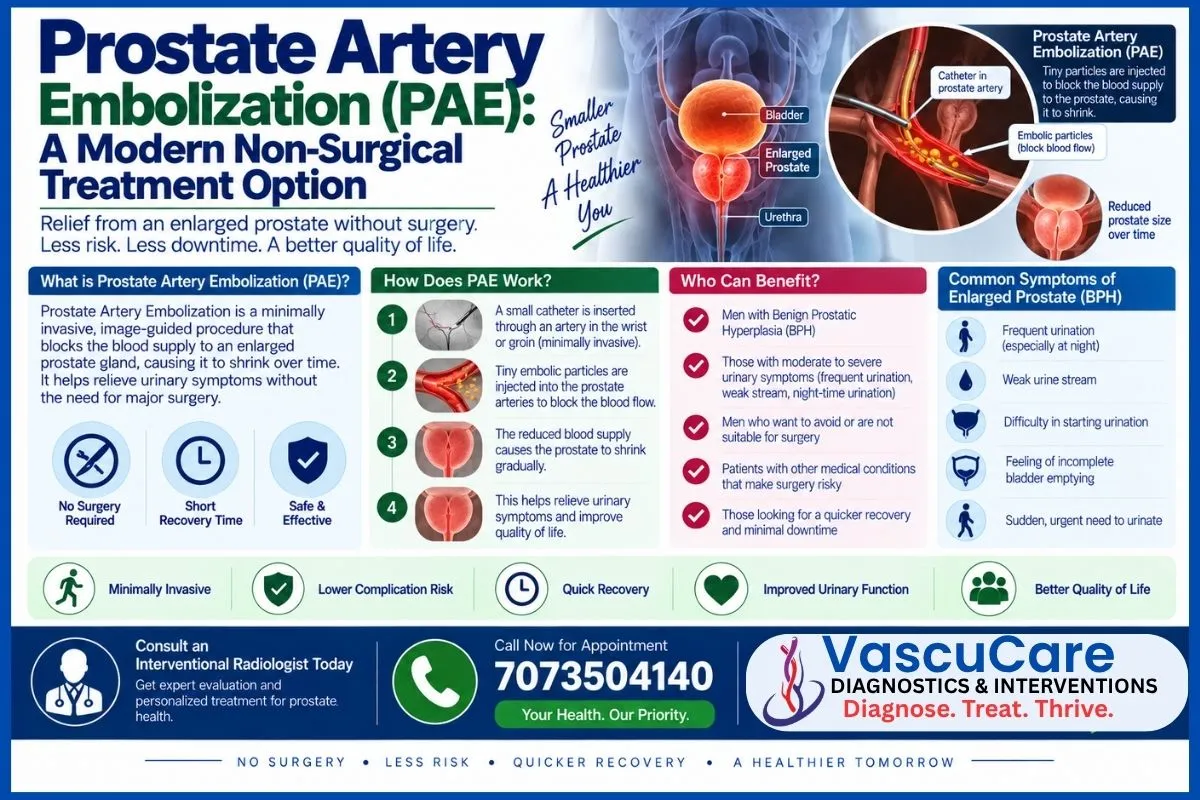
PAE is a minimally invasive, image-guided procedure performed by an interventional radiologist. Instead of surgically removing prostate tissue, it works by selectively reducing blood supply to the enlarged prostate so that it can gradually shrink.
Understanding this mechanism—and knowing who may or may not benefit—is more important than simply describing PAE as “prostate treatment without surgery.”
A Large Prostate Does Not Always Mean Severe Symptoms
One of the most important facts about BPH is that prostate size and symptom severity do not always match perfectly.
A man with a considerably enlarged prostate may have relatively manageable symptoms, while another with a smaller enlargement may experience significant urinary difficulty.
Why?
Because symptoms are influenced not only by prostate volume but also by where the enlargement occurs, how much it affects the urinary passage, bladder function, and other urinary conditions.
This is why treatment should not be selected from prostate size alone.
Which Urinary Changes Suggest BPH?
An enlarged prostate can place pressure around the urethra and interfere with normal urine flow.
Men may notice:
• Difficulty starting urination
• Weak or interrupted urinary stream
• Straining to urinate
• Frequent urination
• Urgency
• Waking repeatedly at night to urinate
• Feeling that the bladder has not emptied completely
These symptoms can gradually become part of everyday life, causing patients to organize travel, meetings, and sleep around access to a toilet.
However, urinary symptoms should not automatically be assumed to be BPH. Infection, bladder disorders, prostate cancer, urethral problems, and other conditions may produce overlapping symptoms.
Proper urological evaluation is therefore essential.
What Makes Prostate Artery Embolization Different?
Traditional prostate procedures generally address obstruction by surgically removing, cutting, vaporizing, or otherwise treating prostate tissue.
Prostate Artery Embolization Doctor In Jaipur takes a vascular route.
The prostate requires blood supply to maintain its enlarged tissue. PAE targets selected arteries supplying that tissue.
During the procedure, an interventional radiologist navigates a very small catheter through the blood vessels toward the prostate arteries.
Tiny embolic particles are then delivered into selected vessels to reduce blood flow.
Over the following weeks and months, reduced blood supply can cause the prostate to shrink, potentially decreasing pressure on the urinary passage and improving BPH-related symptoms.
The prostate is therefore treated through its arteries rather than through a surgical incision into the prostate itself.
How Does the Doctor Reach the Prostate Without Surgery?
This is often the part patients find most surprising.
The catheter does not need a large abdominal incision.
Vascular access is obtained through an artery, commonly through a small puncture at the wrist or groin depending on the patient’s anatomy and operator’s approach.
Using fluoroscopic X-ray guidance, the interventional radiologist navigates through the arterial system until reaching the small arteries supplying the prostate.
The ability to see and navigate these blood vessels is what makes PAE an interventional radiology procedure.
Why Is PAE Technically Challenging?
Prostate arteries can be small and anatomically variable.
They may arise from different pelvic arteries in different patients and can have connections with blood vessels supplying nearby structures.
Therefore, successful embolization requires more than simply introducing particles into an artery.
The interventional radiologist must identify the correct vascular anatomy and selectively target the prostate while minimizing unintended embolization of nearby tissues.
Advanced imaging during the procedure can assist with this detailed vascular mapping.
This is one reason experience in image-guided embolization is important.
What Happens Before Prostate Artery Embolization?
PAE should not begin with the assumption that every urinary symptom comes from prostate enlargement.
Before treatment, patients generally require appropriate evaluation to establish that BPH is the likely cause of symptoms and to rule out other clinically important conditions.
Assessment may include urinary symptom history, examination, laboratory testing, prostate imaging, urinary-flow assessment, and other investigations depending on the patient.
The medical team also needs to consider medications, kidney function, allergies, bleeding risk, previous procedures, and other health conditions.
Evaluation by a urologist may be an important part of this process.
Who May Be Considered for PAE?
Prostate Artery Embolization may be considered for selected men with bothersome urinary symptoms related to BPH, particularly when conservative measures or medications have not provided adequate improvement or have caused unwanted effects.
Some patients may also wish to explore minimally invasive alternatives before choosing a surgical procedure.
But patient preference alone does not establish suitability.
The decision depends on factors such as:
• Severity of urinary symptoms
• Prostate anatomy and size
• Cause of urinary obstruction
• Bladder function
• Vascular anatomy
• Previous BPH treatment
• Overall medical condition
• Treatment expectations
The aim is to identify patients whose symptoms are genuinely likely to respond to reducing prostate blood supply.
PAE vs TURP: Are They Competing Treatments?
Patients frequently compare Prostate Artery Embolization Doctor In Jaipur with Transurethral Resection of the Prostate (TURP).
However, the two procedures work very differently.
TURP is a well-established surgical treatment in which obstructing prostate tissue is removed through the urinary passage.
PAE does not mechanically remove the obstructing tissue. Instead, it reduces blood flow to the prostate and relies on subsequent shrinkage.
Because the mechanisms differ, the speed and degree of symptom improvement, recovery profile, possible complications, and suitability can also differ.
The correct question is therefore not simply:
“Is PAE better than TURP?”
It is:
“Which treatment best matches my prostate anatomy, symptoms, health and priorities?”
Is Improvement Immediate After PAE?
Not usually.
This is an important expectation for patients to understand.
Because PAE works by causing gradual prostate shrinkage, symptom improvement is generally not expected to occur the instant embolization is completed.
Changes can develop over the following weeks and months.
This differs from procedures that physically remove obstructing tissue during the intervention.
Understanding this timeline helps patients evaluate PAE realistically rather than expecting immediate restoration of urinary flow.
What Is Recovery Like?
PAE is generally performed as a minimally invasive procedure through a small vascular access point.
Because there is no large surgical incision, recovery may be relatively quick for appropriately selected patients.
Temporary symptoms after embolization can occur, including pelvic discomfort, urinary symptoms, or other post-procedure effects.
Patients receive individualized instructions regarding medications, hydration, activity, vascular access-site care, and symptoms that should prompt medical attention.
“Non-surgical” should never be interpreted as “no risk.” PAE has potential complications and limitations that need to be discussed before treatment.
Does PAE Affect Sexual Function?
Sexual function is understandably an important concern for many men considering treatment for BPH.
Different prostate treatments have different potential effects on ejaculation and sexual function.
One reason some patients explore PAE is its minimally invasive vascular approach. However, individual outcomes cannot be guaranteed, and sexual and urinary expectations should be discussed before selecting any BPH treatment.
The patient’s priorities should form part of shared treatment decision-making.
Can BPH Return After PAE?
PAE aims to produce meaningful symptom improvement by reducing prostate blood supply and volume, but it should not be presented as a guaranteed permanent cure.
Some patients may experience persistent or recurrent symptoms and may eventually require medication, repeat intervention, or another BPH treatment.
Long-term follow-up remains important.
A successful procedure should be judged not simply by a smaller prostate measurement but by whether the patient’s urinary function and quality of life actually improve.
Prostate Artery Embolization Doctor in Jaipur
At VascuCare Diagnostics & Interventions, patients interested in minimally invasive embolization procedures can be evaluated to determine whether an image-guided approach may be appropriate.
Dr. Rakesh Kumawat – Best Interventional Radiologist and Pain Management Specialist In Jaipur performs image-guided interventional procedures, including evaluation for Prostate Artery Embolization in Jaipur in appropriately selected patients.
PAE represents an important shift in how BPH can be approached: rather than entering the prostate surgically to remove tissue, the interventional radiologist can potentially treat enlargement through the blood vessels feeding it.
But the value of PAE depends heavily on correct patient selection.
For men with bothersome urinary symptoms, the first goal should therefore not be to choose between PAE and surgery. It should be to establish why urination has changed, how much the prostate contributes to the problem, and which treatment offers the most appropriate balance of effectiveness, recovery, and risk for that individual patient.
Frequently Asked Questions (FAQs)
1. Is Prostate Artery Embolization considered prostate surgery?
Prostate Artery Embolization Doctor In Jaipur is generally described as a minimally invasive image-guided procedure rather than traditional prostate surgery. It is performed through arterial access using a small catheter.
2. Does PAE remove part of the prostate?
No. PAE does not surgically remove prostate tissue. It selectively reduces blood flow to the enlarged prostate, which can lead to gradual shrinkage.
3. How quickly can urinary symptoms improve after PAE?
Improvement is usually gradual because prostate shrinkage takes time. The response and timeline vary between patients and may develop over weeks to months.
4. Can PAE be performed for every enlarged prostate?
No. Suitability depends on whether BPH is actually responsible for the symptoms, as well as prostate anatomy, vascular anatomy, bladder function, previous treatments, and overall health.
5. Do I still need a urologist if I am considering PAE?
Urological evaluation can be an important part of determining the cause of urinary symptoms, ruling out other conditions, and comparing appropriate BPH treatments. PAE often fits within multidisciplinary care.
6. Is PAE the same as TURP?
No. TURP removes obstructing prostate tissue through the urinary tract, while PAE reduces blood supply through the prostate arteries to promote gradual shrinkage.
7. Can PAE be considered if BPH medicines are not working?
Potentially. Patients with persistent symptoms despite appropriate medical management may be evaluated for procedural treatment, but eligibility for PAE requires individual assessment.
8. Will I need a urinary catheter after PAE?
Catheter requirements vary according to the patient’s urinary condition and procedural circumstances. Some patients may not require prolonged catheterization, while others may need one based on clinical need.
9. Can prostate enlargement come back after embolization?
Symptoms can persist or recur in some patients. Additional medication, repeat treatment, or another BPH procedure may occasionally be required, which is why follow-up is important.
10. How do I know whether PAE or prostate surgery is right for me?
The decision should consider symptom severity, prostate and vascular anatomy, bladder function, other medical conditions, previous treatment, expected outcomes, and personal priorities. Evaluation by the appropriate specialists can help compare the available options.