
- Jun 25, 2026
- Diagnostics
- 0 Comments
Hearing the word “test” or “needle” can make many patients nervous, especially when a doctor recommends an FNAC test for the first time. One of the most common questions patients ask is: “Is FNAC test painful?” The simple answer is that FNAC is usually a quick and minimally invasive test. Most patients feel only mild discomfort, pressure, or a small needle-prick sensation during the procedure.
FNAC, also called Fine Needle Aspiration Cytology, is commonly used to examine lumps, swellings, nodules, or abnormal tissue areas in the body. It helps doctors collect a small sample of cells using a thin needle. The sample is then studied under a microscope to understand whether the lump is benign, inflammatory, infectious, or suspicious.
At VascuCare Diagnostics & Interventions, Dr. Rakesh Kumawat, Best Interventional Radiologist and Pain Management Specialist in Jaipur, provides image-guided diagnostic and interventional procedures with a patient-focused approach.
What Is an FNAC Test?
FNAC stands for Fine Needle Aspiration Cytology. In this test, a very thin needle is inserted into a lump or swelling to collect cells or fluid. These cells are sent to a laboratory for microscopic examination.
Doctors may recommend FNAC for lumps in the neck, thyroid, breast, lymph nodes, salivary glands, soft tissue, or other superficial body areas. It is often used as an early diagnostic test because it is simple, quick, and less invasive than surgical biopsy.
Is FNAC Test Painful?
FNAC is usually not very painful. Since the needle used in FNAC is thin, most patients feel only a mild prick or pressure. The discomfort is often similar to a blood test or injection. Some patients may feel slight pain depending on the location of the lump, depth of the lesion, individual pain sensitivity, or if the area is already tender.
In many cases, local anesthesia may not be required because the needle is very fine. However, if the lump is deep, painful, or if image-guided FNAC is needed, the doctor may use local numbing medicine depending on the patient’s condition.
Why Do Doctors Recommend FNAC?
Doctors recommend FNAC to understand the nature of a lump or swelling. Not every lump is cancerous. Many lumps may be due to infection, inflammation, cysts, benign growths, or other non-cancerous conditions. FNAC helps doctors get important diagnostic information without immediately going for a surgical procedure.
It may be advised when a patient has a neck swelling, thyroid nodule, breast lump, enlarged lymph node, unexplained soft tissue lump, or swelling that is increasing in size. The test helps doctors decide the next step in treatment.
What Happens Before the FNAC Test?
Before FNAC, the doctor will examine the lump and ask about symptoms, medical history, medicines, allergies, previous reports, and bleeding-related problems. If the patient is taking blood thinners or has a bleeding disorder, the doctor should be informed before the procedure.
In some cases, ultrasound guidance may be used to locate the lump accurately. This is especially useful for small, deep, or difficult-to-feel swellings. Image-guided FNAC improves precision and helps collect the sample from the correct area.
How Is FNAC Test Done?
During the FNAC Testing Centre In Jaipur, the patient is asked to sit or lie down comfortably depending on the location of the lump. The skin over the area is cleaned properly. The doctor then inserts a thin needle into the lump and gently aspirates cells or fluid into a syringe.
Sometimes, the needle may be moved slightly inside the lump to collect enough sample. The sample is then placed on glass slides and sent for laboratory examination. The entire procedure usually takes only a few minutes, although preparation and observation may take longer.
What Will You Feel During FNAC?
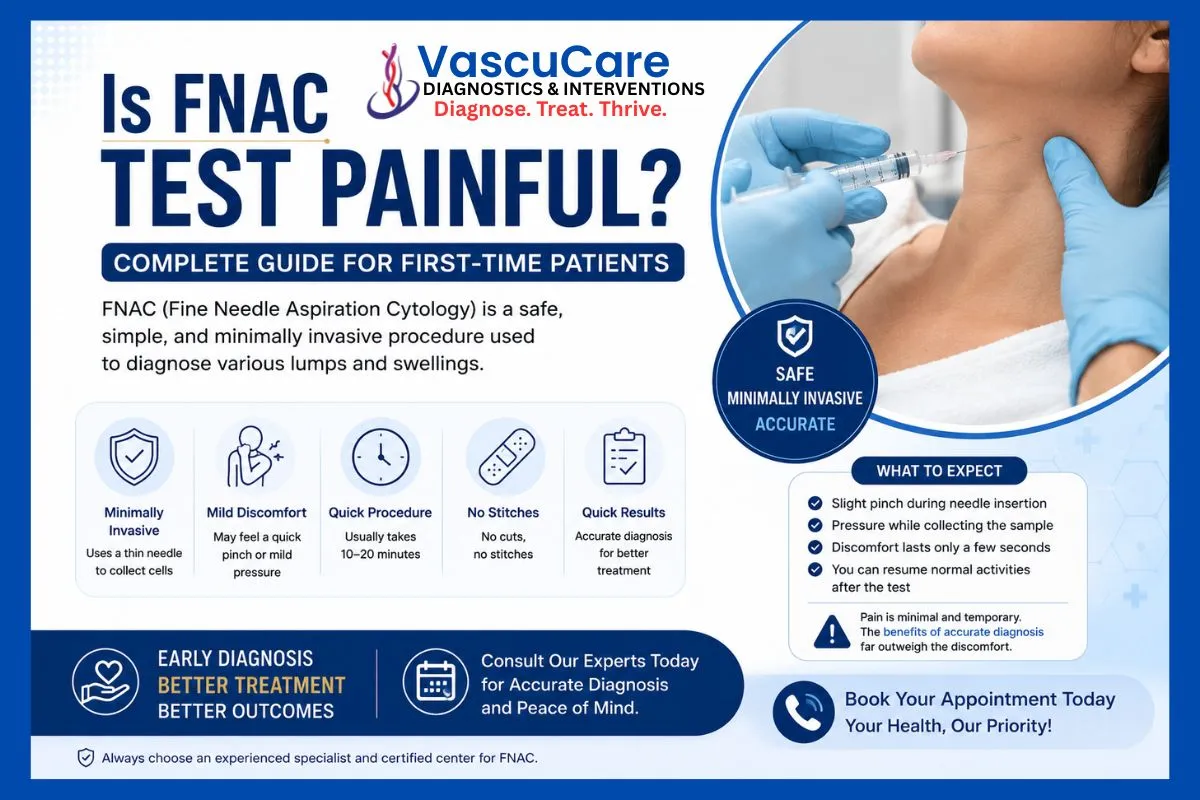
Most patients feel a small needle prick, mild pressure, or slight discomfort. If the area is sensitive, there may be brief pain. However, the discomfort usually lasts for a short time. Patients are advised to stay still during the procedure so that the doctor can collect the sample safely and accurately.
If ultrasound guidance is used, the doctor may move the ultrasound probe over the skin to identify the correct target area. This does not cause pain.
What Happens After FNAC?
After the test, slight soreness, swelling, or minor bruising may occur at the needle site. This usually settles on its own. The doctor may apply pressure for a short time to reduce the chance of bleeding. A small bandage may be placed over the puncture site.
Most patients can return to normal activities soon after the test. However, heavy exercise or pressure on the tested area may be avoided for a short period if advised by the doctor.
Are There Any Risks of FNAC?
FNAC is generally considered a safe procedure when performed by an experienced doctor. Possible minor risks include mild pain, bruising, swelling, bleeding, or infection at the needle site. Serious complications are uncommon.
Patients should contact the doctor if they notice increasing pain, excessive swelling, continuous bleeding, fever, pus, or redness around the puncture area.
FNAC Test vs Biopsy: What Is the Difference?
FNAC collects cells or fluid using a thin needle, while biopsy usually collects a larger tissue sample. FNAC is less invasive and often used as an initial diagnostic test. A biopsy may be recommended if FNAC results are unclear or if a larger tissue sample is required for detailed diagnosis.
Your doctor will decide whether FNAC is enough or whether further testing is needed.
Why Choose VascuCare Diagnostics & Interventions?
VascuCare Diagnostics & Interventions in Jaipur offers advanced diagnostic and image-guided procedures with a patient-first approach. Dr. Rakesh Kumawat, Best Interventional Radiologist and Pain Management Specialist in Jaipur, focuses on accurate evaluation, safe technique, and patient comfort during procedures like FNAC and other diagnostic interventions.
For first-time patients, clear explanation and careful handling can reduce fear and make the procedure easier.
Conclusion
FNAC test is usually a simple, quick, and minimally invasive diagnostic procedure. Most patients experience only mild discomfort or a small prick-like sensation. It helps doctors understand the nature of lumps and swellings without immediate surgery.
If your doctor has advised FNAC, there is no need to panic. With proper guidance and experienced care, the test can be performed safely and comfortably. For FNAC test in Jaipur, consult Dr. Rakesh Kumawat at VascuCare Diagnostics & Interventions for expert diagnosis and image-guided care.
FAQs
1. Is FNAC test painful?
FNAC is usually not very painful. Most patients feel only a mild prick, pressure, or brief discomfort during the test.
2. What is FNAC test used for?
FNAC is used to examine lumps, swellings, nodules, thyroid lesions, lymph nodes, breast lumps, and other abnormal tissue areas.
3. Is anesthesia needed for FNAC?
In many cases, anesthesia is not required because the needle is very thin. Local anesthesia may be used in selected cases.
4. How long does FNAC test take?
The actual sampling usually takes only a few minutes, but preparation and observation may take some additional time.
5. Can I go home after FNAC?
Yes, most patients can go home soon after the test and return to normal activities, unless the doctor advises rest.
6. What are the side effects of FNAC?
Minor soreness, swelling, bruising, or slight bleeding may occur. These usually settle within a short time.
7. Is FNAC test safe?
Yes, FNAC is generally safe when performed by an experienced doctor using proper technique and hygiene.
8. When is ultrasound-guided FNAC needed?
Ultrasound-guided FNAC may be needed for small, deep, or difficult-to-feel lumps to improve sampling accuracy.
9. Is FNAC the same as biopsy?
No. FNAC collects cells using a thin needle, while biopsy usually collects a larger tissue sample for detailed testing.
10. Where can I get FNAC test in Jaipur?
You can consult Dr. Rakesh Kumawat at VascuCare Diagnostics & Interventions in Jaipur for FNAC Testing Centre In Jaipur and image-guided diagnostic procedures.