- Sep 23, 2026
- Varicose Vein
- 0 Comments
A few enlarged veins on the leg may remain relatively symptom-free for years. But when Varicose Vein Laser Treatment In Jaipur and leg swelling start appearing together, the situation deserves a closer look.
Swelling can indicate that the problem is no longer limited to veins that are visible beneath the skin. In some patients, abnormal pressure within the venous system begins affecting fluid movement in the surrounding tissues. The result may be ankles that become puffy by evening, shoes that feel tighter after work, sock marks that remain visible, or a lower leg that feels heavy and full.
However, there is an important caution: not all leg swelling in a person with varicose veins is caused by varicose veins.
The real clinical question is therefore not simply, “Are my veins getting worse?” It is:
“Is the swelling caused by chronic venous disease, or is something else happening?”
Knowing the difference can help patients understand when routine evaluation is appropriate and when symptoms require urgent medical attention.
Why Can Varicose Veins Cause Swelling?
To understand the swelling, think of the leg veins as a low-pressure return system.
Blood travelling from the feet toward the heart has to move upward against gravity. Muscle contractions—particularly from the calf—help push blood upward, while one-way valves inside the veins help prevent it from falling backward.
When these valves become incompetent, some blood can move in the wrong direction. This is known as venous reflux.
Over time, reflux can increase pressure in the veins of the lower leg. Persistent venous pressure can encourage fluid to move into surrounding tissues, contributing to swelling.
This process is part of chronic venous insufficiency in affected patients.
The “Evening Ankle” Pattern: What Does It Tell You?
One useful clue is how your ankle changes between morning and evening.
Imagine that your ankle looks relatively normal after waking. You then spend the day standing at work or sitting at a desk. By evening, the ankle looks puffy, the lower leg feels heavy, and your socks leave deep marks.
After sleeping with your legs horizontal overnight, much of the swelling improves.
This morning-to-evening change can occur in venous disease because gravity influences venous pressure throughout the day.
It is not enough to diagnose varicose veins by itself, but when combined with visible veins, aching, heaviness, or skin changes, it makes venous evaluation more relevant.
What If the Swelling Stops Disappearing Overnight?
This is an important progression to notice.
Early venous swelling may fluctuate considerably. As chronic venous disease advances, some patients find that their legs remain swollen even after resting.
Persistent swelling can indicate more significant tissue involvement, although other causes also need consideration.
At this stage, repeatedly using home remedies without determining the underlying cause may delay appropriate assessment.
One Swollen Leg and Two Swollen Legs Are Not the Same Clinical Story
Whether swelling affects one leg or both can provide useful diagnostic information.
Chronic venous reflux may affect one or both legs, so laterality alone cannot establish the cause.
However, swelling of both legs may also occur with systemic medical conditions or medication-related fluid retention. Heart, kidney, liver, lymphatic, and other problems may need consideration depending on the patient’s history.
This is why having visible Varicose Vein Doctor In Jaipur does not prove that every episode of swelling comes from those veins.
The presence of varicose veins can sometimes distract attention from another medical problem.
When Sudden One-Leg Swelling Changes the Urgency
Gradual evening swelling is very different from a leg that becomes noticeably swollen over hours or a short period.
Sudden one-sided swelling—especially when accompanied by pain, warmth, redness, or tenderness—requires prompt medical assessment.
Doctors may need to exclude Deep Vein Thrombosis (DVT), in which a clot forms in a deep vein.
Do not assume sudden swelling is simply a “varicose vein flare.”
If leg symptoms are accompanied by sudden breathlessness, chest pain, fainting, or coughing blood, emergency medical care is required because these symptoms can indicate a serious complication.
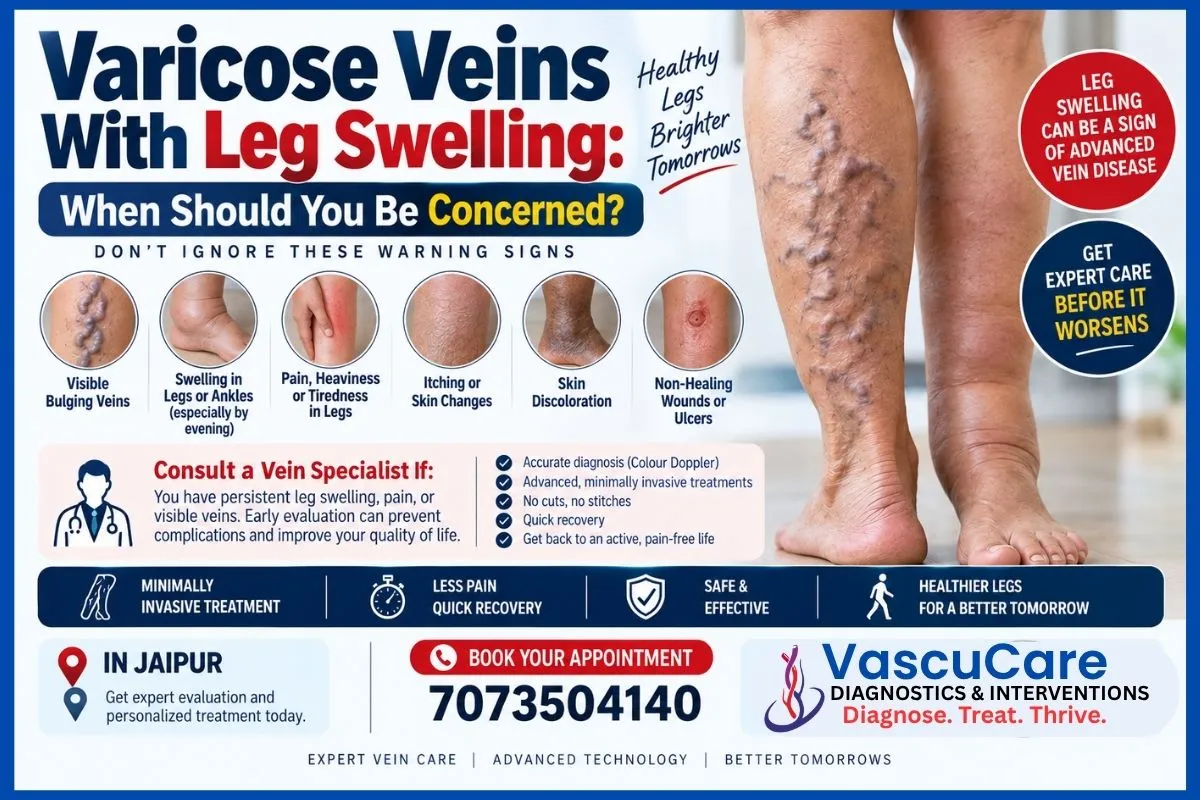
Look at the Skin, Not Just the Size of the Veins
The skin around the ankle can provide clues about how chronic venous pressure is affecting the leg.
Patients sometimes focus entirely on how large their varicose veins have become while overlooking gradual changes in the surrounding skin.
Watch for:
• Brown or darker pigmentation near the ankle
• Persistent itching
• Dry or inflamed skin
• Eczema-like changes
• Hardening or thickening of tissues
• Increasing tenderness
• A wound that is slow to heal
These changes deserve evaluation because they can indicate more advanced chronic venous disease.
Why Is a Non-Healing Ankle Wound Important?
Long-standing venous hypertension can eventually damage tissues enough for a venous leg ulcer to develop.
These wounds commonly occur around the lower leg or ankle and may be difficult to heal if abnormal venous pressure continues.
Simply applying dressings addresses the wound surface but may not address the underlying circulation problem.
When a chronic wound occurs alongside swelling and varicose veins, assessment of the venous system can therefore become an important part of treatment planning.
What Does Colour Doppler Add to the Examination?
Visible veins tell a doctor what is happening on the surface.
Colour Doppler or duplex ultrasound helps investigate what is happening underneath.
The examination can assess the anatomy and function of the leg veins and help determine whether abnormal backward blood flow is present.
For a patient with swelling and Varicose Vein Laser Treatment In Jaipur, Doppler can help answer questions such as:
Which vein is refluxing?
How extensive is the reflux?
Is the visible vein being supplied by another incompetent superficial vein?
Do deeper veins require assessment?
This information helps separate cosmetic appearance from functional venous disease.
Why Treating Only the Swelling May Not Be Enough
Some patients repeatedly elevate their legs, massage them, or use other measures whenever swelling develops.
These measures may temporarily reduce symptoms in some situations, but if significant venous reflux is driving the problem, the underlying abnormal flow remains.
Similarly, treatment should not automatically begin with a procedure simply because swelling exists.
First establish the cause.
For appropriate patients, conservative management may include physical activity, calf-muscle exercise, weight management where relevant, leg elevation, and compression when medically suitable.
When significant symptomatic superficial venous reflux is identified, an intervention may be considered.
Where Does Varicose Vein Laser Treatment Fit?
For suitable venous anatomy, endovenous laser ablation can be used to close a problematic refluxing superficial vein from within.
A thin laser fibre is positioned inside the vein under ultrasound guidance. Controlled thermal energy closes the targeted vein, allowing blood to return through other functioning venous pathways.
This is different from simply treating whichever bulging vein looks largest.
Effective treatment planning should be based on the source and pathway of reflux identified on Doppler.
Additional visible branches may sometimes require separate management.
When Should Swelling Make You Book a Vein Consultation?
Instead of waiting for varicose veins to become extremely large, consider assessment when the behaviour of your leg begins changing.
Examples include swelling that appears repeatedly, increasing heaviness after standing, progressive discomfort, skin pigmentation, persistent itching, tissue hardening, or a wound around the ankle.
These changes can indicate that venous disease is having a functional effect rather than remaining purely cosmetic.
Patients searching for a Varicose Vein Doctor in Jaipur should ideally receive evaluation of the underlying circulation rather than treatment based solely on appearance.
Varicose Veins and Leg Swelling Treatment in Jaipur
At VascuCare Diagnostics & Interventions, patients with varicose veins, recurrent leg swelling, heaviness, skin changes, and other suspected venous symptoms can be evaluated clinically and with Colour Doppler when indicated.
Dr. Rakesh Kumawat – Best Interventional Radiologist and Pain Management Specialist Doctor In Jaipur evaluates vascular conditions and provides minimally invasive image-guided treatment options for appropriately selected patients.
The key distinction is between a swollen leg that can wait for routine evaluation and a swollen leg that should not wait.
Gradually recurring evening swelling associated with chronic varicose veins deserves planned assessment. Sudden significant one-sided swelling or swelling associated with serious chest or breathing symptoms requires much more urgent medical attention.
Understanding that difference is more valuable than simply judging varicose veins by how large they look.
Frequently Asked Questions (FAQs)
1. Why do my varicose veins and ankle swelling become worse in the evening?
Prolonged standing or sitting can increase venous pressure in the lower legs. If venous valves are incompetent, this may contribute to blood pooling and fluid moving into surrounding tissues.
2. Why is my leg swelling better when I wake up?
When you lie horizontally overnight, gravity has less effect on blood and fluid in the lower legs. This can reduce swelling associated with certain venous problems.
3. Is swelling around the ankle a sign that my varicose veins are becoming serious?
Recurring swelling can indicate more significant venous dysfunction, particularly when combined with heaviness, aching, pigmentation, or skin changes. However, other causes of swelling should also be considered.
4. Can I have severe venous insufficiency without very large varicose veins?
Yes. The appearance of surface veins does not always correspond directly with the severity of underlying venous reflux. Clinical evaluation and Doppler findings provide more useful information.
5. Why is only one of my legs more swollen even though both have varicose veins?
The pattern and severity of venous reflux can differ between legs. However, significant one-sided swelling can also have other causes, so assessment may be necessary rather than assuming the difference is due to varicose veins.
6. Does leg elevation treat the actual cause of varicose veins?
Elevation may temporarily reduce venous pressure and swelling, but it does not repair incompetent vein valves or eliminate established reflux.
7. Can compression stockings reduce swelling from varicose veins?
Compression can help control symptoms in appropriately selected patients, but it is not suitable for every circulation problem. The appropriate compression level and suitability should be determined with medical guidance.
8. Will laser treatment immediately remove all swelling from my leg?
Not necessarily. Improvement depends on whether the swelling is actually caused by treatable venous reflux and whether other conditions are contributing. Swelling may also take time to improve after treatment.
9. What test is usually performed when varicose veins are associated with swelling?
Colour Doppler Sonography In Vaishali Nagar or duplex ultrasound is commonly used to assess venous blood flow, valve function, reflux, and the anatomy of affected veins.
10. When should I seek urgent care for a swollen leg?
Seek prompt medical assessment for sudden significant swelling of one leg, especially with pain, warmth, redness, or tenderness. If leg swelling occurs with sudden breathlessness, chest pain, fainting, or coughing blood, seek emergency medical care immediately.