
- Oct 7, 2026
- Pain Management
- 0 Comments
For many people with knee joint pain, the first treatment plan looks familiar: pain-relieving medicines, physiotherapy, exercises, activity modification and perhaps weight management when appropriate.
These measures can be effective, especially during the early stages of many knee conditions. But what happens when you have followed the treatment plan and the knee still hurts?
Perhaps medicines provide relief for only a few hours. Physiotherapy has improved strength but climbing stairs remains painful. You may still struggle to get up from a chair, walk longer distances, or sleep comfortably.
At this point, the answer should not automatically be “take stronger painkillers” or “you need knee replacement.”
There is an important stage between basic conservative treatment and major surgery where a more detailed evaluation may identify other knee joint pain treatment options.
For patients searching for a Knee Pain Doctor In Jaipur, identifying the cause of persistent pain is an important first step.
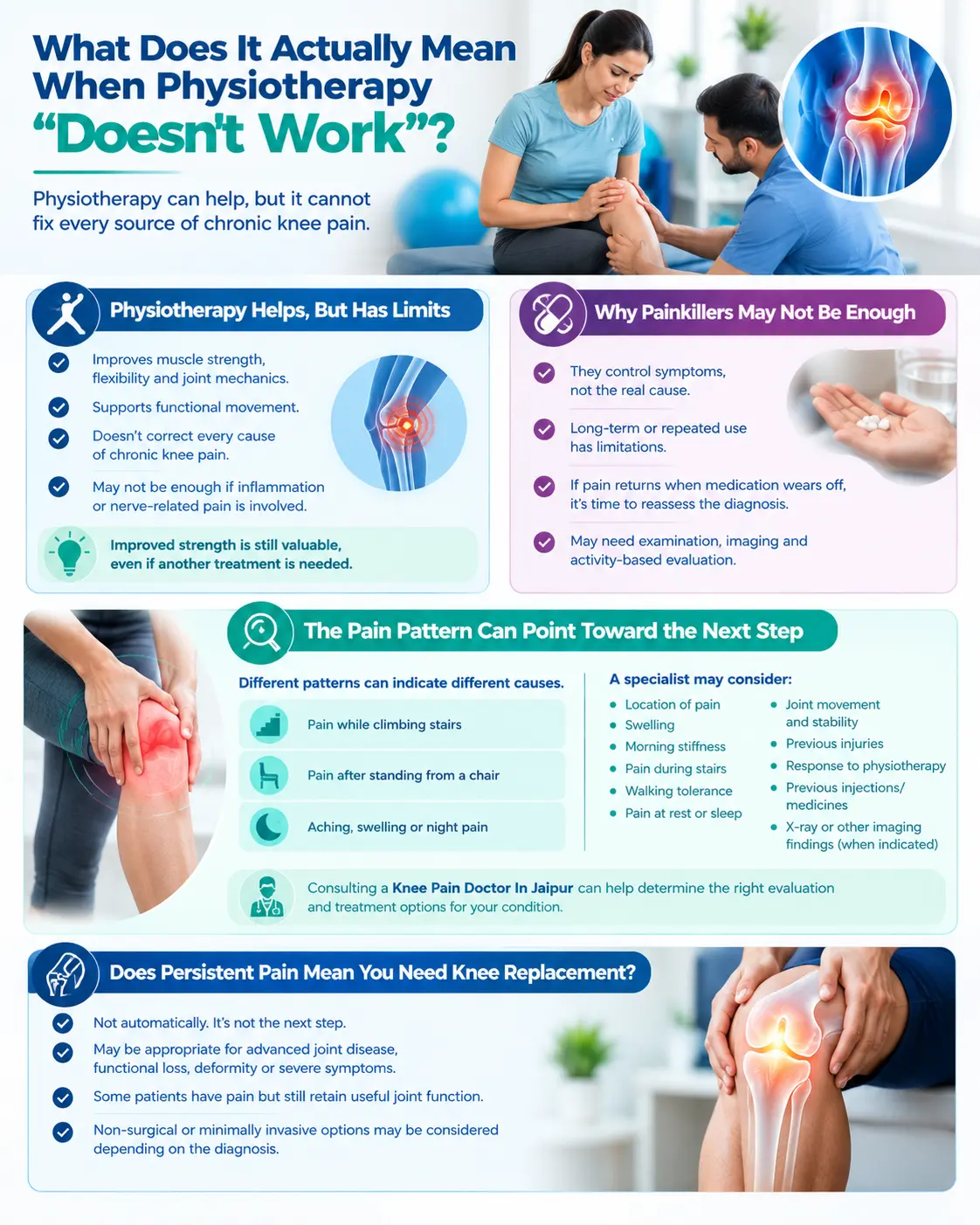
What Does It Actually Mean When Physiotherapy “Doesn’t Work”?
Before declaring physiotherapy unsuccessful, it is important to understand what was being treated.
Physiotherapy can improve muscle strength, flexibility, joint mechanics and functional movement. However, it cannot correct every source of chronic knee pain.
For example, if significant osteoarthritis-related inflammation or persistent pain transmission through sensory nerves is contributing to symptoms, strengthening alone may not provide sufficient relief.
This does not necessarily mean physiotherapy was useless.
In fact, improved muscle strength can remain valuable even if another treatment is subsequently required.
The more useful question is:
“What is continuing to generate pain despite rehabilitation?”
Why Repeated Painkillers May Not Solve the Problem
Pain medicines can play an important role in symptom management when medically appropriate.
But medication primarily controls symptoms. It does not necessarily identify why the pain continues.
Long-term or repeated medication use may also have limitations depending on the medicine and the patient’s medical history.
If knee pain repeatedly returns when medication wears off, it may be time to reassess the diagnosis rather than simply continuing the same cycle.
Persistent symptoms may require examination, appropriate imaging and evaluation of how the pain behaves during different activities.
The Pain Pattern Can Point Toward the Next Step
Not all chronic knee pain behaves in the same way.
One patient may mainly experience pain while climbing stairs.
Another may have pain during the first few steps after standing from a chair.
Someone else may experience persistent aching, swelling or night pain.
These patterns can provide clues about the structures and mechanisms involved.
A specialist may consider:
-
Location of pain
-
Presence of swelling
-
Morning stiffness
-
Pain during stairs
-
Walking tolerance
-
Pain at rest or during sleep
-
Joint movement and stability
-
Previous injuries
-
Response to physiotherapy
-
Response to previous injections or medicines
-
X-ray or other imaging findings when indicated
The objective is to build a pain profile before selecting the next treatment.
Consulting a Knee Pain Doctor In Jaipur can help patients understand which evaluation and treatment options may be appropriate for their individual condition.
Does Persistent Pain Mean You Need Knee Replacement?
No.
Persistent knee pain after medicines and physiotherapy does not automatically mean replacement surgery is the next step.
Knee replacement can be appropriate for patients with advanced structural joint disease, significant functional loss, deformity or severe symptoms that have not responded adequately to appropriate non-surgical treatment.
But some patients have persistent pain while still retaining useful joint function.
For these patients, additional non-surgical or minimally invasive options may be considered depending on the diagnosis.
Where Does PRP Therapy Fit?
Platelet-Rich Plasma (PRP) therapy is a biological treatment used in selected musculoskeletal conditions.
PRP is prepared from the patient’s own blood. A concentrated platelet-containing component is then delivered to the targeted area.
PRP may be considered for certain patients depending on their diagnosis and stage of joint disease.
However, it should not be viewed as a treatment that can rebuild a severely destroyed knee or guarantee avoidance of surgery.
Patient selection and realistic expectations are important.
What Is a Genicular Nerve Block?
Chronic knee pain is transmitted to the brain through sensory nerve pathways.
A Genicular Nerve Block Treatment In Jaipur targets selected sensory nerves around the knee with medication.
For some patients, the procedure may provide temporary relief. It can also have a useful diagnostic role.
If activities that normally cause substantial pain become noticeably easier while the targeted nerves are blocked, the response may suggest that those nerves contribute significantly to the patient’s pain pathway.
This information can help determine whether another nerve-targeted treatment may be appropriate.
What Comes After a Successful Nerve Block?
For selected patients who respond appropriately, Genicular Nerve Ablation (GNA) may be considered.
Instead of repeatedly using medication around the nerve, ablation uses controlled energy to modify pain transmission through targeted sensory nerves.
The objective is pain control—not cartilage regeneration.
Reducing pain may help some patients walk more comfortably and participate more effectively in rehabilitation.
Physiotherapy may therefore remain important even after an interventional pain procedure.
What If Inflammation Is Driving Osteoarthritis Pain?
Some patients with osteoarthritis have persistent inflammatory activity associated with abnormal small blood vessels around affected knee tissues.
This creates a different potential treatment target.
Genicular Artery Embolization (GAE) is a minimally invasive image-guided procedure in which an interventional radiologist navigates a small catheter toward selected arteries around the knee.
The procedure aims to reduce abnormal vascularity associated with inflammation in appropriately selected osteoarthritis patients.
GAE is not the same as a nerve block or nerve ablation.
GNB/GNA target pain transmission. GAE targets abnormal vascularity associated with inflammation.
Understanding this difference is essential when choosing treatment.
Why One Advanced Treatment Does Not Suit Every Patient
When medicines and physiotherapy stop providing sufficient relief, patients may understandably start searching for the “best” procedure.
But there is no single procedure that is best for every painful knee.
A patient whose symptoms are primarily related to advanced structural destruction may require a different pathway from someone whose joint still functions reasonably well but who has persistent inflammatory or nerve-mediated pain.
This is why diagnosis should come before procedure selection.
Modern knee pain management is increasingly about matching the treatment to the dominant pain mechanism.
Knee Joint Pain Treatment in Jaipur
At VascuCare Diagnostics & Interventions, patients with persistent knee joint pain can be evaluated when basic conservative measures have not provided adequate relief.
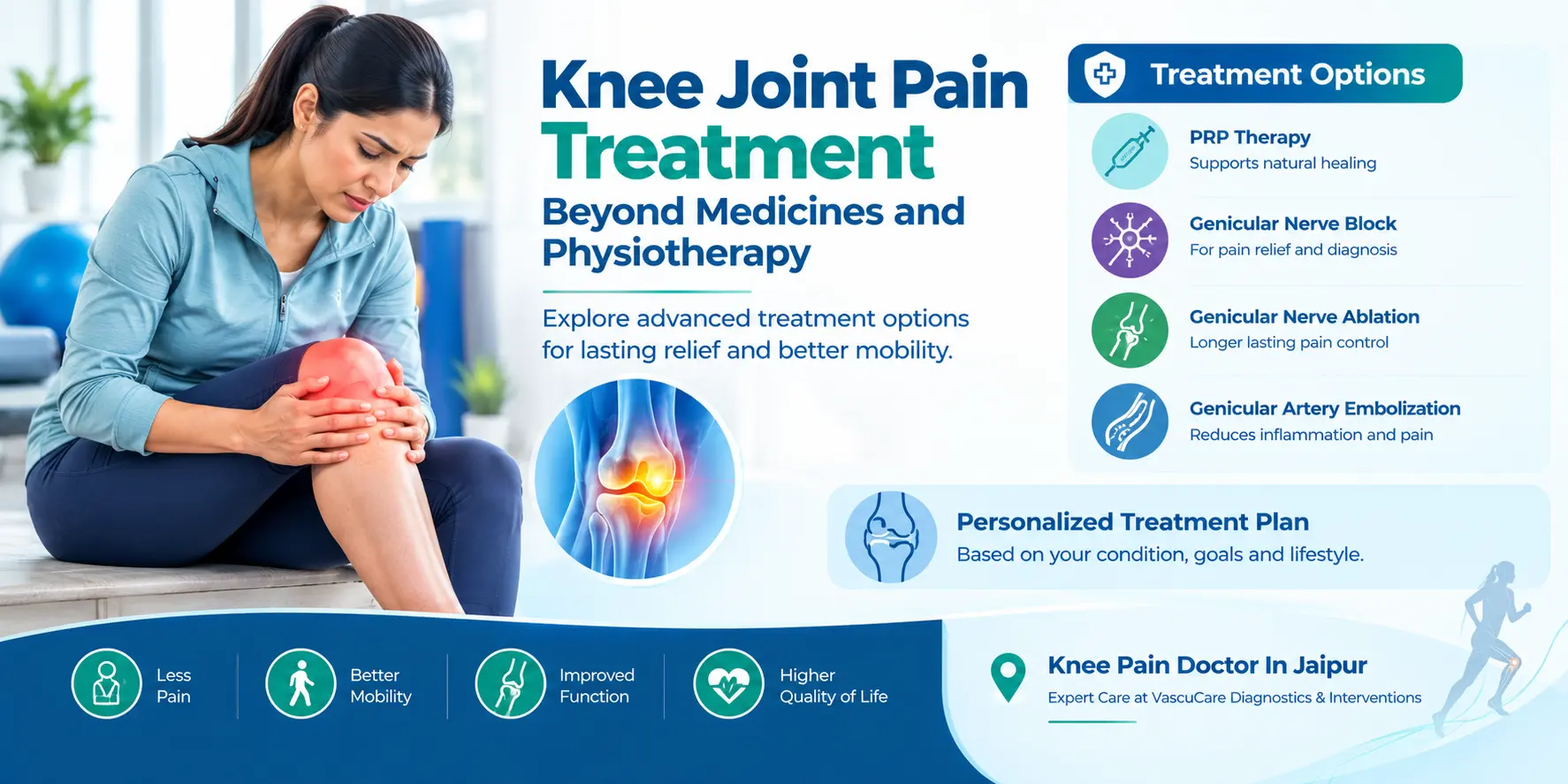
Depending on the diagnosis, previous treatment response and clinical findings, options may include PRP Therapy, Genicular Nerve Block Treatment in Jaipur, Genicular Nerve Ablation, and Genicular Artery Embolization for appropriately selected patients.
Dr. Rakesh Kumawat – Best Interventional Radiologist and Pain Management Specialist In Jaipur provides pain-management and image-guided interventional options for chronic knee conditions.
Patients searching for Knee Pain Doctor In Jaipur or Varicose Vein Doctor In Jaipur should seek a specialist whose expertise matches their specific condition and treatment needs.
For patients searching for Knee Joint Pain Treatment in Jaipur, the next step after failed medicines or physiotherapy should not simply be a stronger version of the same treatment.
It should be a reassessment:
Why does the knee still hurt, which mechanism is maintaining the pain, and what treatment specifically addresses that mechanism?
Answering these questions can create a more personalized path between basic conservative care and major knee surgery.
Frequently Asked Questions (FAQs)
1. What should I do if physiotherapy is not reducing my knee pain?
Persistent pain should be reassessed to confirm the diagnosis and identify the dominant pain mechanism. Depending on the findings, your treatment plan may need modification rather than simply stopping exercise.
2. Does failed physiotherapy mean I need knee replacement?
No. The need for replacement depends on structural joint damage, symptoms, mobility, deformity, stability and response to appropriate treatments. Some patients may have other non-surgical options.
3. What is the difference between GNB and Genicular Nerve Ablation?
GNB uses medication around selected sensory nerves and may provide temporary relief or diagnostic information. Genicular Nerve Ablation uses controlled energy to modify pain transmission for a potentially longer period in selected patients.
4. How is Genicular Artery Embolization different from nerve treatment?
GAE targets abnormal vascularity associated with inflammatory osteoarthritis pain. Genicular nerve procedures target sensory nerves carrying pain signals. They address different mechanisms.
5. Can I continue physiotherapy after an advanced knee pain procedure?
Often, rehabilitation remains an important part of treatment. When pain is better controlled, some patients may participate more comfortably in strengthening and mobility exercises. The timing and type of physiotherapy should be individualized by the treating team.