

- Sep 8, 2026
- Diagnostics
- 0 Comments
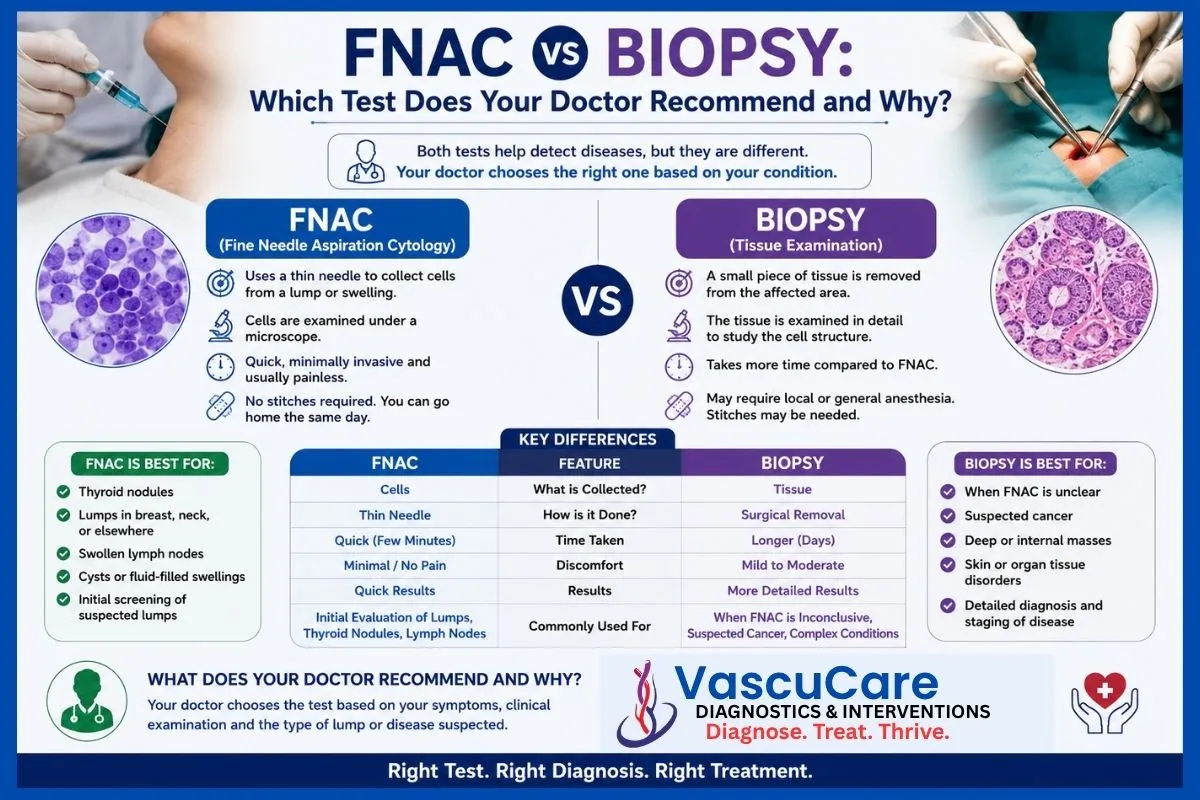
Finding a lump, swelling, thyroid nodule, enlarged lymph node, or suspicious abnormality on an imaging test can naturally raise concerns. However, an abnormal lump does not automatically mean cancer. Doctors often need a tissue or cell sample to understand what the abnormality actually represents. Two commonly recommended diagnostic procedures are FNAC Testing Centre In Jaipur (Fine Needle Aspiration Cytology) and biopsy.
Although both tests help diagnose abnormal tissue, they are not identical. FNAC collects cells using a fine needle, while a biopsy usually obtains a larger tissue sample that preserves more of the tissue architecture. Your doctor chooses between them based on the location and nature of the abnormality, the suspected condition, and how much information is required for an accurate diagnosis.
What Is FNAC?
Fine Needle Aspiration Cytology (FNAC) is a minimally invasive diagnostic procedure in which a thin needle is inserted into a lump or suspicious area to collect cells. These cells are then examined under a microscope by a pathology specialist.
FNAC is commonly considered for abnormalities involving areas such as:
- Thyroid nodules
- Enlarged lymph nodes
- Breast lumps
- Salivary gland swellings
- Superficial lumps and masses
When a lump cannot be accurately targeted by touch alone, ultrasound-guided FNAC or another image-guided approach may help the doctor place the needle precisely within the required area.
What Is a Biopsy?
A biopsy involves removing a small sample of tissue from an abnormal area for laboratory examination. Unlike FNAC, which primarily collects individual cells or small clusters, a core needle biopsy can provide a piece of tissue.
This allows the pathologist to examine not only individual cells but also how those cells are arranged within the tissue.
A biopsy may be recommended when more detailed information is required to establish a diagnosis, characterize a suspicious lesion, or plan further treatment.
Depending on the location of the abnormality, doctors may use ultrasound, CT, or other imaging guidance to accurately obtain the tissue sample.
FNAC vs Biopsy: What Is the Main Difference?
The biggest difference between FNAC and biopsy is the type and amount of sample collected.
FNAC Testing Centre In Jaipur uses a very thin needle to obtain cells for cytological examination. A core needle biopsy generally uses a larger needle to obtain a small cylinder of tissue for histopathological examination.
FNAC is generally quick and minimally invasive and can provide valuable diagnostic information in appropriately selected cases. However, certain conditions require evaluation of tissue architecture or additional laboratory testing, making a biopsy more suitable.
Therefore, one test cannot simply be considered “better” than the other. The right test depends on the clinical situation.
When Does a Doctor Recommend FNAC?
Your doctor may recommend FNAC when a lump or swelling is easily accessible and cellular examination is likely to provide sufficient diagnostic information.
For example, FNAC is frequently used when evaluating thyroid nodules or enlarged lymph nodes. It can help determine whether further investigation, monitoring, or treatment may be required.
Image guidance can improve targeting when the abnormality is small, deep, or close to important structures.
When Is a Biopsy Recommended?
A biopsy may be preferred when the doctor needs a larger tissue sample to reach a more definitive diagnosis.
It can be particularly useful when imaging reveals a suspicious mass or when the tissue structure itself needs to be examined. A biopsy may also be recommended when an earlier FNAC result is inconclusive or does not provide enough information to guide treatment.
In some situations, additional testing on the biopsy specimen may help doctors determine the exact nature or subtype of a disease.
Why Is Image Guidance Important for FNAC and Biopsy?
Not every suspicious lesion is located close to the skin. Some abnormalities may be small or situated deeper inside the body.
Image-guided procedures allow the doctor to visualize the target while positioning the needle. Ultrasound or CT guidance can therefore help obtain samples from the intended area while avoiding nearby structures.
This is particularly useful for deep-seated or difficult-to-access lesions and represents an important application of modern interventional radiology.
Is FNAC or Biopsy Painful?
Both procedures are generally designed to minimize discomfort. FNAC uses a fine needle and is usually completed quickly. For a core biopsy, local anaesthesia is commonly used to numb the area before obtaining the sample.
The exact experience, preparation, recovery instructions, and potential risks vary according to the type of procedure and the part of the body being examined. Your doctor should explain these details before the test.
Which Test Is Right for You?
There is no universal answer. Your doctor may consider your symptoms, physical examination, ultrasound or other imaging findings, location of the abnormality, suspected diagnosis, and the amount of tissue needed before recommending FNAC or Biopsy Testing Centre In Jaipur.
At VascuCare Diagnostics & Interventions, patients can be evaluated for FNAC testing, biopsy testing, ultrasound-guided procedures, and other image-guided diagnostic services.
Dr. Rakesh Kumawat – Best Interventional Radiologist and Pain Management Specialist In Jaipur provides image-guided diagnostic and minimally invasive interventional procedures based on individual clinical requirements.
Getting an accurate tissue diagnosis is important because the next stage of treatment should ideally be based on knowing what the abnormality actually is rather than relying on symptoms or imaging alone.
Frequently Asked Questions (FAQs)
- Which is better, FNAC or biopsy?
Neither test is universally better. FNAC may be sufficient for certain lumps and nodules, while a biopsy provides a larger tissue sample when more detailed examination is required.
- Can FNAC detect cancer?
FNAC can identify suspicious or malignant cells in many conditions, but its accuracy and usefulness depend on the type and location of the lesion and the adequacy of the sample.
- Why would a doctor recommend a biopsy after FNAC?
A biopsy may be recommended if the FNAC result is inconclusive, the sample is insufficient, or the doctor needs tissue architecture or additional testing for a definitive diagnosis.
- How long does an FNAC or biopsy procedure take?
The sampling procedure is often relatively short, but the total time varies according to the location, imaging guidance required, preparation, and observation after the procedure.
- Is image-guided FNAC or biopsy safe?
These procedures are generally considered safe when appropriately indicated and performed by trained medical professionals. Possible risks vary with the procedure and sampling site and should be discussed with your doctor beforehand.