

- Sep 13, 2026
- Pain Management
- 0 Comments
Chronic knee pain can make everyday activities such as walking, climbing stairs, standing for long periods, and getting up from a chair increasingly difficult. Knee osteoarthritis is one of the common causes of persistent knee pain, particularly in middle-aged and older adults. While medicines, physiotherapy, lifestyle modifications, and injections can help many patients, some continue to experience significant symptoms.
For selected patients, Genicular Artery Embolization Doctor In Jaipur (GAE) may offer a minimally invasive treatment option. GAE is an image-guided procedure designed to reduce abnormal blood flow associated with inflammation around an osteoarthritic knee.
However, GAE is not suitable for every person with knee pain. Understanding who may be an appropriate candidate is an important part of choosing the right treatment.
What Is Genicular Artery Embolization?
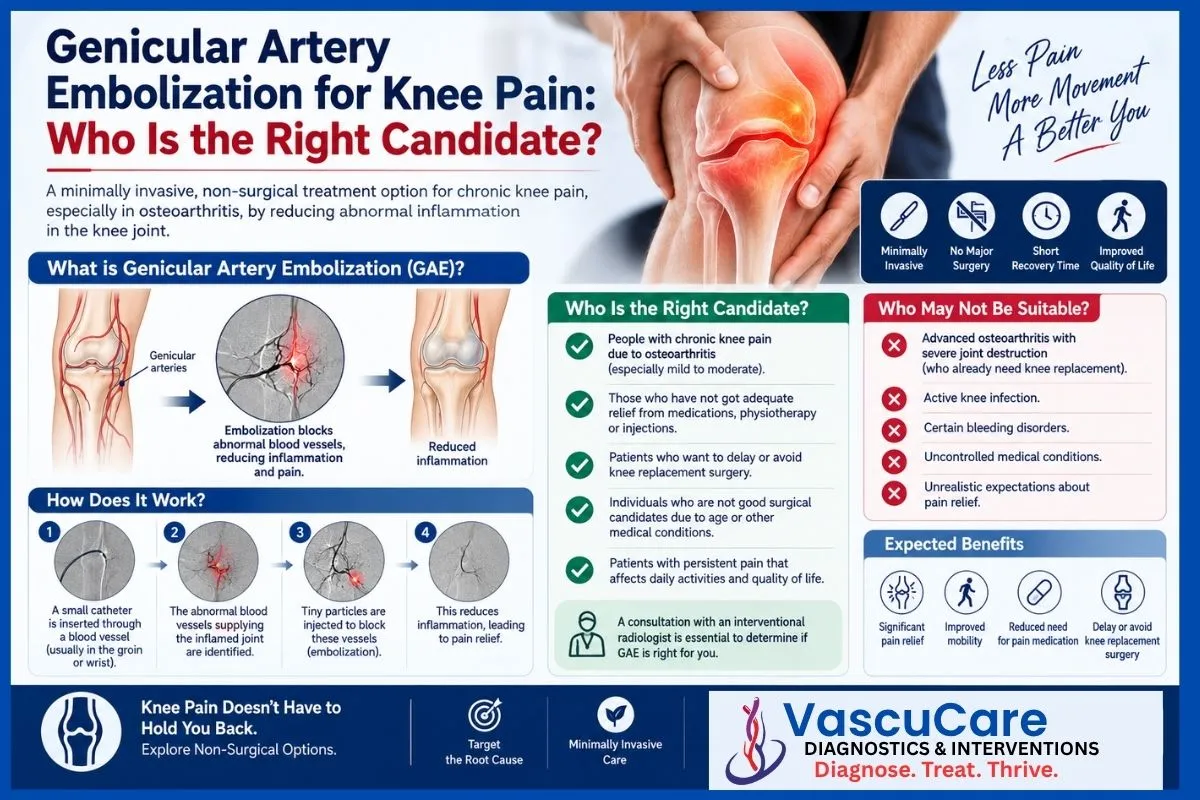
Genicular Artery Embolization is a minimally invasive procedure performed by an interventional radiologist. It targets small genicular arteries supplying areas of abnormal inflammation around the knee.
In knee osteoarthritis, chronic inflammation of the synovium can be associated with increased abnormal blood vessel formation. During GAE, an interventional radiologist uses imaging guidance to identify these vessels and selectively reduces their blood flow using tiny embolic particles.
The aim is to decrease inflammation-related pain while preserving the normal blood supply required by healthy tissues.
GAE does not replace the knee joint and does not require a large surgical incision.
Who May Be a Good Candidate for GAE?
Patient selection is important. A person may be evaluated for GAE when several factors are present.
1. You Have Knee Osteoarthritis
GAE is primarily being used for pain associated with knee osteoarthritis rather than every type of knee pain.
If your pain is caused by a major ligament injury, fracture, infection, or another condition, a different treatment may be required. Clinical examination and appropriate imaging can help identify the underlying cause.
2. Knee Pain Is Affecting Your Daily Activities
Persistent osteoarthritis pain can interfere with walking, stair climbing, exercise, work, and sleep.
Patients whose symptoms significantly affect daily activities despite appropriate conservative treatment may be evaluated for advanced treatment options such as GAE.
3. Conservative Treatment Has Not Provided Enough Relief
Initial knee osteoarthritis management may include physiotherapy, strengthening exercises, activity modification, weight management when appropriate, and medications prescribed by a doctor.
When these measures fail to provide satisfactory relief, additional options can be considered.
Depending on the cause and pattern of pain, these may include PRP therapy, genicular nerve block, Genicular Nerve Ablation, or Genicular Artery Embolization.
4. You Want to Explore a Minimally Invasive Option
Some patients want to delay major surgery, while others may not currently be suitable candidates for knee replacement.
Genicular Artery Embolization Doctor In Jaipur can be considered as a minimally invasive option in appropriately selected patients. However, it should not automatically be viewed as a replacement for knee replacement surgery when joint replacement is clearly indicated.
The decision should be individualized.
5. Inflammation Is Contributing to Your Knee Pain
GAE specifically targets abnormal vascularity associated with inflammation around an osteoarthritic knee.
This is an important distinction because different knee pain treatments target different mechanisms. Determining whether inflammatory changes are contributing to symptoms can help doctors decide whether GAE is appropriate.
How Is Genicular Artery Embolization Performed?
GAE is performed using image guidance.
A small catheter is introduced into an artery, usually through a tiny access point. The interventional radiologist then guides the catheter toward the arteries around the painful knee.
Contrast imaging helps identify abnormal blood vessels supplying areas of inflammation. Tiny embolic particles are selectively delivered into the targeted vessels to reduce excessive blood flow.
Because the procedure is catheter-based, it avoids the large incision associated with open surgery.
Patients are monitored after treatment and receive individualized instructions regarding walking, activity, medications, and follow-up.
GAE vs Genicular Nerve Block: What Is the Difference?
Although both can be used in knee pain management, they work differently.
A genicular nerve block targets sensory nerves responsible for carrying pain signals from the knee. It can provide temporary pain relief and may also help determine whether a nerve-targeted procedure is appropriate.
Genicular Nerve Ablation targets these pain-transmitting nerves for a potentially longer-lasting reduction in pain signals.
GAE, on the other hand, targets abnormal blood vessels associated with inflammation rather than the nerves themselves.
The best option depends on why the knee hurts.
What About PRP Therapy for Knee Pain?
PRP therapy, or platelet-rich plasma therapy, uses a preparation made from the patient’s own blood. It is injected into the targeted area and may be considered for selected patients with knee and musculoskeletal conditions.
PRP therapy, GAE, nerve blocks, and nerve ablation should not be considered interchangeable treatments. Each targets a different aspect of knee pain, and patient selection is essential.
Who May Not Be Suitable for GAE?
Genicular Artery Embolization Doctor In Jaipur may not be appropriate when knee pain is caused by conditions unrelated to osteoarthritis or when another medical problem requires different treatment.
Vascular health, medications, kidney function, allergies to contrast material, infection, severity of joint damage, and overall medical condition may also influence suitability.
A detailed assessment is therefore required before recommending the procedure.
GAE for Knee Pain in Jaipur
At VascuCare Diagnostics & Interventions, patients with persistent knee pain can undergo evaluation to determine the underlying cause and appropriate treatment strategy.
Dr. Rakesh Kumawat – Best Interventional Radiologist and Pain Management Specialist In Jaipur provides minimally invasive and image-guided pain management procedures for appropriately selected patients.
Rather than applying the same treatment to every case, knee pain management should be based on the cause of pain, severity of osteoarthritis, inflammatory changes, previous treatments, and the patient’s individual needs.
Frequently Asked Questions (FAQs)
1. Who is the right candidate for Genicular Artery Embolization?
GAE may be considered for selected patients with symptomatic knee osteoarthritis whose pain continues despite appropriate conservative treatment. A specialist assessment is necessary to determine suitability.
2. Is GAE a replacement for knee replacement surgery?
Not necessarily. GAE may help selected patients manage osteoarthritis-related pain, but it does not replace the damaged joint. Patients with advanced structural disease may still require joint replacement.
3. Is Genicular Artery Embolization a surgery?
GAE is a minimally invasive catheter-based procedure performed under image guidance and does not require a large surgical incision.
4. What is the difference between GAE and Genicular Nerve Ablation?
GAE targets abnormal blood vessels associated with inflammation, whereas Genicular Nerve Ablation targets nerves carrying pain signals from the knee.
5. How do I know whether GAE, PRP or a genicular nerve block is right for me?
The appropriate treatment depends on the cause of your knee pain, osteoarthritis severity, examination and imaging findings, previous treatments, and overall health. A Knee Pain Doctor In Jaipur and interventional specialist can assess which option is most appropriate.