
- Aug 30, 2026
- Diagnostics
- 0 Comments
Blood circulation plays an important role in keeping the legs, arms, organs, and other tissues healthy. When blood flow through an artery or vein becomes abnormal, symptoms such as swelling, pain, heaviness, numbness, or skin changes may develop. In such situations, a doctor may recommend a Colour Doppler Sonography In Vaishali Nagar.
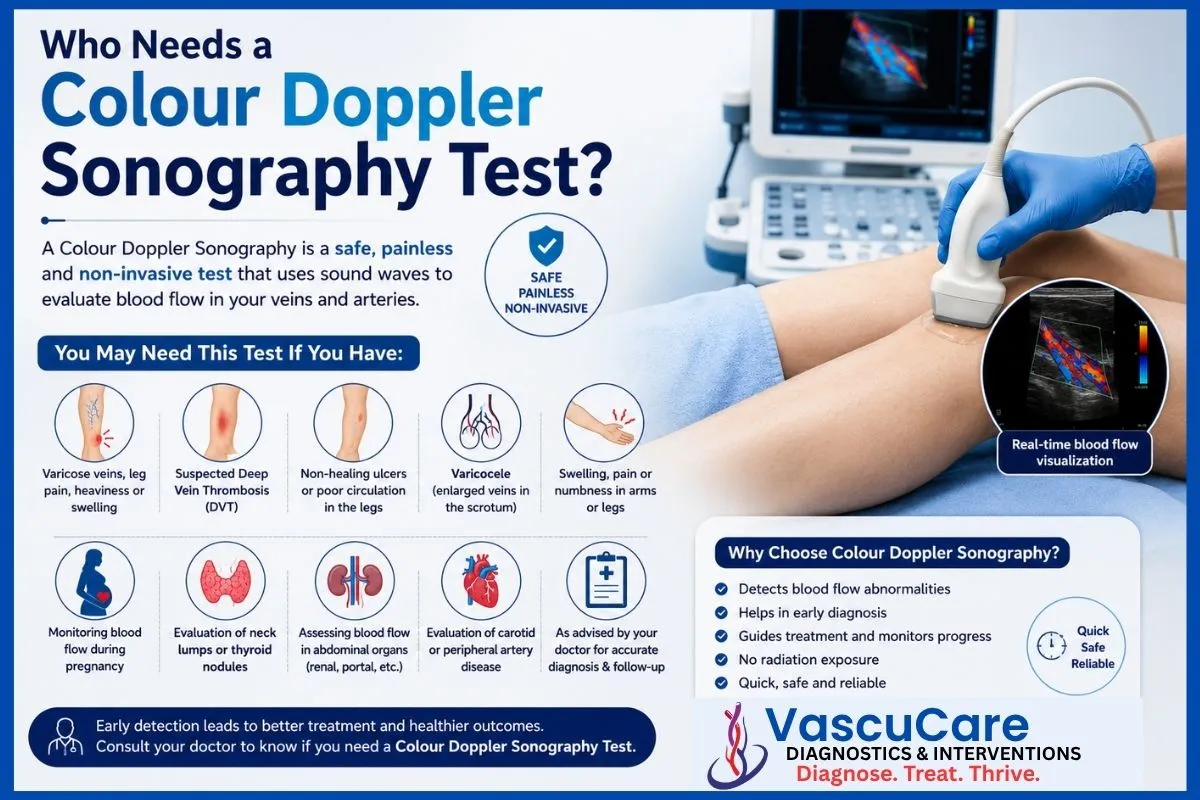
Colour Doppler is a non-invasive ultrasound examination that helps doctors visualize blood vessels and assess the direction and pattern of blood flow. It can be particularly useful when investigating varicose veins, suspected blood clots, arterial circulation problems, and unexplained limb swelling.
VascuCare Diagnostics & Interventions provides Colour Doppler Sonography and other diagnostic services for patients requiring vascular and medical evaluation.
What Is Colour Doppler Sonography?
Colour Doppler Sonography combines conventional ultrasound imaging with Doppler technology.
A standard ultrasound produces images of internal structures, while Doppler technology evaluates the movement of blood. Colour is added to the ultrasound image to represent blood-flow patterns and direction.
The test can help doctors assess:
• Blood flow through arteries
• Blood flow through veins
• Venous reflux
• Narrowing or blockage of vessels
• Possible blood clots
• Certain abnormalities in circulation
It does not use ionizing radiation.
Who May Need a Colour Doppler Test?
A Colour Doppler examination is not required for everyone. Doctors usually recommend it when symptoms, clinical examination, or medical history suggest a possible circulation problem.
Here are some common situations where it may be useful.
1. People with Varicose Veins
Patients with enlarged, twisted, or bulging veins in their legs may require a Venous Colour Doppler.
Varicose veins often develop when valves inside the veins do not function effectively, allowing blood to flow backward and collect within the vein.
Colour Doppler can help determine:
• Which veins are affected
• Whether venous reflux is present
• Which valves are not functioning properly
• Condition of superficial and deep veins
This information can be important before planning treatments such as endovenous laser therapy or other vein procedures.
2. People with Persistent Leg Swelling
Occasional swelling after prolonged standing may have several causes, but persistent or unexplained swelling deserves medical evaluation.
A Colour Doppler Sonography In Vaishali Nagar may be recommended when a doctor suspects that venous circulation is contributing to the problem.
This is particularly important when swelling affects one leg more than the other.
3. Patients with Suspected Deep Vein Thrombosis
Deep Vein Thrombosis (DVT) occurs when a blood clot develops within a deep vein, commonly in the leg.
Possible warning signs include:
• Sudden one-sided leg swelling
• Pain or tenderness
• Warmth
• Skin discoloration
Doppler ultrasound is commonly used to evaluate suspected DVT.
A suspected blood clot requires prompt medical assessment because a clot can potentially travel to the lungs and cause a serious complication called pulmonary embolism.
4. People with Leg Pain While Walking
Not every leg pain is caused by muscles or joints.
Some people develop pain or cramping in the legs during walking because the muscles are not receiving sufficient blood supply. This can occur with Peripheral Artery Disease (PAD).
An arterial Doppler examination may help assess blood flow and identify possible narrowing or obstruction in the arteries.
5. People with Persistent Leg Heaviness
Leg heaviness, particularly after prolonged standing, can sometimes be associated with venous insufficiency.
If heaviness occurs together with swelling, visible veins, itching, or skin discoloration, your doctor may recommend a venous Doppler evaluation.
6. Patients with Skin Changes Around the Ankles
Chronic venous problems can gradually affect the skin.
Possible changes include:
• Brown or dark pigmentation
• Dryness or itching
• Thickened skin
• Persistent swelling
• Slow-healing wounds
Colour Doppler can help determine whether abnormal venous circulation is contributing to these changes.
7. People with Non-Healing Leg Ulcers
A wound on the leg or ankle that does not heal normally requires medical evaluation.
Both venous and arterial circulation problems can contribute to chronic wounds.
Depending on the clinical situation, Doppler studies can help doctors understand whether inadequate blood flow or chronic venous pressure is involved.
8. Patients Being Evaluated Before Varicose Vein Treatment
Visible veins alone do not provide enough information to plan varicose vein treatment.
Before procedures such as Endovenous Laser Treatment (EVLT), a Colour Doppler examination can help map the veins and identify the source of reflux.
This allows treatment to focus on the underlying abnormal vein rather than only the veins visible on the skin.
What Happens During a Colour Doppler Test?
Colour Doppler Sonography In Vaishali Nagar is generally simple and painless.
You will usually lie on an examination table while ultrasound gel is applied to the area being assessed. A handheld device called a transducer is moved over the skin.
The healthcare professional views the blood vessels and blood-flow information on a monitor in real time.
You may be asked to change position or perform certain movements depending on the area being examined.
Do You Need Preparation?
Preparation depends on the part of the body being examined.
For many leg artery and vein Doppler studies, extensive preparation is usually not required. Doppler examinations involving abdominal blood vessels may have different preparation instructions.
Always follow the instructions provided when scheduling your test.
Is Colour Doppler Sonography Safe?
Colour Doppler uses ultrasound sound waves rather than ionizing radiation.
It is non-invasive and generally does not require needles, injections, or surgical incisions for routine vascular assessment.
This makes it a widely used diagnostic tool for evaluating circulation.
Colour Doppler Sonography at VascuCare Diagnostics & Interventions
VascuCare Diagnostics & Interventions provides Colour Doppler Sonography for patients requiring evaluation of vascular and circulation-related conditions.
A Doppler examination can provide valuable information when investigating varicose veins, venous insufficiency, suspected DVT, leg swelling, arterial circulation problems, and other vascular concerns.
The appropriate test should always be selected according to your symptoms and doctor’s recommendation.
Frequently Asked Questions (FAQs)
1. What is Colour Doppler Sonography?
It is an ultrasound technique used to visualize blood vessels and assess the direction and pattern of blood flow.
2. Why is Colour Doppler recommended for varicose veins?
It helps identify venous reflux, faulty valves, and the veins responsible for abnormal circulation.
3. Can Colour Doppler detect a blood clot?
Doppler ultrasound is commonly used when evaluating suspected Deep Vein Thrombosis in the legs.
4. Is Colour Doppler useful for leg swelling?
Yes. It may help determine whether a venous or vascular problem is contributing to unexplained swelling.
5. Can Doppler check arteries as well as veins?
Yes. Doppler ultrasound can be used to evaluate both arterial and venous blood flow.
6. Does Colour Doppler use radiation?
No. It uses ultrasound sound waves rather than ionizing radiation.
7. Is Colour Doppler painful?
The examination is generally painless and non-invasive.
8. Do I need fasting before a Colour Doppler test?
Many limb Doppler examinations do not require fasting, but preparation depends on the area being examined.
9. How does Colour Doppler help before varicose vein laser treatment?
It maps the venous system and helps identify reflux and abnormal veins so treatment can be planned appropriately.
10. Where can I get a Colour Doppler Sonography Test?
VascuCare Diagnostics & Interventions provides Colour Doppler Sonography In Vaishali Nagar for patients requiring vascular and circulation-related diagnostic evaluation.