

- Aug 29, 2026
- Diagnostics
- 0 Comments
Finding a lump, swelling, or unusual nodule can be concerning, but not every lump indicates a serious disease. Many swellings are caused by benign conditions, infections, inflammation, cysts, or other non-cancerous changes. To understand what a lump may represent, doctors often recommend FNAC Testing Centre In Jaipur (Fine Needle Aspiration Cytology) as an initial diagnostic test.
FNAC is a relatively quick, minimally invasive procedure in which a small sample of cells is collected from an abnormal area and examined under a microscope. It can provide valuable information that helps doctors decide whether observation, additional testing, or treatment is required.
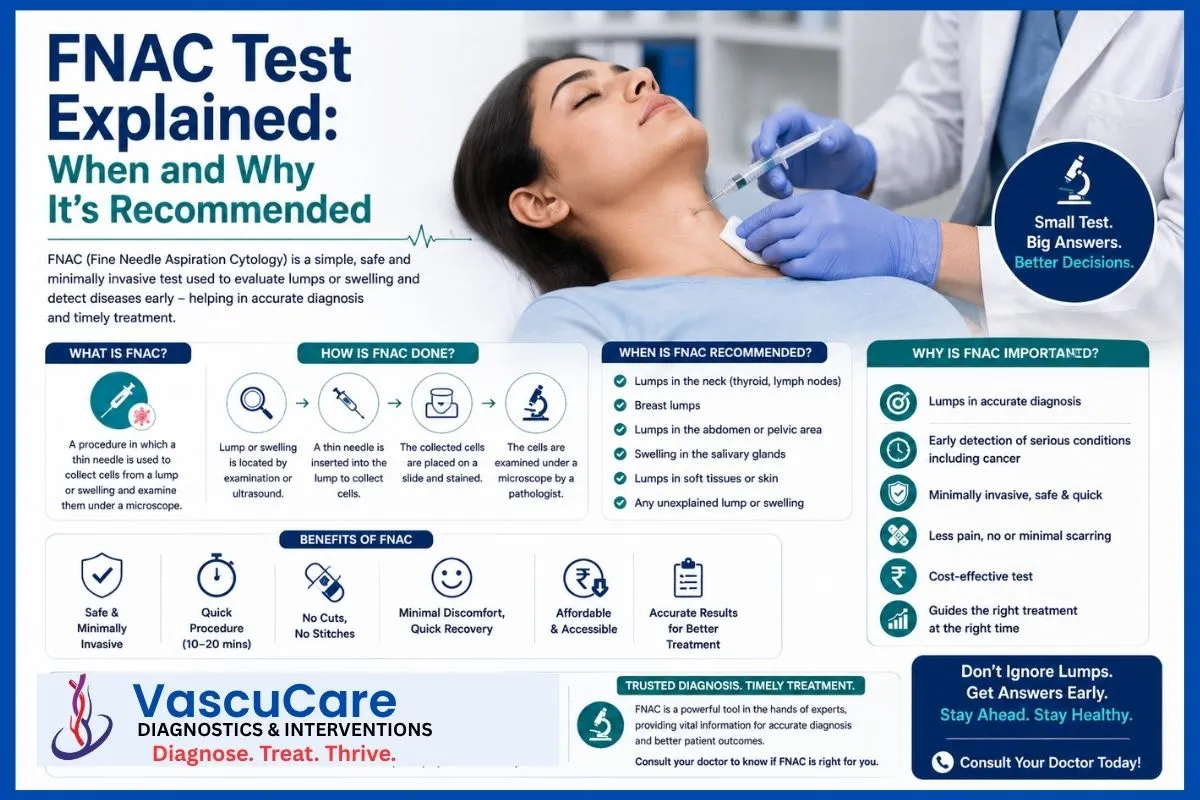
What Is an FNAC Test?
Fine Needle Aspiration Cytology (FNAC) involves inserting a thin needle into a lump, swelling, nodule, or suspicious area to collect cells.
The collected material is prepared on slides and examined by a pathologist. Based on the appearance of the cells, the report may suggest whether the abnormality is benign, inflammatory, infectious, suspicious, or malignant.
FNAC is commonly used because it usually requires no large incision and can often be performed as an outpatient procedure.
When Is an FNAC Test Recommended?
Doctors may recommend FNAC when a persistent or suspicious lump requires further evaluation.
Common situations include:
• Thyroid nodules
• Enlarged lymph nodes
• Breast lumps
• Neck swellings
• Salivary gland lumps
• Superficial soft-tissue masses
• Persistent unexplained swelling
• Certain abnormalities detected during imaging
The decision to perform FNAC depends on the location, size, appearance, symptoms, and clinical history of the patient.
FNAC for Thyroid Nodules
Thyroid nodules are relatively common, and many are benign. However, certain nodules require further investigation based on their size or ultrasound appearance.
Ultrasound-Guided FNAC can help collect cells from a specific part of the thyroid nodule.
The cytology findings, combined with ultrasound features and clinical assessment, can help determine whether the nodule requires monitoring, repeat testing, additional investigation, or treatment.
FNAC for Enlarged Lymph Nodes
Lymph nodes can enlarge for many reasons, including infections and inflammatory conditions. In some situations, persistent or unusual lymph node enlargement requires further investigation.
FNAC may help determine the type of cellular changes present within the lymph node.
However, some lymph-node conditions require a core or excisional biopsy because tissue architecture is important for diagnosis. Your doctor will decide which investigation is most appropriate.
Why Is FNAC Recommended?
One of the main advantages of FNAC is that it provides cellular information without requiring major surgery.
It may help doctors:
• Investigate unexplained lumps
• Differentiate some benign and malignant conditions
• Identify inflammatory changes
• Evaluate certain infections
• Determine whether further testing is necessary
• Guide treatment planning
FNAC can therefore act as an important bridge between physical examination or imaging and the next stage of diagnosis.
Does FNAC Detect Cancer?
FNAC can detect malignant cells in many cases, but it is important to understand its limitations.
A result may be reported as benign, malignant, suspicious, atypical, or inadequate depending on the type and quality of the sample.
An FNAC recommendation does not automatically mean that your doctor suspects or has diagnosed cancer. Many patients undergoing FNAC receive benign or non-cancerous results.
If the result is uncertain or insufficient, another FNAC, core needle biopsy, or different investigation may be recommended.
What Is Ultrasound-Guided FNAC?
Some lumps are easy to feel and can be sampled directly. Others may be small, deep, or located close to important structures.
In these situations, Ultrasound-Guided FNAC may be used.
Ultrasound allows the doctor to visualize the abnormality and needle position in real time. This can help target the intended area more precisely.
Image guidance can be particularly useful for thyroid nodules, lymph nodes, and certain deeper lesions.
How Is an FNAC Test Performed?
Before the procedure, the doctor reviews the relevant medical history and imaging. The skin over the target area is cleaned.
A fine needle is then inserted into the abnormal area and a small sample of cells is collected. More than one needle pass may occasionally be necessary to obtain an adequate specimen.
The collected cells are sent for laboratory examination.
The procedure itself is generally brief, although the total appointment may take longer because of preparation and imaging.
Is FNAC Painful?
Most patients experience brief discomfort similar to an injection or blood test.
Mild tenderness, soreness, or bruising may occur afterward. These symptoms usually settle with time.
The experience can vary depending on the location and depth of the lesion.
How Should You Prepare for FNAC?
FNAC usually requires minimal preparation.
Before the procedure:
• Inform your doctor about your medications
• Mention blood-thinning medicines
• Discuss any bleeding disorders
• Tell your doctor about relevant allergies
• Carry previous ultrasound, CT, MRI, or pathology reports
• Follow any specific instructions provided by the centre
Do not stop prescribed blood-thinning or other medication without medical advice.
FNAC vs Biopsy: Which One Is Needed?
FNAC primarily collects individual cells or small groups of cells, whereas a core needle biopsy obtains a small piece of tissue.
A tissue biopsy allows the pathologist to examine the architecture of the tissue and may therefore provide information that FNAC cannot provide in certain conditions.
FNAC may be appropriate as an initial test for many abnormalities, but a biopsy may be recommended when more detailed tissue evaluation is required.
Neither test is automatically “better”; they answer somewhat different diagnostic questions.
What Happens After the FNAC Test?
Most patients can resume normal routine activities soon after a straightforward FNAC Testing Centre In Jaipur.
A small dressing may be placed over the needle site. Temporary tenderness or mild bruising can occur.
The laboratory then processes and examines the sample. Report turnaround time varies depending on the type of sample and whether additional studies are required.
Your doctor should interpret the report together with your symptoms, examination findings, and imaging results.
Why Timely Investigation Matters
Many lumps are harmless, but a persistent or changing lump should not simply be ignored.
Seek medical evaluation if you notice a lump that:
• Continues to grow
• Persists for several weeks
• Becomes unusually hard or fixed
• Repeatedly returns
• Is associated with unexplained symptoms
• Has concerning features on imaging
Early evaluation can help determine whether the abnormality simply needs observation or requires further investigation.
Conclusion
FNAC is a useful, minimally invasive diagnostic test for evaluating many types of lumps, nodules, and swellings. It may help identify benign conditions, inflammation, infection, suspicious cellular changes, or cancer.
However, FNAC does not provide a definitive answer in every situation. An inadequate or uncertain result may require repeat sampling or a biopsy.
The key is to view FNAC as part of a broader diagnostic process involving clinical examination, imaging, pathology, and medical judgment.
Frequently Asked Questions (FAQs)
1. What is the full form of FNAC?
FNAC stands for Fine Needle Aspiration Cytology.
2. Why is an FNAC test recommended?
It is commonly recommended to investigate a lump, swelling, nodule, or other abnormal area.
3. Can FNAC detect cancer?
Yes, FNAC can identify malignant cells in many cases, but additional testing may sometimes be required for confirmation.
4. Does being advised FNAC mean I have cancer?
No. Many lumps evaluated with FNAC are caused by benign, inflammatory, or infectious conditions.
5. Is FNAC painful?
Most patients experience only brief discomfort during needle insertion and mild temporary soreness afterward.
6. What is Ultrasound-Guided FNAC?
It is FNAC performed while using ultrasound to visualize the lesion and guide the needle accurately toward the target.
7. Is fasting required before FNAC?
Most superficial FNAC procedures do not require fasting, but preparation varies according to the procedure. Follow your doctor’s instructions.
8. What is the difference between FNAC and biopsy?
FNAC collects cells, while a core biopsy collects a small tissue sample that preserves more tissue architecture for examination.
9. Can an FNAC result be inconclusive?
Yes. Occasionally, the sample may be inadequate or findings uncertain, requiring repeat FNAC Testing Centre In Jaipur or another type of biopsy.
10. What should I do after receiving my FNAC report?
Discuss the report with your doctor. It should be interpreted together with your clinical examination, symptoms, imaging findings, and medical history.