
- Oct 11, 2026
- Pain Management
- 0 Comments
An enlarged prostate often announces itself through everyday inconveniences rather than sudden pain. A man may start waking several times at night to urinate, waiting longer for urine flow to begin, or searching for a washroom soon after leaving home. Gradually, these changes can affect sleep, travel, work and confidence.
For many men, the cause is Benign Prostatic Hyperplasia (BPH)—a non-cancerous enlargement of the prostate that becomes more common with age.
Medicines can help many patients, while surgery remains an important treatment when clinically required. However, selected men may also be candidates for a minimally invasive option called Prostate Artery Embolization (PAE).
PAE approaches an enlarged prostate differently. Instead of surgically removing prostate tissue, an interventional radiologist treats the arteries supplying it.
For people exploring treatment options, consulting a Prostate Artery Embolization Doctor In Jaipur can help determine whether this minimally invasive procedure may be appropriate. At the same time, a Varicose Vein Doctor In Jaipur or a Knee Pain Doctor In Jaipur may evaluate separate vascular or joint-related concerns.
Why Does an Enlarged Prostate Affect Urination?
The prostate sits below the bladder and surrounds part of the urethra—the passage through which urine leaves the body.
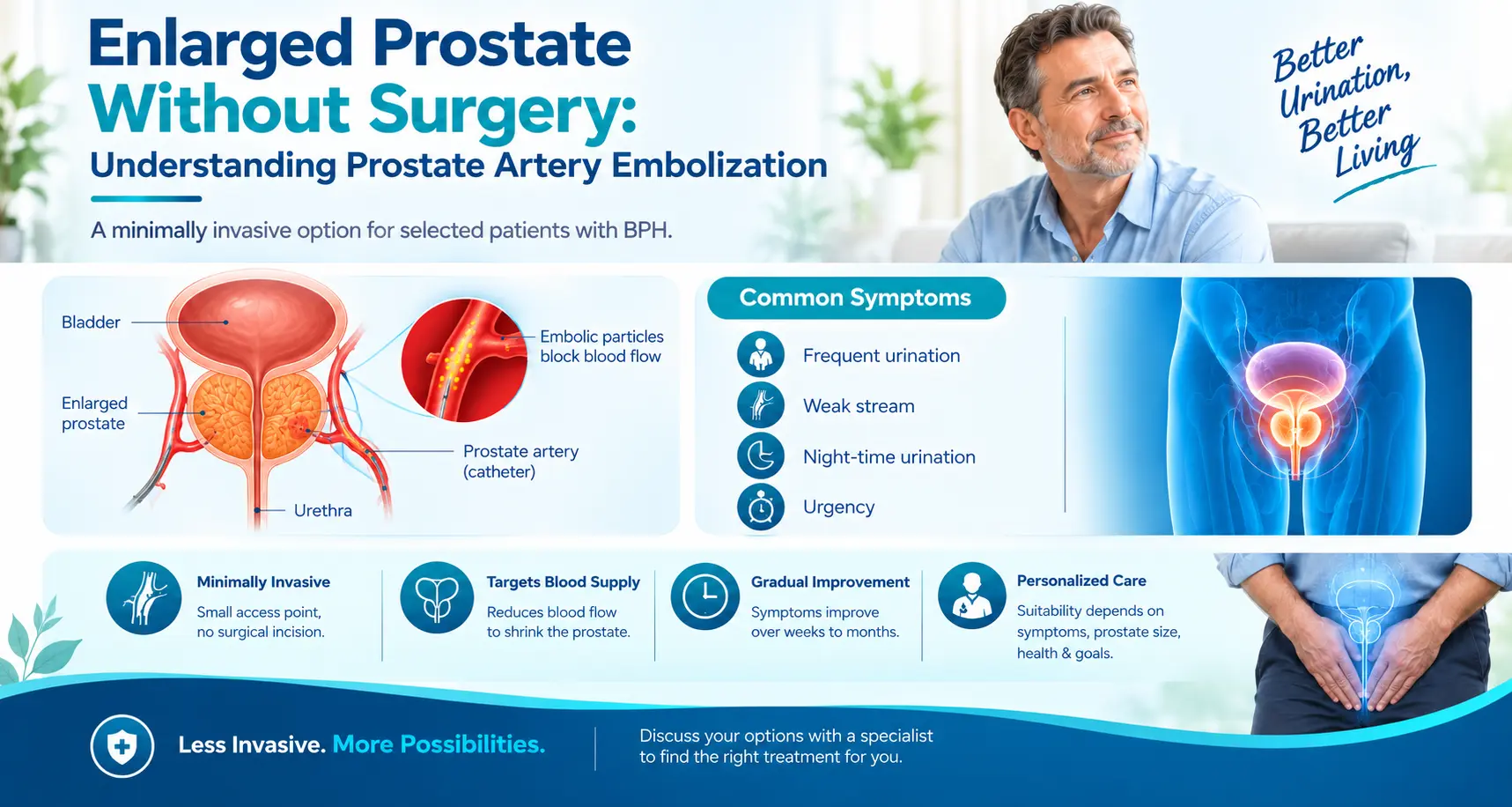
As the prostate enlarges, it can affect this urinary pathway. Patients may develop symptoms such as:
-
Weak urinary stream
-
Difficulty starting urination
-
Frequent urination
-
Urgency
-
Interrupted urine flow
-
Straining to urinate
-
Waking repeatedly at night
-
Feeling that the bladder has not emptied completely
But an important point is often missed:
Urinary symptoms do not always equal BPH.
Urinary infection, bladder dysfunction, urethral problems, prostate cancer and other conditions may produce overlapping symptoms.
This is why diagnosis should come before choosing treatment.
Does a Bigger Prostate Always Cause Worse Symptoms?
Not necessarily.
Prostate size and symptom severity do not always move together.
A significantly enlarged prostate may cause surprisingly mild symptoms in one man, while another patient with less enlargement can have substantial difficulty urinating.
Symptoms depend on several factors, including the location and pattern of prostate enlargement, degree of urinary obstruction and bladder function.
Therefore, a scan showing an enlarged prostate does not automatically mean surgery—or PAE—is required.
Treatment should be based on the complete clinical picture.
What Happens When Medicines Are Not Enough?
BPH is often initially managed with medication when appropriate.
Some medicines help relax muscles around the prostate and bladder outlet, while others may influence prostate enlargement over time.
However, some men continue experiencing bothersome symptoms despite medical treatment. Others may experience medication-related side effects or may eventually require a procedural treatment.
Traditionally, this could mean considering procedures that treat or remove obstructing prostate tissue.
PAE creates another pathway for appropriately selected patients.
Men considering treatment can consult a Prostate Artery Embolization Doctor In Jaipur to discuss available options. Similarly, people with vein-related symptoms may need assessment by a Varicose Vein Doctor In Jaipur, while persistent knee discomfort may require evaluation by a Knee Pain Doctor In Jaipur.
What Is Prostate Artery Embolization?
Prostate Artery Embolization is a minimally invasive, image-guided procedure used to treat symptoms related to BPH in selected patients.
Instead of entering the prostate through a surgical incision, an interventional radiologist reaches it through the arterial system.
A small catheter is inserted through an artery, commonly using vascular access at the wrist or groin depending on the individual case.
Using real-time imaging, the catheter is carefully navigated through pelvic arteries until the blood vessels supplying the prostate are identified.
Tiny embolic particles are then delivered selectively into these arteries.
Why Does Reducing Blood Flow Help an Enlarged Prostate?
An enlarged prostate requires a continuous blood supply to maintain its tissue.
PAE reduces blood flow to selected areas of the prostate. Over time, the treated tissue can shrink.
As prostate volume decreases, pressure affecting the urinary pathway may also decrease, potentially improving BPH-related symptoms.
This means PAE works gradually.
Unlike a surgical procedure that physically removes obstructing tissue during treatment, PAE relies on biological shrinkage after embolization.
Patients should therefore not expect their urinary stream to change immediately after leaving the procedure room.

Why Is PAE an Image-Guided Procedure?
The prostate arteries are small and their anatomy can vary significantly between patients.
They may also have connections with arteries supplying nearby structures.
The interventional radiologist therefore needs to identify the correct arterial pathway and position the catheter selectively before embolization.
Imaging guidance is central to this process.
This is also why PAE should not be thought of as simply “injecting something to shrink the prostate.” It is a technically detailed vascular intervention requiring careful arterial mapping.
Who May Be Considered for PAE?
PAE may be considered in selected men with bothersome urinary symptoms related to BPH, particularly when symptoms remain significant despite appropriate conservative or medical treatment.
Evaluation may consider:
-
Severity of urinary symptoms
-
Prostate size and anatomy
-
Degree and cause of urinary obstruction
-
Bladder function
-
Vascular anatomy
-
Previous prostate treatment
-
Other medical conditions
-
Current medications
-
Patient expectations
The objective is to determine whether reducing prostate blood supply is likely to address the patient’s actual urinary problem.
Is PAE the Same as TURP?
No.
Transurethral Resection of the Prostate (TURP) is an established surgical treatment that removes obstructing prostate tissue through the urinary passage.
PAE does not remove tissue directly.
Instead, it reduces arterial blood supply and allows the prostate to shrink gradually.
Because these procedures work differently, they also differ in their treatment experience, recovery, potential risks, speed of symptom improvement and suitability.
The question should therefore not simply be, “Which one is better?”
It should be, “Which approach is appropriate for my prostate, urinary symptoms and overall health?”
What Is Recovery Like After PAE?
Because PAE uses a small arterial access point rather than a large surgical incision, recovery may be relatively quick for suitable patients.
However, temporary symptoms can occur after embolization. These may include pelvic discomfort, urinary irritation, fatigue or other post-procedure effects.
Patients receive instructions about medications, hydration, activity and care of the vascular access site.
Follow-up is also important because symptom improvement usually develops progressively rather than instantly.
Does PAE Guarantee That Prostate Surgery Will Never Be Needed?
No.
PAE should not be presented as a guaranteed permanent replacement for surgery.
Some patients may experience significant and durable improvement, while others may have persistent or recurrent urinary symptoms. Additional medication, another procedure or surgical treatment may eventually be required.
Good patient selection and realistic expectations are therefore essential.
Prostate Artery Embolization in Jaipur
At VascuCare Diagnostics & Interventions, men with symptomatic prostate enlargement can be evaluated to determine whether a minimally invasive image-guided approach may be appropriate.
Dr. Rakesh Kumawat – Best Interventional Radiologist and Pain Management Specialist In Jaipur provides interventional radiology procedures, including evaluation for Prostate Artery Embolization in Jaipur for appropriately selected patients.
For men looking for enlarged prostate treatment without surgery, PAE provides an important option to discuss.
Patients searching for a Prostate Artery Embolization Doctor In Jaipur can discuss their symptoms, diagnostic findings and treatment suitability with a qualified specialist. For other concerns, a Varicose Vein Doctor In Jaipur can assess vein-related symptoms, while a Knee Pain Doctor In Jaipur can evaluate persistent knee pain and discuss appropriate treatment options.
But the first goal is not to avoid surgery at any cost.
It is to establish why urinary symptoms are occurring and then choose the treatment that best matches the cause, prostate anatomy and individual patient’s needs.
Frequently Asked Questions (FAQs)
1. Can an enlarged prostate be treated without surgery?
Yes. Depending on the severity and cause of symptoms, treatment may include lifestyle measures, medicines or minimally invasive options such as Prostate Artery Embolization. Not every patient is suitable for PAE.
2. Does PAE remove the enlarged prostate?
No. PAE does not surgically remove prostate tissue. It reduces blood supply to selected prostate tissue, which can cause gradual shrinkage.
3. How quickly will urination improve after Prostate Artery Embolization?
PAE generally produces gradual rather than immediate improvement. Changes may develop over the following weeks and months, and individual response varies.
4. Is PAE better than TURP for an enlarged prostate?
Neither treatment is universally better. TURP and PAE work differently and have different advantages, limitations and suitability criteria. The appropriate option depends on symptoms, prostate anatomy, bladder function, overall health and treatment priorities.
5. Who should I consult for Prostate Artery Embolization?
PAE is performed by an interventional radiologist with expertise in image-guided vascular procedures. Appropriate urological assessment may also be important to confirm that BPH is responsible for the urinary symptoms and to compare available treatment options.