- Sep 17, 2026
- Varicose Vein
- 0 Comments
Leg pain and swelling are easy to blame on a long working day, excessive walking, travel, or simply getting older. Sometimes that explanation is correct. But when swelling keeps returning, one leg behaves differently from the other, visible veins begin appearing, or discomfort consistently increases after standing, the problem may involve your veins.
The challenge is that leg swelling is a symptom, not a diagnosis. Problems involving veins are only one possible cause. Heart, kidney, liver, lymphatic, joint, medication-related, and other medical conditions can also cause swelling.
So, when should you consult a Vein Specialist Doctor In Jaipur? The answer depends less on whether you can see a vein and more on the pattern of your symptoms.
Start by Asking: What Pattern Does Your Leg Swelling Follow?
The timing of swelling can provide useful information.
For example, venous symptoms commonly become more noticeable after prolonged standing or sitting because blood must travel upward from the legs against gravity. If the valves inside the veins are not functioning effectively, blood may flow backward and increase pressure in the lower leg.
A person may therefore notice relatively comfortable legs in the morning but increasing heaviness, ankle swelling, or aching by evening.
This does not confirm venous disease by itself, but it is a pattern worth discussing with a specialist.
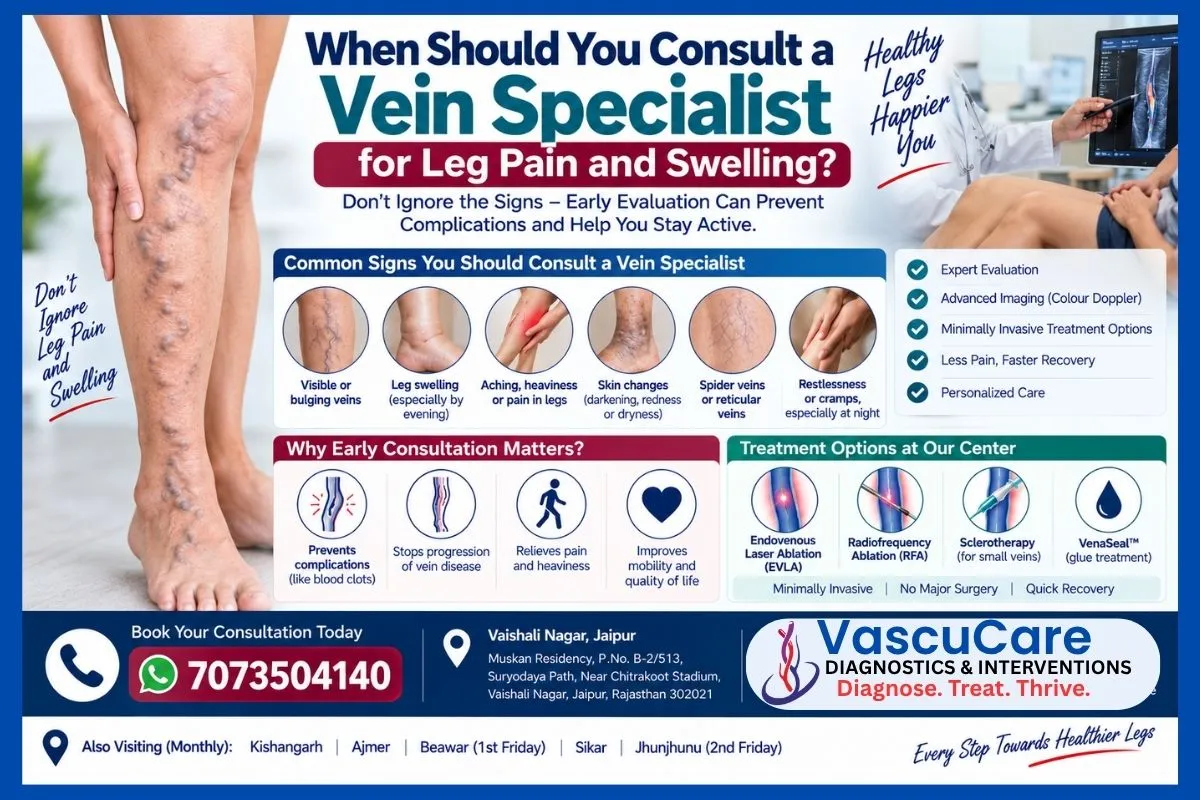
Sign #1: Your Legs Feel Heavy by the End of the Day
“Heaviness” is different from ordinary muscle tiredness.
Some patients describe their legs as feeling unusually heavy, full, tight, or difficult to move after standing for several hours. Elevating the legs may temporarily make them feel better.
When this pattern occurs repeatedly—especially alongside visible veins or ankle swelling—it may indicate problems with venous return.
A vein specialist can evaluate whether chronic venous insufficiency is contributing to the symptoms.
Sign #2: Your Ankles Swell Repeatedly
Ankle swelling that appears once after an unusually active day may not necessarily indicate a vein disorder.
Repeated swelling deserves more attention.
Venous pressure can cause fluid to move into surrounding tissues, producing swelling around the ankles and lower legs. Initially, it may improve after overnight rest and return later the following day.
However, persistent swelling should never automatically be labelled as varicose veins because several medical conditions can produce similar symptoms.
The purpose of specialist evaluation is to establish the cause—not simply treat the swelling.
Sign #3: Leg Pain Increases After Standing
Venous discomfort often follows a characteristic pattern.
Instead of sharp pain triggered by a specific joint movement, patients may describe:
• Dull aching
• Throbbing
• Burning
• Pressure
• Heaviness
• Tired legs
• Discomfort around visible veins
Symptoms may become worse after standing for prolonged periods and improve somewhat with walking, rest, or leg elevation.
This pattern can help differentiate venous symptoms from certain muscular, neurological, or joint-related problems, although clinical assessment is still necessary.
Sign #4: Pain and Swelling Are Accompanied by Visible Varicose Veins
Large blue, purple, twisted, or bulging veins provide an additional reason to investigate recurring leg symptoms.
The important question is not simply:
“How can these visible veins be removed?”
A better question is:
“Why have these veins become enlarged?”
The visible vein may be a consequence of abnormal pressure originating elsewhere in the superficial venous system. Treating appearance alone without evaluating the underlying circulation may fail to address the actual source of the problem.
This is where Colour Doppler ultrasound becomes particularly useful.
Sign #5: Your Skin Is Starting to Change
Skin changes can provide important clues about the duration and severity of venous disease.
Persistent venous hypertension may eventually contribute to itching, dryness, eczema-like irritation, brown pigmentation, or hardening of tissues around the lower leg and ankle.
At this stage, the conversation is no longer mainly about cosmetic varicose veins.
Skin changes suggest that abnormal venous pressure may be affecting surrounding tissues and deserve specialist assessment.
Sign #6: A Wound Near Your Ankle Is Not Healing
A persistent wound around the lower leg or ankle can sometimes be associated with advanced chronic venous insufficiency.
These venous ulcers require proper wound management, but treating only the surface wound may not be enough if abnormal venous pressure continues underneath.
A vascular assessment can help determine whether venous reflux is contributing to delayed healing.
Sign #7: Only One Leg Suddenly Becomes Swollen
This situation is different from gradually worsening chronic varicose veins.
Sudden swelling in one leg—particularly when associated with pain, warmth, redness, or tenderness—requires prompt medical assessment.
A doctor may need to rule out deep vein thrombosis (DVT) or another acute condition.
Similarly, leg swelling accompanied by chest pain, sudden breathlessness, fainting, or coughing blood requires urgent emergency medical attention.
These symptoms should not wait for a routine varicose-vein appointment.
What Does a Vein Specialist Actually Check?
A specialist consultation should involve more than looking at visible veins.
The doctor may ask when swelling starts, whether symptoms improve overnight, whether one or both legs are affected, how long you stand during the day, previous pregnancies, family history, previous blood clots, medical conditions, medications, and previous vein treatments.
Physical examination is then combined with imaging when required.
Why Is Colour Doppler So Important?
A Colour Doppler Sonography In Vaishali Nagar or duplex ultrasound allows assessment of the veins beneath the skin rather than judging the problem only by appearance.
It can help determine:
• Whether blood is flowing normally
• Whether venous reflux is present
• Which superficial veins are affected
• Whether deeper veins require evaluation
• Which vein may be feeding visible varicosities
• How treatment should be planned
This creates a kind of venous map of the leg.
Two patients with similar-looking varicose veins may have different patterns of reflux and therefore may not require identical treatment.
Does Seeing a Vein Specialist Mean You Need a Procedure?
No.
A consultation does not automatically mean laser treatment or surgery.
Some patients may initially be managed with lifestyle measures, exercise, weight management where appropriate, leg elevation, or compression therapy when medically suitable.
Other patients with symptomatic venous reflux may benefit from an intervention.
The treatment decision should follow the diagnosis—not the other way around.
When Is Varicose Vein Laser Treatment Considered?
For appropriately selected patients with problematic superficial venous reflux, endovenous laser treatment may be considered.
Instead of surgically removing the vein through large incisions, a thin laser fibre is introduced into the affected vein under ultrasound guidance. Controlled thermal energy closes the abnormal vein, and blood continues through healthier venous pathways.
Depending on the venous anatomy, associated branch veins may require additional management.
This is why a Colour Doppler-based treatment plan is more meaningful than deciding on laser treatment simply because veins are visible.
Leg Pain and Swelling Treatment in Jaipur
At VascuCare Diagnostics & Interventions, patients with persistent leg pain, swelling, varicose veins, and suspected venous circulation problems can undergo clinical and Colour Doppler evaluation.
Dr. Rakesh Kumawat – Best Interventional Radiologist and Pain Management Specialist Doctor In Jaipur evaluates vascular conditions and provides minimally invasive, image-guided treatment options for appropriately selected patients.
If your legs regularly become painful, swollen, or unusually heavy, the goal should not be to immediately assume that you have varicose veins. The better approach is to determine whether the swelling is venous, where the circulation problem originates, and whether it actually requires treatment.
Frequently Asked Questions (FAQs)
1. How can I tell if my leg swelling is caused by veins?
Venous swelling may become worse after prolonged standing and more noticeable toward the evening. Visible varicose veins, heaviness, aching, or skin changes can provide additional clues. However, Colour Doppler and medical evaluation may be needed because many conditions can cause leg swelling.
2. Why are my legs normal in the morning but swollen in the evening?
Gravity and prolonged standing can increase pressure in the leg veins throughout the day. This pattern may occur with venous insufficiency, although it is not enough by itself to confirm the diagnosis.
3. Should I see a vein specialist even if I don’t have visible varicose veins?
Yes, if symptoms suggest a possible vascular problem. Venous disease can sometimes exist before prominent surface veins become obvious.
4. Is swelling in both legs always caused by varicose veins?
No. Bilateral leg swelling can have several causes, including systemic medical conditions and medications. Proper evaluation is important before attributing it to venous disease.
5. Why does elevating my legs reduce the swelling?
Elevation can help gravity assist blood and fluid return from the lower legs. Improvement with elevation can occur with venous swelling but does not establish a diagnosis on its own.
6. Can sitting all day cause vein-related leg swelling?
Prolonged sitting reduces calf-muscle activity that normally helps move venous blood upward. This can worsen symptoms in people who already have impaired venous circulation.
7. What is the best test for checking circulation in varicose veins?
Colour Doppler Sonography In Vaishali Nagar or duplex ultrasound is commonly used to assess venous blood flow, valve function, reflux, and the anatomy of superficial and deeper veins.
8. Does every patient with venous reflux need laser treatment?
No. Treatment depends on symptoms, reflux pattern, clinical severity, affected veins, medical history, and individual circumstances. Not every Doppler abnormality automatically requires intervention.
9. Can varicose vein treatment help leg swelling?
It may help when the swelling is genuinely related to treatable venous reflux. If swelling has another cause, treating visible veins may not resolve it. Establishing the cause first is therefore essential.
10. When is leg swelling an emergency?
Seek urgent medical care for sudden one-sided swelling with significant pain, redness, warmth, or tenderness, or when leg symptoms occur with chest pain, sudden shortness of breath, fainting, or coughing blood. These symptoms require immediate assessment rather than a routine vein consultation.