
- Sep 19, 2026
- Diagnostics
- 0 Comments
Leg swelling can look simple from the outside, but its cause is not always obvious. Two people may both have swollen ankles at the end of the day, yet one may have a problem with venous valves while the other may have swelling unrelated to the veins. In another patient, sudden swelling of one leg may require urgent assessment for a blood clot.
This is why doctors sometimes recommend a Colour Doppler for leg swelling instead of making a diagnosis from symptoms alone.
A Colour Doppler Sonography In Vaishali Nagar or duplex ultrasound provides information about the structure of blood vessels and the direction and characteristics of blood flow. When venous disease is suspected, it can help answer an important clinical question:
Is the swelling actually coming from a circulation problem in the leg veins?
Leg Swelling Is a Symptom, Not a Diagnosis
A common mistake is to assume that every swollen leg means poor circulation or varicose veins.
Leg swelling can have several possible causes. These include venous insufficiency, deep vein thrombosis (DVT), lymphatic problems, infection, injury, certain medications, and systemic conditions involving the heart, kidneys, or liver.
The pattern of swelling provides useful clues.
A gradually increasing ankle swelling that becomes worse after prolonged standing is different from a leg that suddenly becomes swollen and painful over a short period.
Colour Doppler becomes particularly useful when the doctor needs to investigate whether the venous system is contributing to the symptoms.
What Exactly Does a Colour Doppler Check?
A standard ultrasound produces images of structures inside the body. Doppler techniques add information about moving blood.
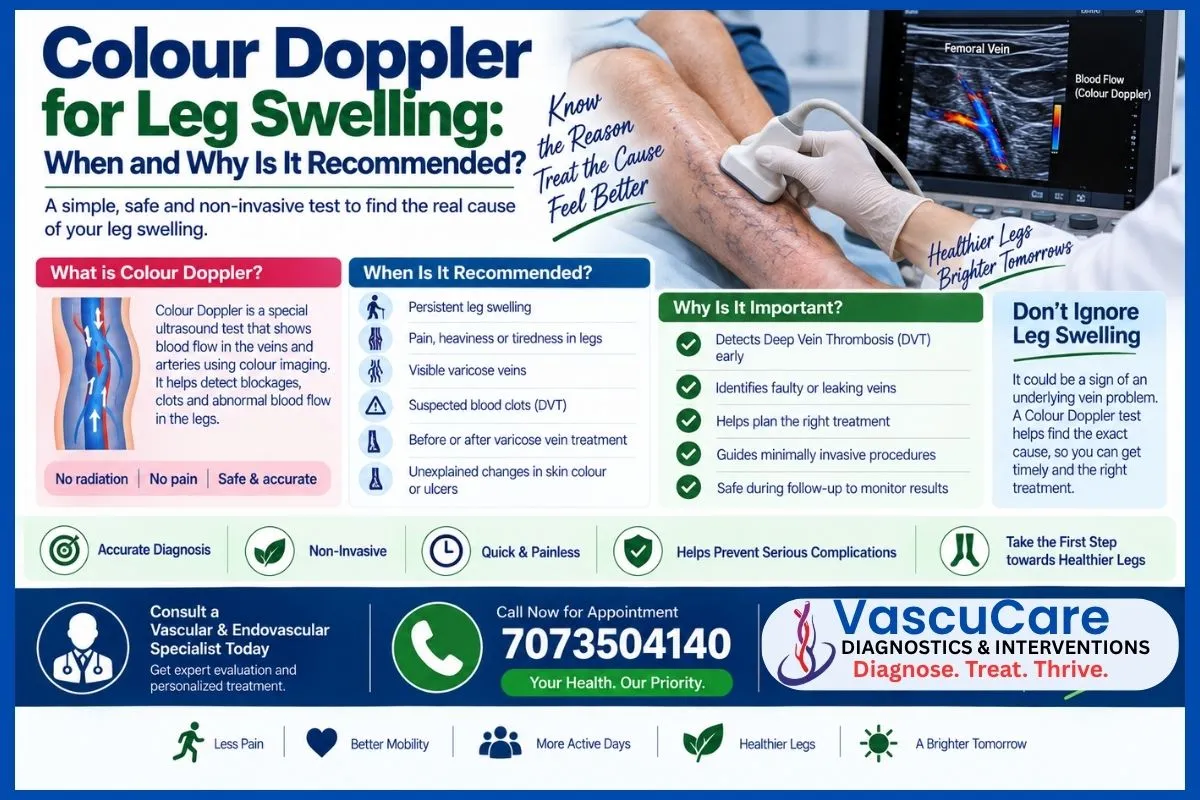
During a Colour Doppler examination of the leg veins, the radiologist or trained professional can assess important aspects of circulation, including:
• Whether veins are open
• Whether blood is flowing through them
• The direction of blood flow
• Whether venous valves are functioning effectively
• Whether abnormal backward flow, called reflux, is present
• Whether findings suggest a blood clot
• Which veins are involved in varicose vein disease
Instead of simply showing that a vein exists, Doppler helps evaluate how that vein is functioning.
When Is Colour Doppler Recommended for Leg Swelling?
There is no rule that every swollen leg requires a Doppler scan. Doctors usually consider the patient’s symptoms, examination, medical history, and likelihood of a vascular problem.
Several situations may make venous Doppler evaluation particularly relevant.
1. One Leg Suddenly Becomes Swollen
Sudden swelling affecting one leg deserves attention, particularly when accompanied by pain, tenderness, warmth, or redness.
One condition doctors may need to exclude is Deep Vein Thrombosis (DVT), in which a blood clot develops within a deep vein.
A venous duplex ultrasound is commonly used as part of DVT assessment.
This is different from a routine Varicose Vein Doctor In Jaipur scan. Suspected DVT can require urgent medical evaluation rather than waiting for symptoms to disappear on their own.
2. Your Ankles Swell Repeatedly by Evening
Another pattern is gradual swelling that becomes more noticeable after standing or sitting for long periods and improves after resting overnight.
This can occur when the veins have difficulty efficiently returning blood upward from the legs.
If the valves inside superficial veins become incompetent, blood may flow backward. This is called venous reflux.
Doppler can demonstrate this abnormal flow and help identify the veins responsible.
3. Swelling Occurs With Visible Varicose Veins
Bulging veins plus recurring swelling raises a different question:
Are the visible veins themselves the problem, or are they being supplied by a larger vein with faulty valves?
Looking at the surface of the leg cannot reliably answer this.
Colour Doppler can map the superficial venous system and identify the source of reflux. This information becomes especially important before planning varicose vein laser treatment or another vein procedure.
4. Swelling Is Accompanied by Skin Changes
Long-standing venous hypertension can eventually affect the tissues around the ankle and lower leg.
Patients may notice brown pigmentation, itching, eczema-like changes, thickening of the skin, or wounds that heal slowly.
When these changes occur together with swelling, Doppler can help determine whether chronic venous insufficiency is contributing to the problem.
5. Swelling Persists Without an Obvious Explanation
Sometimes the clinical examination alone cannot establish the cause.
If a vascular cause remains possible, Colour Doppler may help either identify venous abnormalities or provide information that encourrages the doctor to investigate other causes.
A normal venous Doppler does not mean the swelling is imaginary or insignificant. It simply means another explanation may need to be considered.
What Is the Difference Between Venous Reflux and DVT?
These two terms are often confused, but they represent different problems.
Venous reflux occurs when valves do not close effectively and blood flows backward. It is commonly associated with chronic venous insufficiency and varicose veins.
DVT involves formation of a blood clot within a deep vein.
One tends to represent a chronic circulation problem, while the other can be an acute and potentially serious condition.
Colour Doppler/duplex ultrasound can play an important role in evaluating both, although the examination protocol and clinical urgency may differ.
What Happens During a Colour Doppler Test?
Colour Doppler Sonography In Vaishali Nagar is a non-invasive ultrasound examination.
Gel is applied to the skin and an ultrasound probe is moved over different areas of the leg. Depending on what needs to be assessed, the examination may involve different positions and techniques.
When evaluating venous reflux, the examiner may use maneuvers designed to assess the direction of blood flow and valve function.
When investigating possible DVT, the veins are examined for features such as compressibility and blood flow.
There are no surgical cuts, injections, or radiation involved in a standard ultrasound Doppler examination.
Why Is Doppler Important Before Varicose Vein Treatment?
Modern vein treatment should not be planned solely by looking at the most visible veins.
Suppose two patients have almost identical bulging veins around the calf. Their Doppler studies may reveal completely different sources of reflux.
If treatment is performed without understanding this underlying venous map, the actual source of abnormal pressure may not be adequately addressed.
This is why Colour Doppler helps transform treatment from “remove the visible vein” into “identify and treat the abnormal venous pathway.”
For selected patients, the findings may support treatments such as endovenous laser ablation. Other patients may require a different approach or no procedure at all.
Can Colour Doppler Tell Whether You Need Laser Treatment?
Colour Doppler provides essential information, but the scan alone should not decide treatment.
A specialist also considers symptoms, clinical examination, skin changes, medical history, previous thrombosis, affected veins, and the patient’s overall health.
For example, demonstrating reflux on Doppler does not automatically mean every patient requires varicose vein laser treatment.
The scan should support clinical decision-making rather than replace it.
Colour Doppler Sonography in Vaishali Nagar, Jaipur
At VascuCare Diagnostics & Interventions, patients with leg swelling, suspected varicose veins, and vascular symptoms can undergo clinical assessment and Colour Doppler Sonography in Vaishali Nagar when clinically appropriate.
Dr. Rakesh Kumawat – Best Interventional Radiologist and Pain Management Specialist In Jaipur provides diagnostic evaluation and image-guided minimally invasive treatment options for appropriately selected vascular conditions.
For a patient with leg swelling, the most valuable outcome of a Doppler examination is not simply receiving a scan report. It is answering the right clinical question: Is there a venous problem, where is it located, and does it explain the patient’s symptoms?
That information can prevent both unnecessary treatment and delays in treating an important vascular condition.
Frequently Asked Questions (FAQs)
1. Should I Get a Colour Doppler for Every Episode of Leg Swelling?
No. Not every episode requires Doppler testing. A doctor considers the onset, severity, whether one or both legs are affected, associated symptoms, examination findings, and medical history before recommending the test.
2. Why Would a Doctor Order Doppler if Only One Leg Is Swollen?
One-sided swelling can sometimes indicate a localized vascular problem. If DVT or another venous abnormality is suspected, venous duplex ultrasound may be recommended as part of the evaluation.
3. Can Colour Doppler Detect a Blood Clot in the Leg?
Venous duplex ultrasound is commonly used when evaluating suspected DVT. Doctors interpret the Ultrasound Centre In Vaishali Nagar findings together with symptoms, clinical probability, and other tests when required.
4. Can Doppler Show Why My Varicose Veins Developed?
It can help identify venous reflux and determine which veins have faulty valve function. This can reveal the underlying circulation pattern contributing to visible varicose veins.
5. My Doppler Is Normal, So Why Are My Legs Still Swollen?
A normal venous Doppler does not exclude every cause of swelling. Lymphatic, cardiac, kidney, liver, medication-related, inflammatory, and other causes may need to be considered depending on the clinical situation.
6. Is Colour Doppler Painful?
The examination is generally painless and non-invasive. Some pressure may be applied with the ultrasound probe, particularly when veins need to be assessed for compressibility.
7. Does Colour Doppler Use Radiation?
No. Ultrasound Doppler uses sound waves and does not involve ionizing radiation such as that used in X-rays or CT scans.
8. Can Colour Doppler Tell Whether I Need Varicose Vein Laser Treatment?
It can show the anatomy and pattern of venous reflux needed for treatment planning, but the decision also depends on symptoms, examination findings, medical history, and specialist assessment.
9. What Does “Venous Reflux” on a Doppler Report Mean?
Venous reflux means blood is flowing backward for an abnormal period because the vein valves are not functioning effectively. Its significance depends on which veins are affected and whether it corresponds with the patient’s symptoms.
10. When Is Leg Swelling Urgent Rather Than a Routine Doppler Issue?
Sudden significant one-sided swelling with pain, redness, warmth, or tenderness requires prompt medical evaluation. If swelling is accompanied by sudden breathlessness, chest pain, fainting, or coughing blood, seek emergency medical care immediately.