
- Jul 30, 2026
- Pain Management
- 0 Comments
Knee pain is one of the most common musculoskeletal problems affecting people of all ages. Whether it’s caused by aging, osteoarthritis, sports injuries, ligament damage, or chronic inflammation, persistent knee pain can make everyday activities like walking, climbing stairs, sitting, or even sleeping uncomfortable.
While many people rely on painkillers or postpone treatment until surgery seems inevitable, modern medicine offers several effective non-surgical and minimally invasive treatment options that can provide lasting relief and improve mobility.
If you’re searching for the best Knee Pain Treatment in Jaipur, understanding the full range of available treatment options—from lifestyle changes to advanced image-guided procedures—can help you choose the right care.
Dr. Rakesh Kumawat – Best Interventional Radiologist and Pain Management Specialist in Jaipur, at VascuCare Diagnostics & Interventions, specializes in diagnosing the root cause of chronic knee pain and providing personalized, minimally invasive treatments such as Genicular Nerve Block, Genicular Nerve Ablation, PRP Therapy, and Genicular Artery Embolization (GAE) for suitable patients.
Understanding Knee Pain
The knee is the largest and one of the most important joints in the body. It supports your body weight while allowing movement during walking, running, climbing stairs, and other daily activities.
Because it is constantly under stress, the knee is vulnerable to injury, wear and tear, and inflammatory conditions.
Knee pain may develop gradually or occur suddenly depending on the underlying cause.
Common Causes of Knee Pain
Several conditions can lead to knee pain, including:
- Osteoarthritis
- Rheumatoid arthritis
- Sports injuries
- Meniscus tears
- Ligament injuries
- Cartilage damage
- Tendon inflammation
- Bursitis
- Previous fractures
- Age-related joint degeneration
- Obesity-related joint stress
Finding the exact cause is essential because treatment varies depending on the diagnosis.
Symptoms That Should Not Be Ignored
Consult a specialist if you experience:
- Persistent knee pain
- Swelling
- Morning stiffness
- Difficulty walking
- Pain while climbing stairs
- Knee instability
- Clicking or locking
- Reduced range of motion
- Night pain
- Pain that limits daily activities
Early diagnosis often leads to better outcomes.
How Knee Pain Is Diagnosed
Before recommending treatment, your doctor performs a detailed evaluation.
Diagnosis may include:
- Medical history
- Physical examination
- Digital X-rays
- MRI when required
- Ultrasound in selected cases
- Blood tests for inflammatory conditions
Accurate diagnosis ensures that treatment targets the underlying cause rather than simply masking symptoms.
Step 1: Conservative (Simple) Knee Pain Treatment
For many patients, treatment begins with conservative measures.
These may include:
Lifestyle Modification
Maintaining a healthy weight reduces pressure on the Knee Joint Pain Treatment In Jaipur and may improve symptoms.
Physiotherapy
Strengthening the muscles around the knee improves stability and supports joint function.
Activity Modification
Avoiding activities that worsen pain while remaining physically active can help protect the joint.
Medications
Pain-relieving and anti-inflammatory medicines may provide temporary symptom relief under medical supervision.
Knee Support
Braces or supportive devices may be recommended in selected patients.
If symptoms continue despite these measures, advanced treatment options may be considered.
Step 2: PRP Therapy for Knee Pain
What Is PRP Therapy?
Platelet-Rich Plasma (PRP) Therapy uses a concentrated portion of the patient’s own blood containing platelets and natural growth factors.
After processing the blood sample, the platelet-rich solution is injected into the affected knee under appropriate guidance.
Potential Benefits
- Supports natural healing
- May reduce inflammation
- May improve joint function
- Uses the patient’s own blood
- Minimally invasive procedure
PRP Therapy is commonly considered for selected patients with early osteoarthritis, tendon injuries, and chronic knee pain.
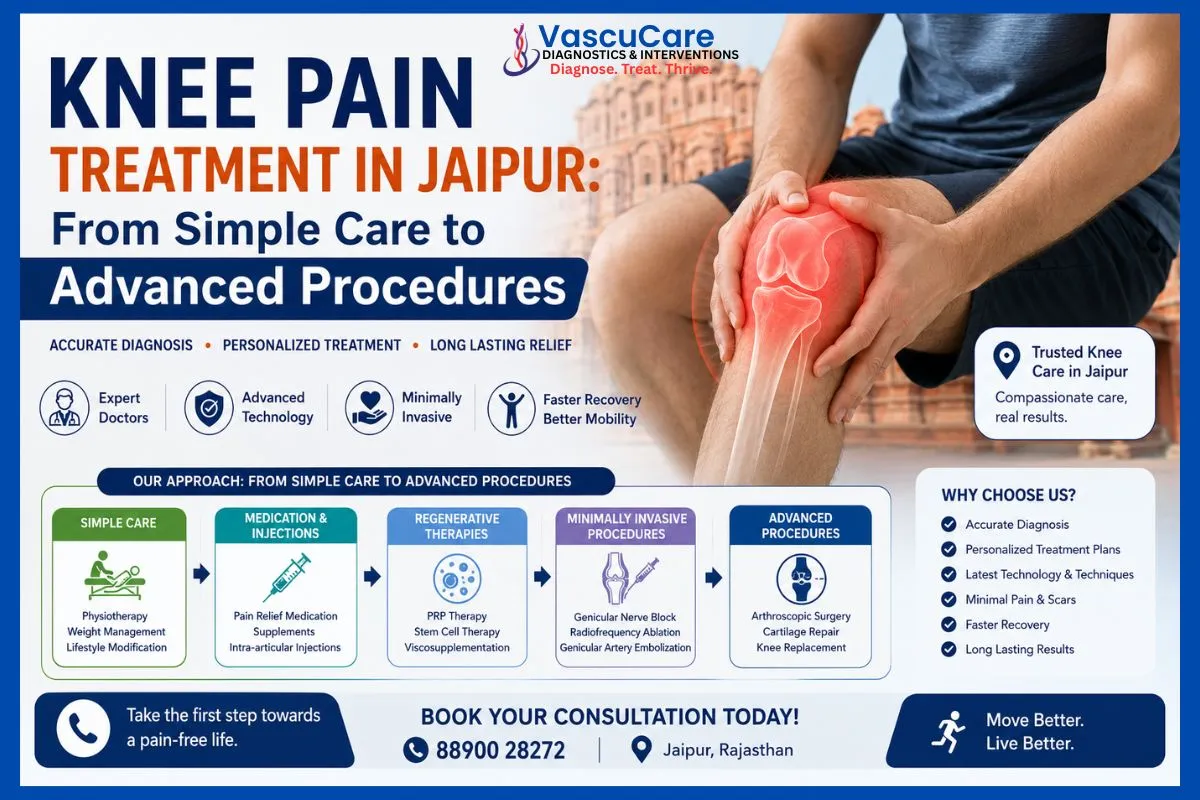
Step 3: Genicular Nerve Block
What Is a Genicular Nerve Block?
The Genicular Nerve Block Treatment In Jaipur is a minimally invasive, image-guided injection that targets the small sensory nerves responsible for transmitting pain signals from the knee.
The procedure involves injecting a local anesthetic, sometimes combined with other medications when appropriate, around these nerves.
Benefits
- Helps identify the source of pain
- Provides temporary pain relief
- Improves mobility
- Can reduce dependence on pain medications
- Helps determine suitability for further procedures such as Genicular Nerve Ablation
Many patients experience meaningful pain relief following the procedure, although the duration varies depending on the individual condition.
Step 4: Genicular Nerve Ablation
What Is Genicular Nerve Ablation?
If a patient experiences good pain relief after a Genicular Nerve Block, Genicular Nerve Ablation may be recommended.
This minimally invasive procedure uses Radiofrequency Ablation (RFA) to interrupt pain signals from the genicular nerves while preserving knee movement.
Potential Advantages
- Longer-lasting pain relief
- Improved mobility
- Outpatient procedure
- Minimal recovery time
- Reduced reliance on pain medication
It is often considered for patients with chronic knee osteoarthritis who are not ready for surgery or are not suitable surgical candidates.
Step 5: Genicular Artery Embolization (GAE)
What Is Genicular Artery Embolization?
Genicular Artery Embolization (GAE) is an advanced image-guided procedure performed by an Interventional Radiologist.
Research has shown that chronic knee osteoarthritis may be associated with abnormal blood vessel formation that contributes to persistent inflammation and pain.
During GAE:
- A tiny catheter is inserted through a small puncture.
- Advanced imaging guides the catheter to the abnormal blood vessels supplying the inflamed area.
- Tiny embolic particles are delivered to reduce excessive blood flow and inflammation.
Benefits of GAE
- Minimally invasive
- No large surgical incision
- Day-care procedure in many cases
- May reduce chronic inflammation
- May improve pain and joint function
- Short recovery period
Not every patient is suitable for GAE, and careful clinical evaluation is essential before recommending this treatment.
Why Choose Dr. Rakesh Kumawat?
Choosing the right specialist is essential for long-term pain relief.
Dr. Rakesh Kumawat – Best Interventional Radiologist and Pain Management Specialist in Jaipur, at VascuCare Diagnostics & Interventions, provides comprehensive evaluation and advanced minimally invasive treatments for chronic knee pain.
Patients benefit from:
- Accurate diagnosis
- Personalized treatment planning
- PRP Therapy
- Genicular Nerve Block
- Genicular Nerve Ablation
- Genicular Artery Embolization (GAE)
- Image-guided minimally invasive procedures
- Modern pain management techniques
- Comprehensive follow-up care
The focus is on relieving pain, improving function, and helping patients maintain an active lifestyle while delaying or avoiding surgery whenever appropriate.
Frequently Asked Questions (FAQs)
1. What is the best treatment for chronic knee pain?
The best treatment depends on the underlying cause. Options may include lifestyle modification, physiotherapy, medications, PRP Therapy, Genicular Nerve Block, Genicular Nerve Ablation, or Genicular Artery Embolization (GAE).
2. Is surgery necessary for every knee pain patient?
No. Many patients benefit from non-surgical and minimally invasive treatments before considering knee replacement surgery.
3. What is PRP Therapy for knee pain?
PRP Therapy uses concentrated platelets from your own blood to support tissue healing and may help reduce pain in selected patients.
4. What is a Genicular Nerve Block?
It is an image-guided injection around the sensory nerves of the knee that helps relieve pain and can also determine whether a patient may benefit from Genicular Nerve Ablation.
5. How is Genicular Nerve Ablation different from a nerve block?
A Genicular Nerve Block provides temporary relief and serves as a diagnostic tool, while Genicular Nerve Ablation uses radiofrequency energy to provide longer-lasting pain relief in suitable patients.
6. What is Genicular Artery Embolization (GAE)?
GAE is a minimally invasive procedure that reduces abnormal blood flow associated with chronic knee inflammation in selected patients with osteoarthritis.
7. Who is a candidate for advanced knee pain procedures?
Patients with persistent Knee Pain Doctor In Jaipur despite medications, physiotherapy, or lifestyle modifications may be evaluated for these treatments after proper clinical assessment.
8. How long does recovery take after minimally invasive knee procedures?
Most patients undergoing image-guided procedures experience relatively quick recovery and can resume routine activities within a short period, depending on the treatment performed.
9. Can these treatments delay knee replacement surgery?
For selected patients, minimally invasive procedures may help reduce pain, improve function, and potentially delay the need for knee replacement. Suitability varies from person to person.
10. Where can I get advanced Knee Pain Treatment in Jaipur?
For personalized diagnosis and minimally invasive knee pain management, consult Dr. Rakesh Kumawat – Best Interventional Radiologist and Pain Management Specialist in Jaipur, at VascuCare Diagnostics & Interventions, offering advanced treatments such as PRP Therapy, Genicular Nerve Block, Genicular Nerve Ablation, and Genicular Artery Embolization (GAE).