
- May 27, 2026
- Pain Management
- 0 Comments
Knee pain is one of the most common problems affecting daily life, especially in people who have arthritis, age-related joint wear, sports injuries, ligament strain, cartilage damage, or chronic inflammation. Many patients experience pain while walking, climbing stairs, standing for long hours, sitting cross-legged, or getting up from a chair. In the past, patients often had limited options such as painkillers, physiotherapy, steroid injections, or surgery. Today, image-guided pain management has become an advanced and precise approach for selected knee pain patients.
At VascuCare Diagnostics & Interventions, Dr. Rakesh Kumawat – Best Interventional Radiologist and Pain Management Specialist in Jaipur provides advanced image-guided procedures that help diagnose and treat knee pain with accuracy, safety, and a minimally invasive approach for patients seeking Knee Pain Treatment In Jaipur.
What is Image-Guided Pain Management?
Image-guided pain management means using imaging technology such as ultrasound, fluoroscopy, CT scan, or X-ray guidance during pain procedures. Instead of giving an injection blindly, the doctor uses real-time imaging to see the target area and place the needle or treatment device more accurately.
Interventional radiology uses imaging methods such as ultrasound, CT, and X-ray to guide small devices inside the body, and it can be used instead of surgery for many conditions in suitable cases.
In knee pain treatment, this approach can help target the exact pain-generating area, such as the knee joint, surrounding soft tissues, inflamed structures, or pain-carrying nerves.
Why Accuracy Matters in Knee Pain Treatment
The knee is a complex joint made of bones, cartilage, ligaments, tendons, muscles, fluid spaces, and nerves. Knee pain may come from different sources, including:
• Osteoarthritis
• Cartilage wear and tear
• Ligament injury
• Meniscus-related pain
• Tendon inflammation
• Bursitis
• Nerve-related pain
• Post-surgical knee pain
• Chronic joint inflammation
If the treatment is not delivered to the correct location, the result may be incomplete or temporary. Image guidance helps the specialist identify the exact target and deliver treatment more precisely.
This is especially useful in patients who have long-term knee pain, recurrent swelling, arthritis, failed previous injections, or pain that does not match simple X-ray findings.
How Image-Guided Procedures Help in Knee Pain
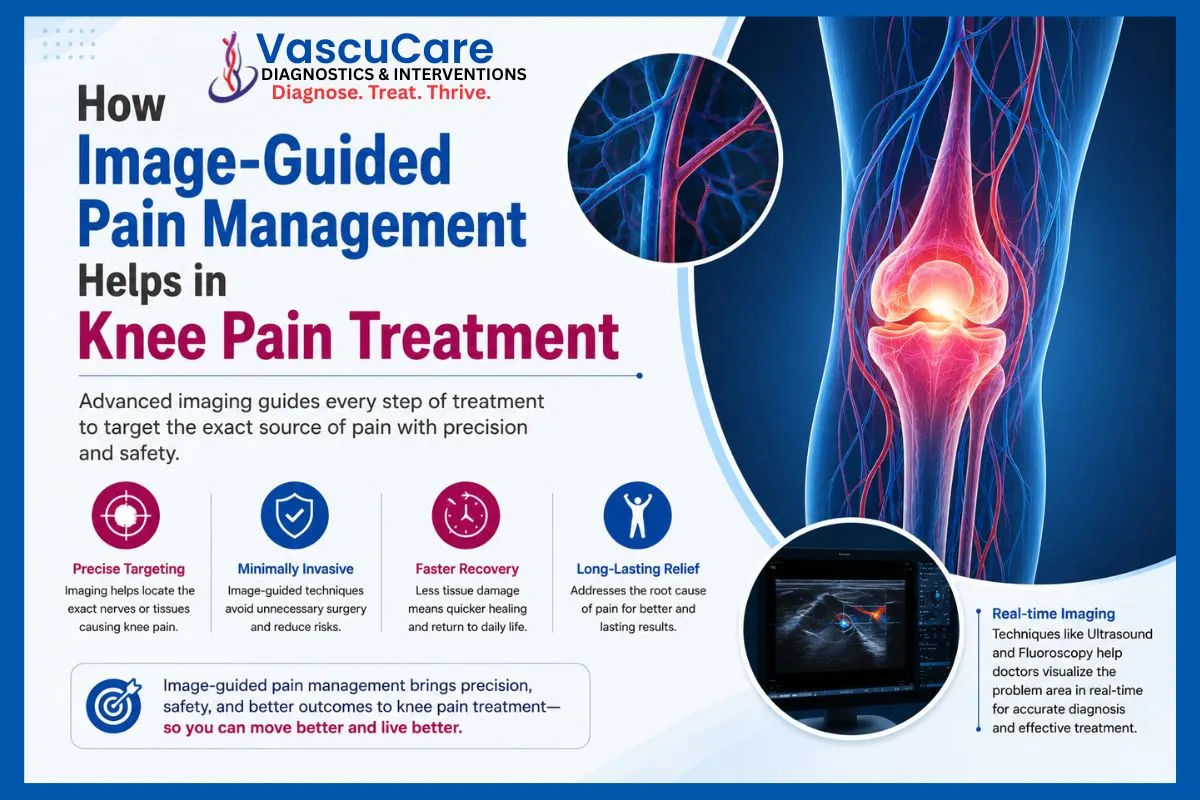
Image-guided knee pain treatment is not a single procedure. It is a group of targeted treatments selected according to the patient’s diagnosis, pain severity, age, mobility, imaging findings, and treatment goals.
1. Accurate Knee Joint Injections
In some patients, medication needs to be delivered inside the knee joint. This may include anti-inflammatory injections, viscosupplementation, PRP therapy, or other joint-based treatments.
When injections are performed with ultrasound or fluoroscopy guidance, the doctor can confirm that the medicine is going into the correct joint space. This can improve accuracy and reduce unnecessary tissue irritation.
2. PRP Therapy for Knee Pain
PRP, or Platelet-Rich Plasma therapy, uses a concentrated portion of the patient’s own blood that contains platelets and growth factors. It may be considered in selected patients with early to moderate knee osteoarthritis, sports injuries, or soft tissue-related knee pain.
In image-guided PRP therapy, the PRP can be delivered more accurately into the affected area. This is important because PRP is not just a painkiller; it is used to support the body’s healing response in appropriate cases.
3. Genicular Nerve Block
Some chronic knee pain is driven by the nerves around the knee joint. These are called genicular nerves. A genicular nerve block targets these pain-carrying nerves with medication to reduce pain signals and is commonly used in Genicular Nerve Block Treatment In Jaipur.
This procedure is often used in patients with knee osteoarthritis, chronic knee pain, or persistent pain after knee surgery. Cleveland Clinic explains that a genicular nerve block involves injecting medication close to certain knee nerves to provide temporary pain relief.
Image guidance is important because the nerves are small and located near specific bony landmarks. Ultrasound or fluoroscopy helps the doctor place the injection more accurately.
4. Radiofrequency Ablation for Longer Pain Relief
If a patient gets good relief from a diagnostic genicular nerve block, radiofrequency ablation may be considered for longer-lasting pain relief. In this procedure, controlled heat energy is used to reduce pain signals from targeted nerves.
Research on interventional radiology therapies for knee osteoarthritis includes intra-articular injections, neurotomy, neuromodulation techniques, and transcatheter therapies aimed at controlling pain, inflammation, mobility, and function.
Radiofrequency treatment is usually planned after careful evaluation and is not suitable for every patient. The doctor decides based on response to nerve block, arthritis severity, medical history, and overall treatment goals.
5. Treatment for Patients Who Want to Avoid or Delay Surgery
Not every patient with knee pain needs immediate surgery. Some patients have early or moderate arthritis. Some are not medically fit for surgery. Some want to delay knee replacement. Others may have pain even after surgery.
In such cases, image-guided pain management can offer a middle path between basic medicines and major surgery. It may help reduce pain, improve walking comfort, support physiotherapy, and improve day-to-day function.
Benefits of Image-Guided Pain Management for Knee Pain
Image-guided pain management offers several advantages for suitable patients:
• Minimally invasive treatment approach
• More accurate needle placement
• Targeted pain relief
• Less dependence on repeated painkillers
• Can help improve walking and mobility
• Useful for chronic knee arthritis pain
• Can help identify the exact pain source
• May delay surgery in selected patients
• Usually performed as a day-care procedure
• Personalized treatment based on diagnosis
Johns Hopkins notes that image-guided interventional radiology procedures may reduce risk, pain, and recovery time compared with open surgery in suitable conditions.
Who Can Benefit from Image-Guided Knee Pain Treatment?
Image-guided pain management may be suitable for patients who have:
• Long-term knee pain
• Knee osteoarthritis
• Knee joint pain while walking
• Pain while climbing stairs
• Knee stiffness and swelling
• Pain not improving with medicines
• Pain not improving with physiotherapy alone
• Post-knee replacement pain
• Patients who want non-surgical treatment
• Patients who are not fit for surgery
However, every patient needs proper evaluation. Severe bone-on-bone arthritis, major deformity, infection, unstable injury, or advanced joint destruction may require different treatment planning.
Why Choose VascuCare Diagnostics & Interventions?
At VascuCare Diagnostics & Interventions, patients receive a focused approach for knee pain diagnosis and treatment. The aim is not only to reduce pain temporarily, but to understand the pain source and choose a suitable treatment plan.
Dr. Rakesh Kumawat – Best Interventional Radiologist and Pain Management Specialist in Jaipur provides image-guided care with advanced diagnostic and interventional expertise. His approach includes:
• Detailed patient history
• Clinical examination
• Imaging-based evaluation
• Pain source identification
• Image-guided treatment planning
• Minimally invasive procedures
• Follow-up and rehabilitation guidance
This makes the treatment more precise and patient-specific.
When Should You Consult a Pain Management Specialist?
You should consider consultation if you have:
• Knee pain for more than a few weeks
• Pain while walking or climbing stairs
• Swelling or stiffness in the knee
• Difficulty standing for long hours
• Pain despite medicines and physiotherapy
• Recurrent knee pain after injections
• Knee pain after surgery
• Desire to avoid or delay knee replacement
Early consultation can help prevent worsening of symptoms and improve treatment outcomes.
FAQs
1. What is image-guided pain management for knee pain?
Image-guided pain management uses ultrasound, fluoroscopy, CT, or X-ray guidance to deliver treatment accurately to the painful joint, tissue, or nerve area.
2. Is image-guided knee injection better than normal injection?
Image guidance can improve accuracy because the doctor can see the target area in real time. This is especially helpful in complex cases, chronic pain, arthritis, or previously failed injections.
3. Can image-guided pain management avoid knee surgery?
It may help delay or avoid surgery in selected patients with early or moderate arthritis or nerve-related knee pain. However, severe joint damage may still require surgical treatment.
4. Is the procedure painful?
Most image-guided procedures are done with local anesthesia. Patients may feel mild pressure or temporary soreness, but the procedure is usually well tolerated.
5. Who is the best doctor for image-guided knee pain treatment in Jaipur?
For advanced image-guided knee pain treatment, you can consult Dr. Rakesh Kumawat – Best Interventional Radiologist and Pain Management Specialist in Jaipur at VascuCare Diagnostics & Interventions.