

- Nov 15, 2026
- Pain Management
- 0 Comments
Have you noticed that your knee feels tight when getting out of bed, standing after sitting, or trying to climb stairs? Perhaps bending the knee has become difficult, or walking a familiar distance now takes more effort.
Knee stiffness and reduced mobility can result from osteoarthritis, inflammation, previous injuries, muscle weakness, or changes affecting the structures inside the joint.
Although occasional stiffness may improve with movement, persistent restriction should not automatically be considered a normal part of ageing.
Understanding why the knee feels stiff is essential because different causes require different treatment approaches.
For patients seeking Knee Joint Pain Treatment in Jaipur, an accurate evaluation can help identify whether the main problem is joint restriction, pain, weakness, or a combination of these factors. Knee Pain Treatment In Jaipur begins with identifying the underlying cause of the symptoms.
What Is Knee Stiffness?
Knee stiffness is a sensation of tightness, resistance, or difficulty moving the joint normally.
It may affect bending, straightening, or both.
However, doctors distinguish between two important situations.
True movement restriction occurs when the knee physically cannot move through its expected range, even during an appropriate clinical examination.
Pain-limited movement occurs when a patient avoids bending or straightening because movement causes discomfort.
This difference matters because treating pain alone may not resolve a fixed mechanical restriction.
What Causes Knee Stiffness and Reduced Mobility?
- Knee Osteoarthritis
Osteoarthritis is a common cause of knee stiffness, particularly among middle-aged and older adults.
Changes in joint cartilage, bone, and surrounding tissues may contribute to pain, reduced flexibility, and difficulty performing everyday activities.
Stiffness is often noticeable after resting and may improve somewhat after gentle movement.
- Joint Inflammation
Inflammatory conditions can cause swelling, warmth, discomfort, and restricted movement.
Persistent morning stiffness, particularly when it lasts a prolonged period or affects several joints, may suggest an inflammatory condition requiring further investigation.
- Meniscus and Cartilage Problems
Meniscus injuries or loose fragments inside the knee may sometimes cause catching, locking, or difficulty fully straightening the joint.
A knee that becomes mechanically locked requires timely assessment.
- Previous Knee Injuries
Ligament injuries, fractures, surgery, or prolonged immobilization can contribute to stiffness.
Scar tissue and reduced movement during recovery may also affect joint flexibility.
- Muscle Weakness and Reduced Activity
Weak quadriceps and other supporting muscles can make knee movement feel difficult.
When patients avoid activity because of pain, muscle strength may decline, further reducing mobility.
This creates a cycle in which discomfort leads to less movement, and reduced movement contributes to functional limitations.
Why Does Knee Stiffness Feel Worse After Sitting?
During prolonged sitting, the knee remains in a relatively fixed position.
People with osteoarthritis or certain other joint conditions may experience temporary stiffness when they begin moving again.
This is sometimes described as start-up stiffness.
A few steps may make movement feel easier.
However, repeated stiffness accompanied by swelling, significant pain, or progressive loss of flexibility should be evaluated.
How Do Doctors Evaluate Knee Stiffness?
A Knee Pain Doctor in Jaipur typically begins by understanding when stiffness occurs and how it affects daily activities.
The doctor may ask whether symptoms are worse in the morning, after sitting, during walking, or following physical activity.
Clinical examination can assess:
- Active and passive knee movement
- Joint tenderness and swelling
- Muscle strength
- Ligament stability
- Walking patterns
- Mechanical catching or locking
Comparing active and passive movement can help distinguish weakness or pain-related limitation from a more fixed restriction.
Are X-Rays or MRI Necessary?
X-rays may help identify joint-space narrowing, bone changes, and other features associated with osteoarthritis.
MRI may be considered when meniscus, ligament, cartilage, or other soft-tissue abnormalities are suspected.
Blood tests may also be appropriate when inflammatory arthritis or infection is a concern.
Not every patient requires every investigation.
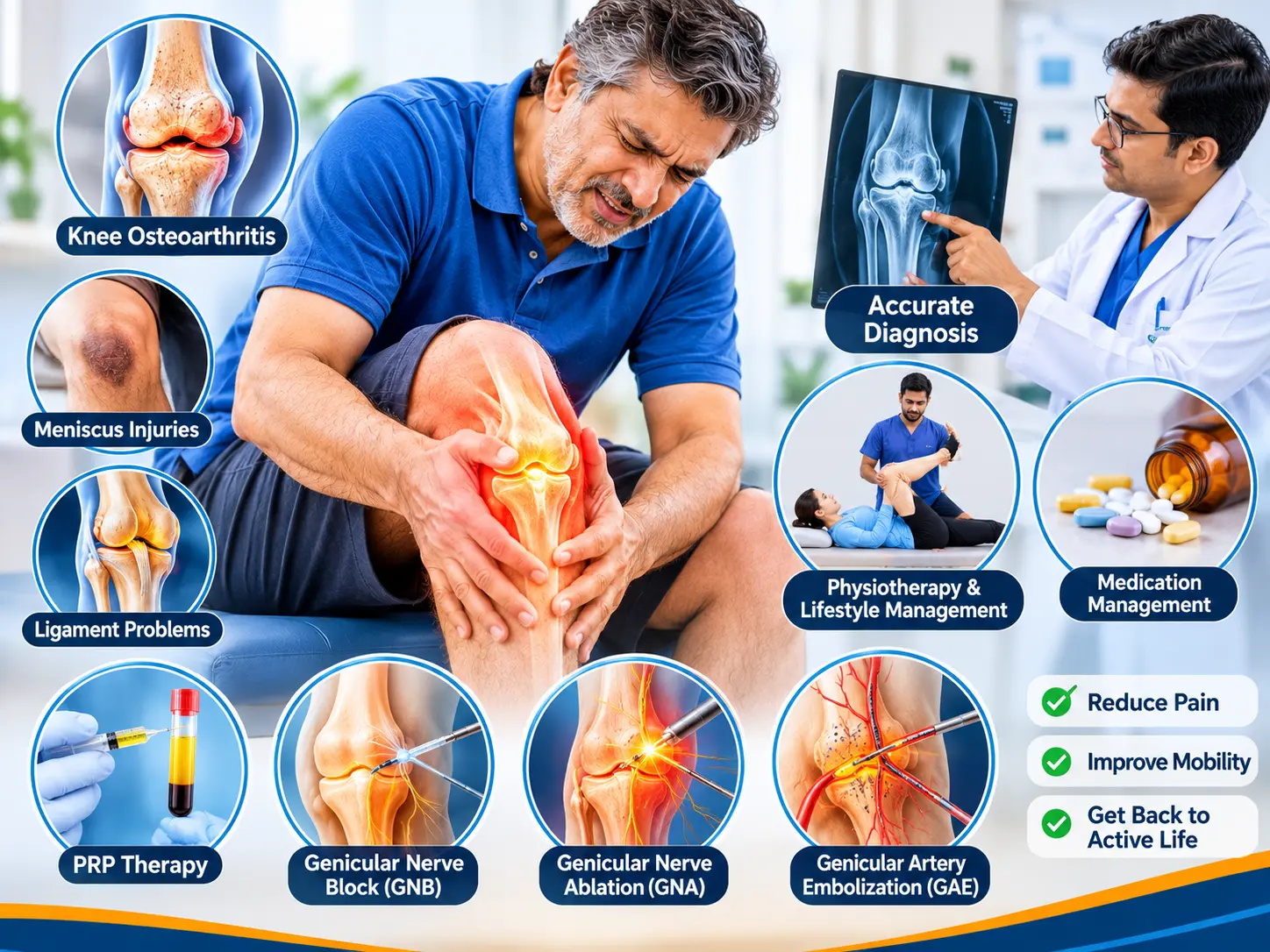
How Is Knee Stiffness Treated?
Treatment depends on the cause, severity, and degree of movement restriction.
Physiotherapy and Mobility Exercises
For many patients, physiotherapy is an important starting point.
A supervised programme may include gentle range-of-motion exercises, quadriceps strengthening, flexibility training, and gradual improvement in walking tolerance.
The objective is to restore comfortable movement without unnecessarily aggravating symptoms.
Activity Modification and Weight Management
Avoiding prolonged inactivity and maintaining suitable physical activity may help manage stiffness.
For patients with excess body weight, gradual weight reduction can reduce mechanical loading on the knee.
Medicines and Inflammation Management
Doctors may prescribe appropriate medication when pain or inflammation interferes with movement.
However, medication alone may not correct mechanical locking, fixed contractures, or significant structural abnormalities.
Can Advanced Procedures Help Knee Pain With Stiffness?
Selected patients with persistent osteoarthritis-related pain may be considered for additional treatment after conservative care.
Options can include PRP Therapy, Genicular Nerve Block (GNB), Genicular Nerve Ablation (GNA), and Genicular Artery Embolization (GAE).
These procedures address different pain mechanisms.
For example, GNB and GNA target selected sensory nerve pathways, while GAE targets abnormal vascularity associated with inflammation in selected osteoarthritis patients.
These procedures primarily aim to manage pain; they do not directly restore a mechanically blocked joint or reverse advanced structural damage.
Improved pain control may help some patients participate more comfortably in rehabilitation, but results vary.
Patients with fixed deformity, severe joint damage, or true mechanical locking may require orthopedic evaluation. Knee Pain Treatment In Jaipur may involve assessing whether these advanced pain-management procedures are appropriate.
When Should You Seek Medical Attention?
Consider medical evaluation when stiffness persists, worsens, or interferes with walking, climbing stairs, or daily activities.
Repeated swelling, instability, or progressive inability to straighten the knee also warrants assessment.
Seek urgent medical care for a hot, swollen knee with fever, major injury, severe pain, or sudden inability to bear weight.
Knee Stiffness and Knee Pain Treatment in Jaipur
At VascuCare Diagnostics & Interventions, patients with persistent knee pain and mobility limitations can be evaluated for appropriate pain-management and minimally invasive treatment options.
Dr. Rakesh Kumawat, Interventional Radiologist and Pain Management Specialist in Jaipur, provides image-guided interventions for appropriately selected patients.
For individuals searching for Knee Joint Pain Treatment in Jaipur, Knee Pain Doctor in Jaipur, or a Pain Management Specialist Doctor in Jaipur, understanding whether stiffness is caused by pain, inflammation, weakness, or structural restriction is an important first step. Knee Pain Treatment In Jaipur should be guided by an appropriate clinical evaluation.
Frequently Asked Questions (FAQs)
1. What is the most common cause of knee stiffness?
Knee osteoarthritis is a common cause, especially in older adults. However, inflammation, previous injuries, muscle weakness, and meniscus problems can also cause stiffness.
2. Why does my knee become stiff after sitting for a long time?
Prolonged sitting can make stiffness more noticeable in people with osteoarthritis or other knee conditions. This start-up stiffness may improve with gentle movement, but recurring symptoms deserve evaluation.
3. Can physiotherapy improve knee stiffness?
Yes. Physiotherapy can improve strength, flexibility, and movement in many patients. Its effectiveness depends on whether stiffness is caused by weakness, pain, inflammation, or fixed structural restriction.
4. Can knee stiffness be treated without surgery?
Many cases improve with appropriate exercises, physiotherapy, activity modification, and medical management. Fixed mechanical problems or advanced joint damage may require surgical assessment.
5. When should I consult a knee pain specialist in Jaipur?
Consult a specialist when stiffness repeatedly returns, limits bending or straightening, affects walking, or persists despite appropriate care. Sudden severe symptoms or a hot, swollen joint require urgent evaluation.