- Oct 31, 2026
- Varicose Vein
- 0 Comments
When varicose veins start causing leg pain, heaviness, swelling or skin changes, treatment may become necessary. Patients exploring their options often encounter two very different approaches: endovenous laser treatment and conventional varicose vein surgery.
This naturally raises a common question:
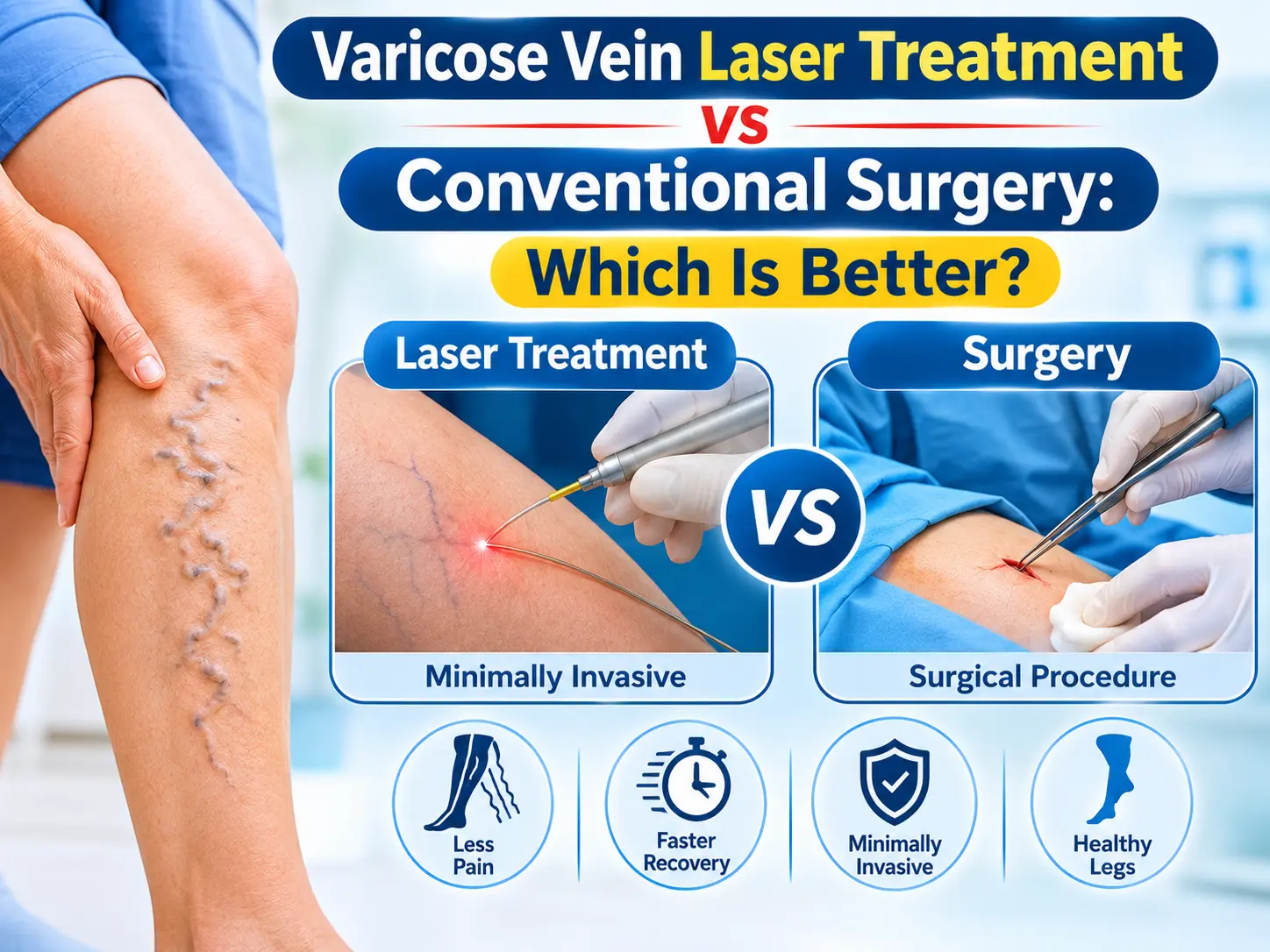
Varicose vein laser treatment vs surgery—which is better?
There is no universal answer for every patient. Modern endovenous laser treatment offers a minimally invasive way to close certain refluxing veins, while conventional surgery may still have a role in selected situations.
The correct choice depends on venous anatomy, Colour Doppler findings, symptoms, previous treatment and individual medical factors. Patients searching for a Knee Pain Doctor In Jaipur should also understand the importance of proper diagnosis and choosing treatment according to their individual condition.
Why Do Varicose Veins Need Treatment?
Varicose veins commonly develop when valves inside superficial leg veins stop working effectively.
Normally, these valves help blood travel upward toward the heart. When they become incompetent, blood can flow backward—a condition known as venous reflux.
This increases venous pressure and may lead to enlarged veins, heaviness, aching, swelling, itching and eventually skin changes in some patients.
The purpose of treatment is therefore not simply to make a visible vein disappear.
A good treatment strategy identifies and addresses the underlying refluxing pathway.
How Does Conventional Varicose Vein Surgery Work?
Traditional varicose vein surgery has historically included procedures such as ligation and stripping.
Depending on the surgical technique, the abnormal superficial vein may be tied off and physically removed through incisions.
Because treatment involves surgical access and removal of the affected vein, recovery may involve incision care, bruising and a period of activity modification.
Surgical techniques have successfully treated varicose veins for many years and may still be considered in particular clinical or anatomical situations.
However, modern treatment increasingly includes endovenous techniques that approach the same refluxing vein from inside.
How Does Varicose Vein Laser Treatment Work?
Endovenous Laser Ablation (EVLA/EVLT) takes a different approach.
Instead of surgically stripping out the refluxing vein, a thin laser fibre is introduced into the target vein, usually under ultrasound guidance.
Once correctly positioned, controlled thermal energy is delivered inside the vein. This causes the abnormal vein to close.
Blood then redirects through other functioning venous pathways.
Over time, the treated vein undergoes natural changes after closure.
This inside-the-vein approach is one of the main differences between Varicose Vein Laser Treatment in Jaipur and conventional surgery.
Laser vs Surgery: What Is the Difference in Incisions?
Conventional surgery may require surgical incisions to access, ligate or remove abnormal veins.
Endovenous laser treatment usually requires a small puncture through which the treatment fibre is inserted.
For many patients, this difference in access is significant because it can affect wound care, bruising and the overall recovery experience.
However, additional treatment may sometimes be required for prominent branch veins even after the main refluxing vein has been addressed.
Which Treatment Has a Faster Recovery?
Endovenous laser treatment is generally associated with a relatively quick return to routine activity compared with traditional vein stripping, although individual recovery varies.
Many patients can walk soon after an uncomplicated endovenous procedure according to their doctor’s instructions.
Conventional surgery may require more recovery because tissue is affected by surgical access and vein removal.
But “faster recovery” should not be the only factor used to select treatment.
The first question remains whether the patient’s anatomy is appropriate for the procedure being considered.
Is Laser Treatment Less Painful?
A minimally invasive approach can reduce the tissue disruption associated with open surgery, and many patients find the recovery after endovenous treatment manageable.
Nevertheless, laser treatment is still a medical procedure.
Temporary tightness, tenderness, bruising or discomfort can occur after treatment. Every procedure also carries potential risks and complications that should be discussed before treatment.
“Laser” should not be interpreted as meaning completely painless or risk-free.
Why Is Colour Doppler Important Before Choosing?
A patient may see several enlarged veins on the surface, but those veins do not reveal the complete venous circulation underneath.
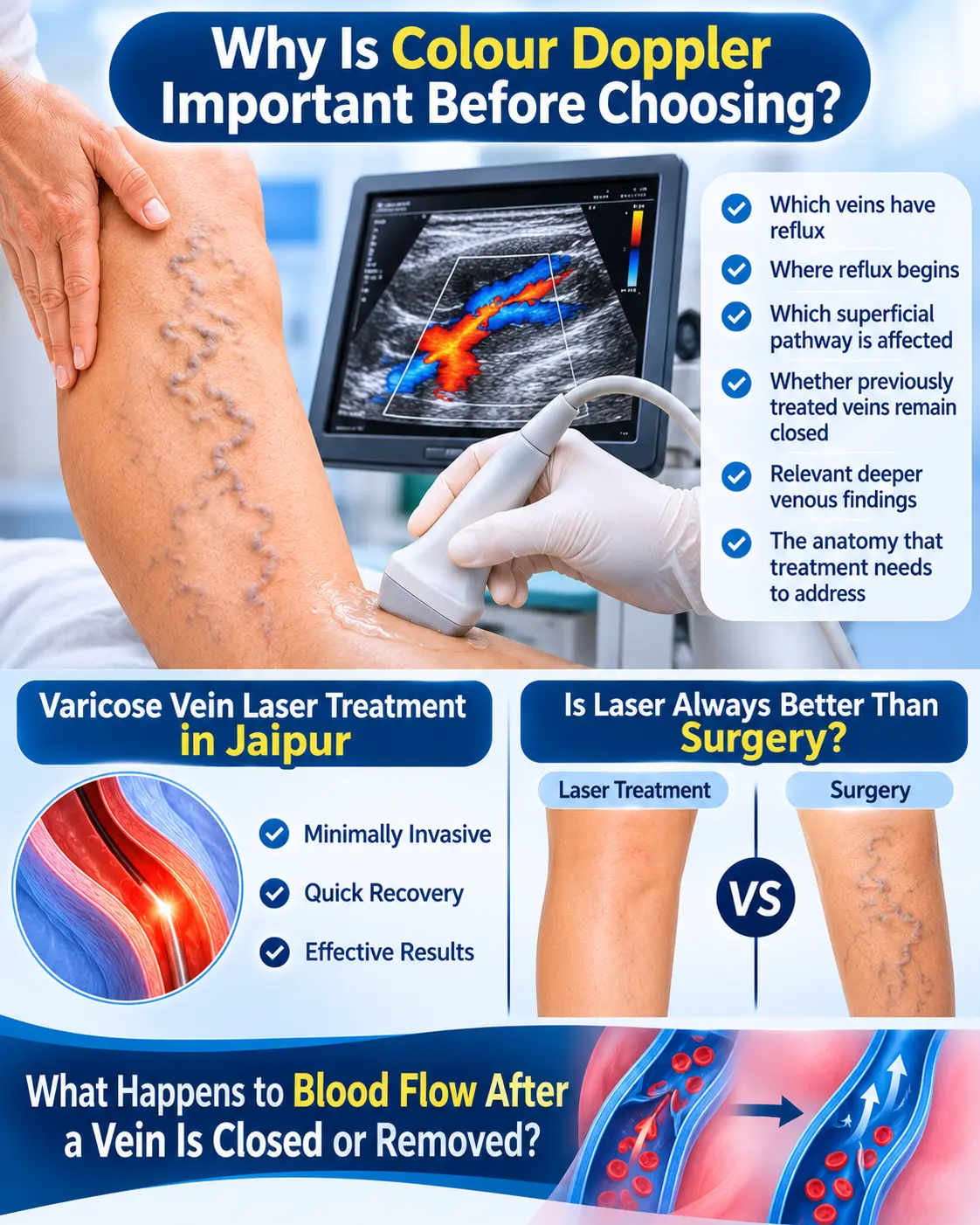
Colour Doppler or duplex ultrasound can identify:
- Which veins have reflux
- Where reflux begins
- Which superficial pathway is affected
- Whether previously treated veins remain closed
- Relevant deeper venous findings
- The anatomy that treatment needs to address
This is especially important when comparing laser with surgery.
The treatment decision should be based on a venous map, not simply on which technique sounds newer.
For patients looking for a Knee Pain Doctor In Jaipur, understanding the role of diagnostic evaluation is important before considering any treatment.
Does Laser Treatment Have a Lower Risk of Recurrence?
Recurrence is more complicated than asking whether laser or surgery “lasts longer.”
Varicose veins can return for several reasons.
A treated vein may reopen in some cases. Residual reflux may remain elsewhere, or an entirely different vein can become incompetent years later as venous disease progresses.
Previous surgery can also alter anatomy, while new venous pathways may develop over time.
Therefore, long-term success depends not only on the procedure but also on accurate diagnosis, appropriate treatment of the reflux source and follow-up when new symptoms appear.
No responsible treatment should promise that a patient will never develop another varicose vein.
Is Laser Always Better Than Surgery?
No.
Endovenous laser treatment offers important advantages for many suitable patients, particularly because it can treat an incompetent superficial vein through a minimally invasive, image-guided approach.
But that does not mean conventional surgery has no role.
Venous anatomy varies considerably. Previous procedures, unusually shaped veins, associated conditions or other clinical factors may influence treatment planning.
The better question is not:
“Which procedure is better in general?”
It is:
“Which procedure appropriately treats my current source of venous reflux?”
What Happens to Blood Flow After a Vein Is Closed or Removed?
Patients often worry that closing or removing a vein will make leg circulation worse.
When treatment is appropriately planned, the targeted superficial vein is already functioning abnormally because its valves allow reflux.
After that abnormal pathway is closed or removed, blood can redirect through functioning venous pathways.
Colour Doppler evaluation helps doctors understand the circulation before treatment and select appropriate veins for intervention.
Varicose Vein Laser Treatment in Jaipur
At VascuCare Diagnostics & Interventions, patients with visible varicose veins, heaviness, leg pain, swelling and venous skin changes can be evaluated clinically and with Colour Doppler when appropriate.
For suitable patients, minimally invasive Varicose Vein Laser Treatment in Jaipur may be considered based on venous anatomy and the source of reflux.
Dr. Rakesh Kumawat – Best Interventional Radiologist and Pain Management Specialist In Jaipur provides image-guided treatment options for appropriately selected venous conditions.
Patients searching for a Varicose Vein Doctor in Jaipur, Vein Specialist Doctor in Jaipur, or Varicose Vein Treatment in Jaipur should focus on diagnosis before choosing a procedure.
The most modern treatment is useful only when it targets the correct vein for the correct reason.
For people researching a Varicose Vein Doctor In Jaipur selecting an appropriate specialist and understanding the available treatment options can help them make informed healthcare decisions.
Frequently Asked Questions (FAQs)
1. Is laser treatment better than surgery for varicose veins?
Endovenous laser treatment offers a minimally invasive option with small vascular access and relatively rapid recovery for many suitable patients. However, treatment should be selected according to Colour Doppler findings, venous anatomy and individual clinical factors.
2. Is varicose vein laser treatment painful?
Patients may experience temporary discomfort, bruising, tenderness or tightness after the procedure. The experience varies, and appropriate anesthesia and pain-management measures are used according to the treatment plan.
3. Can varicose veins return after laser treatment?
Yes. A treated vein can occasionally reopen, or new reflux may develop in another vein later. Recurrence does not automatically mean the original laser treatment failed.
4. Why is Colour Doppler required before varicose vein treatment?
Colour Doppler maps blood flow and identifies refluxing veins. It helps determine the actual source of the varicose veins and whether laser, surgery or another approach may be appropriate.
5. How soon can I walk after varicose vein laser treatment?
Many patients are encouraged to walk relatively soon after an uncomplicated endovenous laser procedure. Exact activity and recovery instructions depend on the procedure and individual condition and should be provided by the treating doctor.