

- Oct 25, 2026
- Diagnostics
- 0 Comments
Finding a lump, enlarged lymph node, thyroid nodule or suspicious abnormality on an ultrasound or scan often leads to an important question: What exactly is it?
Imaging can reveal the size, location and appearance of an abnormality, but sometimes doctors need to examine actual cells or tissue before reaching a more definite diagnosis. Two commonly used procedures for this purpose are FNAC (Fine Needle Aspiration Cytology) and biopsy.
Although both involve taking a sample from the body, they do not provide exactly the same type of information.
Understanding the difference between Biopsy and FNAC can help patients know why one test may be recommended instead of the other. Patients searching for a FNAC Testing Centre In Jaipur should understand how these two diagnostic procedures differ.
What Is FNAC?
Fine Needle Aspiration Cytology (FNAC) uses a thin needle to collect cells from a lump, nodule or other abnormal area.
The collected material is examined under a microscope by a pathology specialist.
FNAC is commonly considered for accessible abnormalities such as certain:
- Thyroid nodules
- Enlarged lymph nodes
- Breast lumps
- Salivary gland swellings
- Superficial masses
Depending on the location, FNAC may be performed using palpation or with imaging guidance.
Because the needle is relatively fine and the procedure is generally quick, FNAC can provide useful diagnostic information with minimal intervention in appropriately selected cases.
What Is a Biopsy?
A biopsy generally removes a small piece or core of tissue rather than collecting only individual or small groups of cells.
This allows the pathology laboratory to examine not only what the cells look like but also how those cells are arranged within the tissue.
This arrangement is called tissue architecture.
In some diseases, tissue architecture provides information that cytology alone may not be able to demonstrate adequately.
Different types of biopsy exist. The appropriate technique depends on the organ, location, suspected condition and amount of tissue required for diagnosis.
FNAC vs Biopsy: What Is the Main Difference?
One of the simplest ways to understand the difference is:
FNAC primarily studies cells. Biopsy can study cells within their tissue structure.
Imagine trying to understand a building.
FNAC may be compared with examining individual bricks taken from that building. You can learn important information about those bricks.
A biopsy is more like examining a small section of the wall, allowing you to see both the bricks and how they are organized.
Neither approach is automatically superior in every situation.
The correct test depends on the clinical question the doctor needs answered.
Why Would a Doctor Choose FNAC First?
FNAC can be useful when cellular information is likely to answer the diagnostic question.
For example, certain thyroid nodules or enlarged lymph nodes may initially be evaluated with FNAC when clinically appropriate.
The procedure can often be performed relatively quickly and usually requires limited recovery.
However, FNAC does have limitations.
Sometimes the collected material may be insufficient. In other cases, cellular findings may not provide enough information to make a definitive diagnosis.
An inconclusive FNAC does not automatically mean something dangerous has been found.
It may simply mean that more or different tissue is required.
Why Might a Biopsy Be Recommended Instead?
A biopsy may be preferred when the diagnosis depends on evaluating tissue architecture or when a larger sample is necessary.
It may also be recommended after an inconclusive previous test or when imaging and clinical findings require more detailed tissue assessment.
In modern diagnosis, tissue may sometimes be used for additional laboratory testing beyond basic microscopic examination, depending on the suspected disease.
Therefore, the decision between FNAC and biopsy is not simply based on which procedure is easier.
It is based on how much diagnostic information is required.
What Happens If the Sample Is Inadequate?
This is an important part of tissue diagnosis that patients may not expect.
A technically completed procedure does not always guarantee that the sample contains enough diagnostic material.
For example, a lesion may contain fluid, necrotic tissue or different areas with different characteristics. A very small abnormality may also be challenging to sample.
If a pathology report states that a sample is inadequate or non-diagnostic, the doctor may recommend repeat sampling, another sampling technique or additional imaging depending on the clinical situation.
The goal is not simply to obtain “a sample.”
The goal is to obtain a representative sample from the correct target.
How Does Image Guidance Improve Sampling?
Not every lump can be accurately felt from outside the body.
Some abnormalities are small, deep or located close to blood vessels and other important structures.
This is where image-guided FNAC or biopsy can be valuable.
Ultrasound or CT guidance can help the doctor visualize the target and plan an appropriate needle path.
Imaging can help answer questions such as:
-
Where exactly is the abnormality?
-
Which part should be sampled?
-
Are there important structures nearby?
-
Is the needle positioned within the intended target?
Image guidance does not replace pathology. Instead, it helps obtain the material that the pathology specialist will examine.
Does FNAC or Biopsy Mean Cancer Is Suspected?
Not necessarily.
This is an important misconception.
FNAC and biopsy can be used to investigate both benign and malignant conditions, as well as inflammatory, infectious and other abnormalities.
The procedure is performed because additional information is needed to identify the nature of an abnormality.
A recommendation for tissue sampling should therefore not be interpreted as a cancer diagnosis.
The pathology result is what provides further diagnostic information.
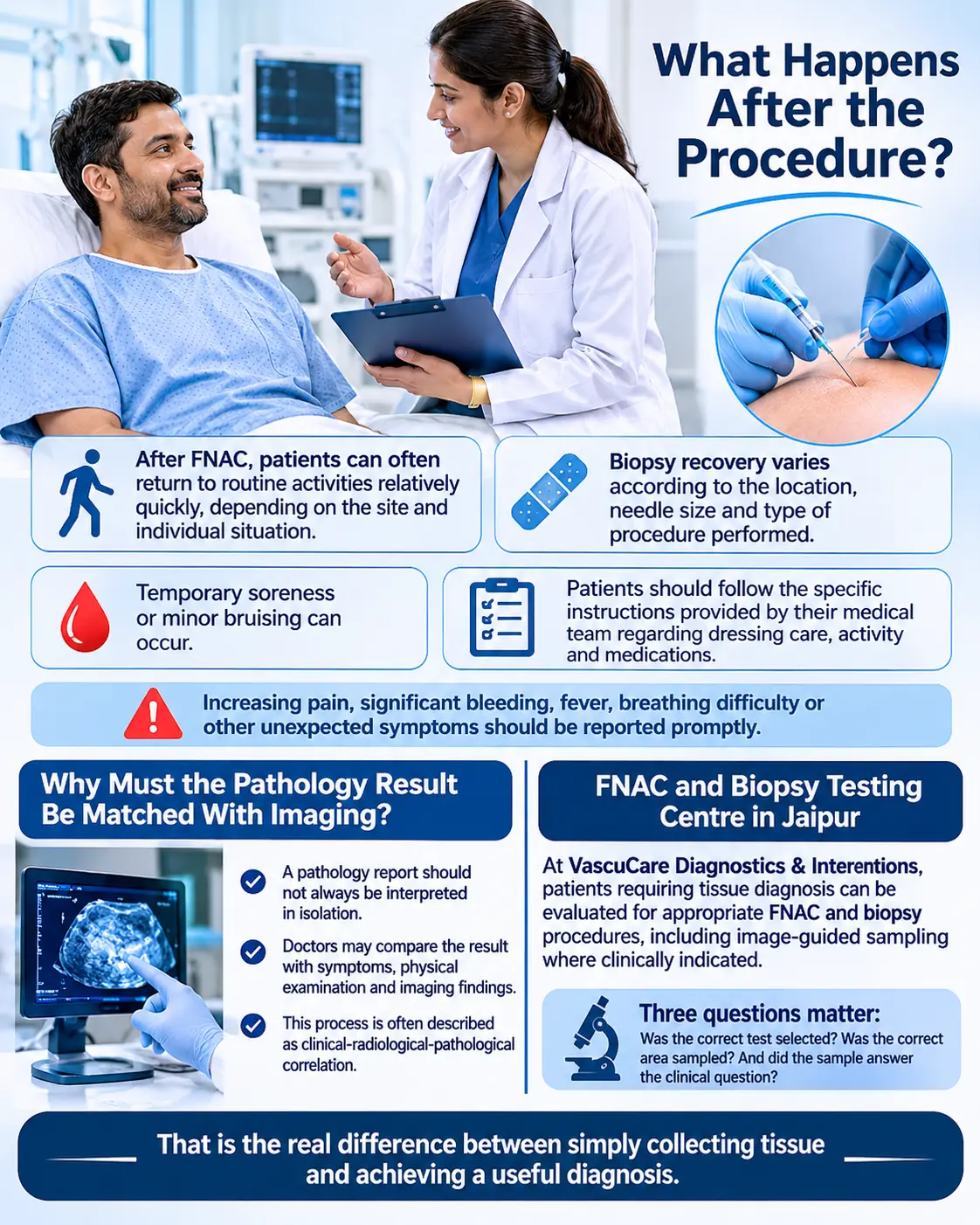
What Happens After the Procedure?
After FNAC, patients can often return to routine activities relatively quickly, depending on the site and individual situation.
Biopsy recovery varies according to the location, needle size and type of procedure performed.
Temporary soreness or minor bruising can occur.
Patients should follow the specific instructions provided by their medical team regarding dressing care, activity and medications.
Increasing pain, significant bleeding, fever, breathing difficulty or other unexpected symptoms should be reported promptly.
Why Must the Pathology Result Be Matched With Imaging?
A pathology report should not always be interpreted in isolation.
Doctors may compare the result with symptoms, physical examination and imaging findings.
For example, if imaging appears highly suspicious but the tissue result is unexpectedly non-diagnostic or does not explain the abnormality, further evaluation may be required.
This process is often described as clinical-radiological-pathological correlation.
A useful diagnostic result is one that makes sense within the patient’s complete medical picture.
FNAC and Biopsy Testing Centre in Jaipur
At VascuCare Diagnostics & Interventions, patients requiring tissue diagnosis can be evaluated for appropriate FNAC and biopsy procedures, including image-guided sampling where clinically indicated.
Dr. Rakesh Kumawat – Best Interventional Radiologist and Pain Management Specialist In Jaipur provides image-guided diagnostic and interventional procedures for appropriately selected patients.
For people searching for a Biopsy Testing Centre In Jaipur, FNAC Testing Centre In Jaipur, or Diagnostic Centre in Jaipur, the focus should not only be on getting the test performed.
Patients looking for a Biopsy Testing Centre In Jaipur should consider whether the correct test and sampling method have been selected for their diagnostic needs.
Three questions matter:
Was the correct test selected? Was the correct area sampled? And did the sample answer the clinical question?
That is the real difference between simply collecting tissue and achieving a useful diagnosis.
Frequently Asked Questions (FAQs)
1. Which is more accurate: FNAC or biopsy?
Neither test is automatically more accurate in every condition. FNAC provides cellular information, while biopsy can provide additional tissue architecture. The appropriate test depends on the abnormality and the information required for diagnosis.
2. Is FNAC less painful than a biopsy?
FNAC generally uses a thinner needle and is often a relatively quick procedure. Biopsy may use a larger needle to obtain tissue. Discomfort varies according to the location, technique and individual patient.
3. Can FNAC confirm cancer?
FNAC can provide important information about many abnormalities and may identify malignant cells in certain situations. However, some conditions require a biopsy or additional testing for definitive classification.
4. Why would I need a biopsy after an FNAC?
A biopsy may be recommended if FNAC is inconclusive, provides insufficient material, does not match imaging findings, or if tissue architecture is necessary to establish or classify the diagnosis.
5. When is image-guided FNAC or biopsy required?
Image guidance may be useful when an abnormality is small, deep, difficult to feel or located near important structures. Ultrasound or CT can help guide the needle accurately toward the intended target.