
- Oct 30, 2026
- Pain Management
- 0 Comments
When knee pain continues despite medicines, exercise and physiotherapy, many patients begin to think that surgery is the inevitable next step. But modern knee pain management is not always a straight line from tablets to knee replacement.
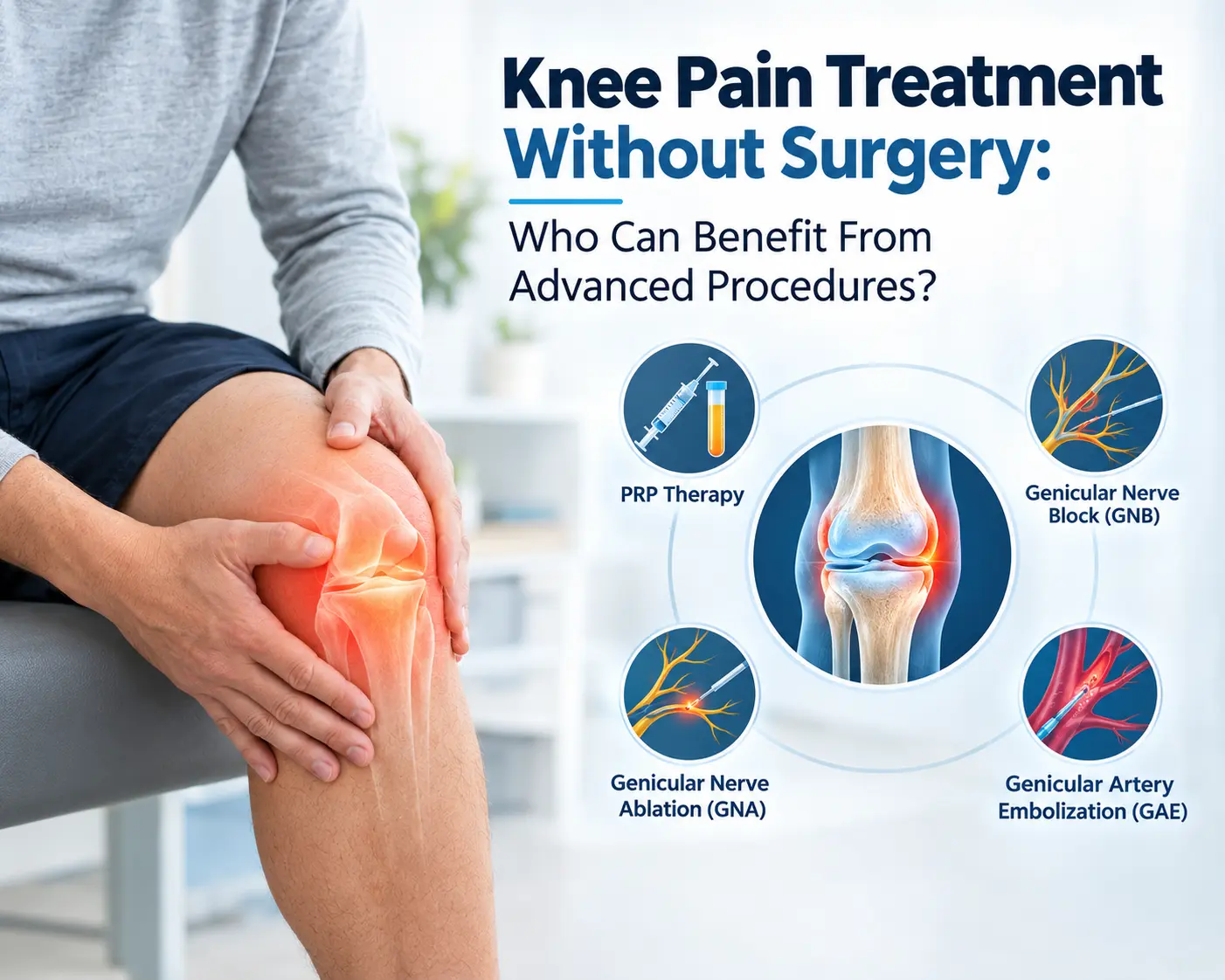
For appropriately selected patients, several advanced non-surgical knee pain treatments may help manage symptoms and improve function. These include PRP Therapy, Genicular Nerve Block (GNB), Genicular Nerve Ablation (GNA) and Genicular Artery Embolization (GAE)Doctor In Jaipur .
However, the most important question is not simply:
“Which advanced treatment is available?”
It is:
“Which treatment matches the reason my knee is hurting?”
Understanding patient selection is therefore one of the most important parts of Knee Pain Treatment in Jaipur. Patients looking for Knee Pain Treatment In Jaipur should first understand the cause of their symptoms and discuss suitable treatment options with a qualified Knee Pain Doctor In Jaipur.
When Should Advanced Knee Pain Treatment Be Considered?
Most knee pain does not immediately require an advanced procedure.
Depending on the diagnosis, initial management may include activity modification, weight management where appropriate, physiotherapy, strengthening exercises and medications.
But further evaluation may be appropriate when pain:
-
Continues despite appropriate conservative treatment
-
Repeatedly returns after temporary improvement
-
Limits walking or stair climbing
-
Interferes with work or daily activities
-
Causes significant night discomfort
-
Leads to frequent painkiller use
-
Prevents effective participation in physiotherapy
At this stage, the diagnosis and pain mechanism should be reconsidered rather than automatically moving to either injections or surgery.
Why Doesn’t One Treatment Work for Every Knee?
“Knee pain” is a symptom, not a diagnosis.
Two people of the same age may both have osteoarthritis but experience pain for different reasons.
One patient’s symptoms may be driven partly by joint degeneration and inflammation. Another may have significant sensory nerve-mediated pain. A third may have an inflammatory-vascular component associated with osteoarthritis.
This difference explains why one advanced procedure cannot be labelled the best option for every painful knee.
The aim is to match the procedure to the pain generator.
Who May Benefit From PRP Therapy?
Platelet-Rich Plasma (PRP) Therapy uses a concentrated preparation derived from the patient’s own blood.
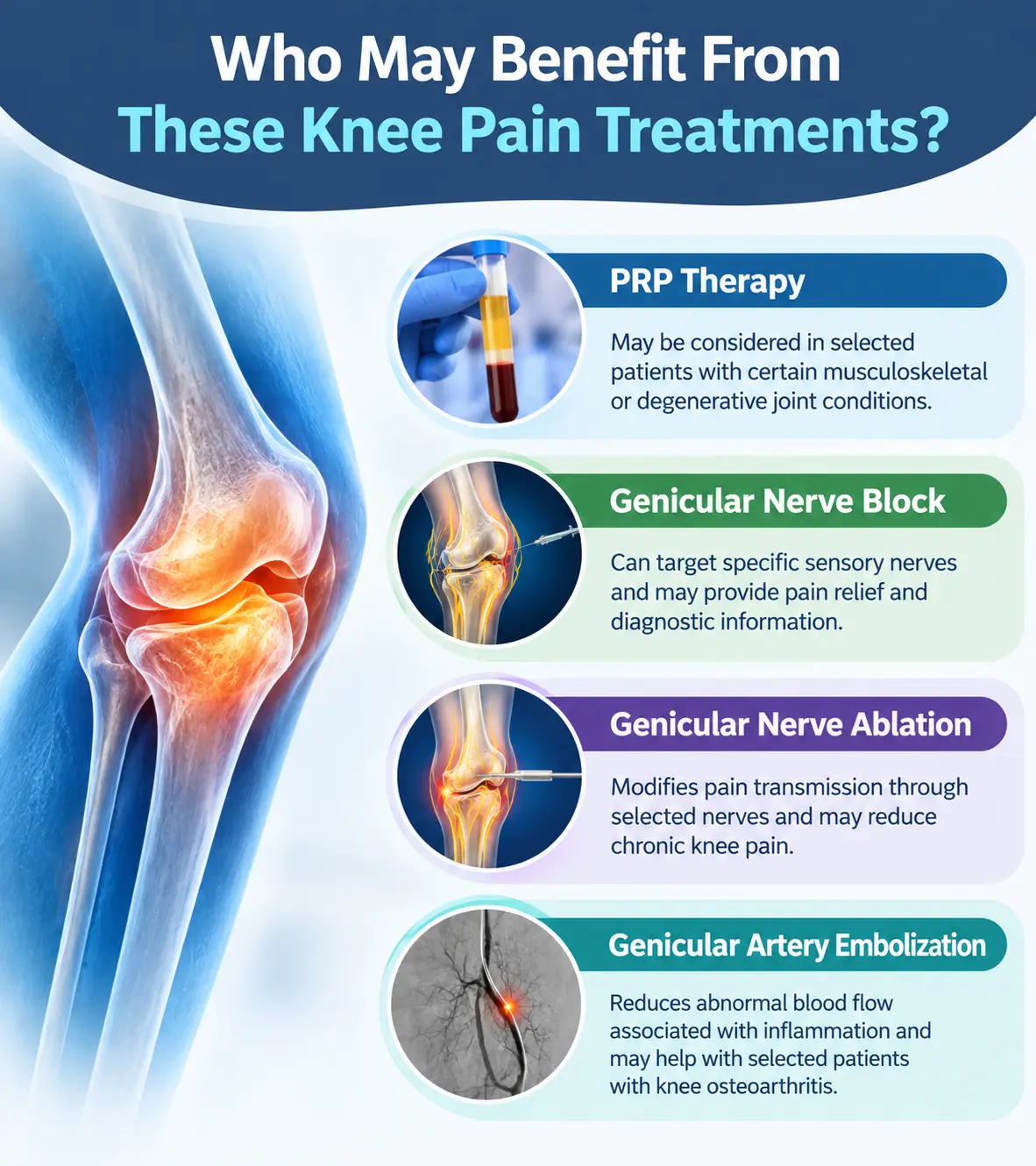
PRP may be considered in selected patients with certain musculoskeletal or degenerative joint conditions.
Patient age, osteoarthritis severity, symptoms, activity level and overall joint condition can influence whether PRP is considered appropriate.
It is important to understand that PRP does not create a new knee or reliably restore severely destroyed cartilage.
For patients with advanced deformity or major structural damage, expectations from PRP need to be particularly realistic.
Who May Benefit From a Genicular Nerve Block?
The knee receives sensory signals through several nerves, including genicular nerve branches.
In selected patients with chronic knee pain, a Genicular Nerve Block (GNB) can target specific sensory nerves using medication.
One useful aspect of a nerve block is that it may provide more than temporary pain relief.
It can also provide diagnostic information.
If temporarily blocking selected nerves produces meaningful improvement in pain and function, it suggests that these nerve pathways contribute significantly to the patient’s symptoms.
This information may help guide further pain-management decisions.
Who May Benefit From Genicular Nerve Ablation?
If a patient’s pain pattern and response to evaluation suggest an important sensory nerve component, Genicular Nerve Ablation (GNA) may be considered in appropriate cases.
GNA uses controlled energy to modify pain transmission through selected nerves around the knee.
The objective is not to repair cartilage or reverse osteoarthritis.
Instead, it targets the pathway carrying pain signals.
This distinction is particularly important. A patient may experience reduced pain even though structural changes remain visible on an X-ray.
Therefore, improvement should also be measured through practical outcomes such as walking, stairs, sleep and daily activity—not imaging alone.
Who May Benefit From Genicular Artery Embolization?
Genicular Artery Embolization (GAE)Doctor In Jaipur works through a completely different mechanism.
Research into osteoarthritis has shown that chronic inflammation can be associated with increased abnormal vascularity in the synovial tissues of some painful knees.
During GAE, an interventional radiologist navigates a small catheter into selected genicular arteries under imaging guidance and delivers embolic material to reduce abnormal blood flow associated with inflammation.
GAE may be considered for selected patients with symptomatic knee osteoarthritis, particularly when appropriate conservative treatment has not provided sufficient relief and clinical assessment supports an inflammatory-vascular pain component.
GAE does not replace cartilage and is not suitable for every osteoarthritis patient.
What If Physiotherapy Has Not Worked?
Patients sometimes say, “I tried physiotherapy, so there is nothing left except surgery.”
That conclusion may be premature.
First, it is important to determine why physiotherapy did not produce adequate improvement.
Was pain preventing proper participation? Was the exercise programme appropriate for the diagnosis? Is significant inflammation present? Is another structure generating pain?
In selected patients, controlling pain through an appropriate intervention may make rehabilitation easier.
Advanced procedures and physiotherapy can therefore sometimes work as different parts of the same treatment strategy rather than alternatives to one another.
Who May Not Benefit From Non-Surgical Procedures?
Advanced non-surgical procedures have limits.
Patients with severe structural destruction, major deformity, significant instability, certain fractures, infection or other conditions requiring surgical correction may need orthopedic evaluation.
Similarly, unexplained knee pain should not be treated with an intervention simply because a minimally invasive procedure is available.
Diagnosis comes first.
This is why a responsible non-surgical treatment plan must also identify patients for whom not performing a procedure is the better decision.
How Does a Doctor Choose Between PRP, GNB, GNA and GAE?
The decision may involve several factors:
Pain pattern: When and where does the knee hurt?
Functional limitation: How far can the patient walk? Are stairs or getting out of a chair difficult?
Imaging: What structural changes are present?
Previous treatment: What has already been tried and how did the knee respond?
Pain mechanism: Does the clinical picture suggest joint degeneration, inflammation, sensory nerve involvement or an inflammatory-vascular component?
These factors help move treatment away from a one-size-fits-all approach.
Knee Pain Treatment Without Surgery in Jaipur
At VascuCare Diagnostics & Interventions, patients with persistent knee pain can be evaluated for conservative and minimally invasive treatment options according to their individual condition.
Advanced options for appropriately selected patients may include PRP Therapy, Genicular Nerve Block, Genicular Nerve Ablation and Genicular Artery Embolization.
Dr. Rakesh Kumawat – Best Interventional Radiologist and Pain Management Specialist In Jaipur provides image-guided and pain-management procedures for selected patients with chronic knee pain.
For people searching for a Knee Pain Doctor in Jaipur, Knee Joint Pain Treatment in Jaipur, Pain Management Specialist Doctor in Jaipur, or Knee Pain Treatment in Jaipur, the goal should not simply be to avoid surgery at any cost.
Patients considering Knee Pain Treatment In Jaipur can discuss their symptoms and treatment options with a qualified Knee Pain Doctor In Jaipur. The appropriate approach depends on the diagnosis, pain mechanism and stage of the condition.
The better goal is to choose the least invasive appropriate treatment that matches the diagnosis, pain mechanism and stage of disease.
Frequently Asked Questions (FAQs)
1. Can severe knee pain be treated without surgery?
Some patients with significant knee pain can benefit from non-surgical treatment, depending on the cause, structural condition of the knee and pain mechanism. Severe deformity or advanced structural damage may still require surgical evaluation.
2. Which is better for knee pain: PRP, GNB, GNA or GAE?
There is no single best procedure for everyone. PRP, nerve blocks, nerve ablation and artery embolization target different aspects of knee pain. Clinical evaluation helps determine which, if any, is appropriate.
3. Can GAE help osteoarthritis knee pain?
GAE may be considered for selected patients with symptomatic knee osteoarthritis where an inflammatory-vascular component is suspected and conservative treatments have not provided adequate relief.
4. Does Genicular Nerve Ablation repair the damaged knee?
No. GNA targets selected sensory nerves to modify pain transmission. It does not rebuild cartilage or reverse structural osteoarthritis.
5. Can advanced knee procedures help delay knee replacement?
For some appropriately selected patients, non-surgical procedures may provide symptom relief and improve function, potentially allowing surgery to be deferred. However, they cannot guarantee that knee replacement will never be required, particularly when structural disease progresses.