
- Oct 15, 2026
- Varicose Vein
- 0 Comments
You had your Varicose Vein Treatment in Jaipur treated months or years ago, your legs improved, and the prominent veins became less noticeable. Then gradually, new veins started appearing. Perhaps heaviness returned by evening, ankle swelling developed again, or a cluster of veins appeared in a different part of the leg.
It is natural to wonder: “Has my varicose vein treatment failed?”
Not necessarily.
Recurrent varicose veins can develop for several reasons. Sometimes the original refluxing pathway remains or reopens. In other cases, previously healthy veins develop valve dysfunction over time. New abnormal venous pathways can also become important.
For this reason, recurrent varicose veins should usually be treated as a new diagnostic problem, not simply by repeating the previous procedure without reassessment.
What Are Recurrent Varicose Veins?
Recurrent varicose veins are varicose veins that appear after previous treatment.
They may occur in exactly the same region or develop elsewhere in the treated leg.
Recurrence can happen after different types of treatment, including previous surgery, endovenous procedures or treatment directed at visible surface veins.
The appearance of another vein does not tell us why recurrence occurred.
That requires evaluation of the underlying venous circulation.
Reason 1: The Original Source of Reflux May Still Be Present
Varicose veins are often driven by venous reflux—backward blood flow caused by valves that are no longer functioning effectively.
If treatment addresses visible branch veins but an important underlying refluxing vein remains untreated, pressure may continue feeding abnormal surface veins.
This illustrates why treating the most obvious vein is not always enough.
Think of the visible varicose vein as a branch on a tree. Removing one branch does not solve the problem if the abnormal pathway supplying it remains active.
A detailed venous assessment is therefore important before both initial and repeat treatment.
Reason 2: A Previously Treated Vein May Reopen
Some treatments are designed to close an incompetent superficial vein.
In certain cases, a treated vein can later develop partial or complete reopening, known as recanalization.
If significant reflux returns through that pathway, symptoms or visible veins may recur.
However, the presence of recurrent symptoms does not prove recanalization. A scan is needed to determine whether the previously treated vein remains closed and whether another pathway is responsible.
Reason 3: Venous Disease Can Progress Over Time
Varicose Vein Surgeon In Jaipur are often part of a chronic venous condition rather than a one-time event.
Even when the original treatment successfully addresses the abnormal veins identified at that time, other veins can develop valve dysfunction years later.
This means a person may have successful treatment and still develop new varicose veins from a different source in the future.
Factors such as age, family history, pregnancy, prolonged standing, obesity and individual venous anatomy may influence the development and progression of venous disease.
Therefore, recurrence does not automatically mean the first treatment was performed incorrectly.
Reason 4: New Connecting Veins May Become Important
The venous system contains an extensive network of superficial, deep and connecting veins.
Over time, alternative pathways may become enlarged or incompetent.
After previous surgery, anatomy can also be different from an untreated leg, making recurrent disease more complex to understand by visual examination alone.
This is one reason why simply looking at the leg and choosing another visible vein for treatment may be inadequate.
The circulation needs to be re-mapped.
What Symptoms Can Return With Recurrent Varicose Veins?
Recurrence is not always first noticed because of appearance.
Some patients notice symptoms before large veins become obvious.
These can include:
· Evening leg heaviness
· Aching after prolonged standing
· Ankle swelling
· Burning or throbbing
· Itching
· Night cramps
· New visible veins
· Skin pigmentation or irritation
Patients who previously developed advanced venous disease should pay particular attention to recurring swelling, skin changes or wounds around the ankle.
Why Is Colour Doppler Important Before Repeat Treatment?
Colour Doppler or duplex ultrasound is particularly valuable when varicose veins return after previous treatment.
The scan can help answer several different questions:
Is the previously treated vein still closed?
Has reflux developed in another superficial vein?
Are branch veins contributing to the recurrence?
Is there another venous pathway that requires attention?
What is happening in the deeper venous system?
This information helps create a new treatment map.
The principle is simple:
Do not assume that today’s varicose veins have the same source as yesterday’s varicose veins.
Can Recurrent Varicose Veins Be Treated Again?
Yes, many recurrent varicose veins can be treated, but the appropriate method depends on the cause identified during evaluation.
For significant superficial venous reflux, endovenous laser treatment may be considered in suitable anatomy.
During laser treatment, a thin fibre is positioned inside the targeted refluxing vein under ultrasound guidance. Controlled thermal energy closes the abnormal vein so blood can redirect through functioning venous pathways.
Other treatment approaches may be considered for residual or branch veins depending on their location, size and anatomy.
Some patients may require a combination of techniques rather than one procedure.
The correct strategy should therefore be based on the current venous map, not merely the name of the treatment used previously.
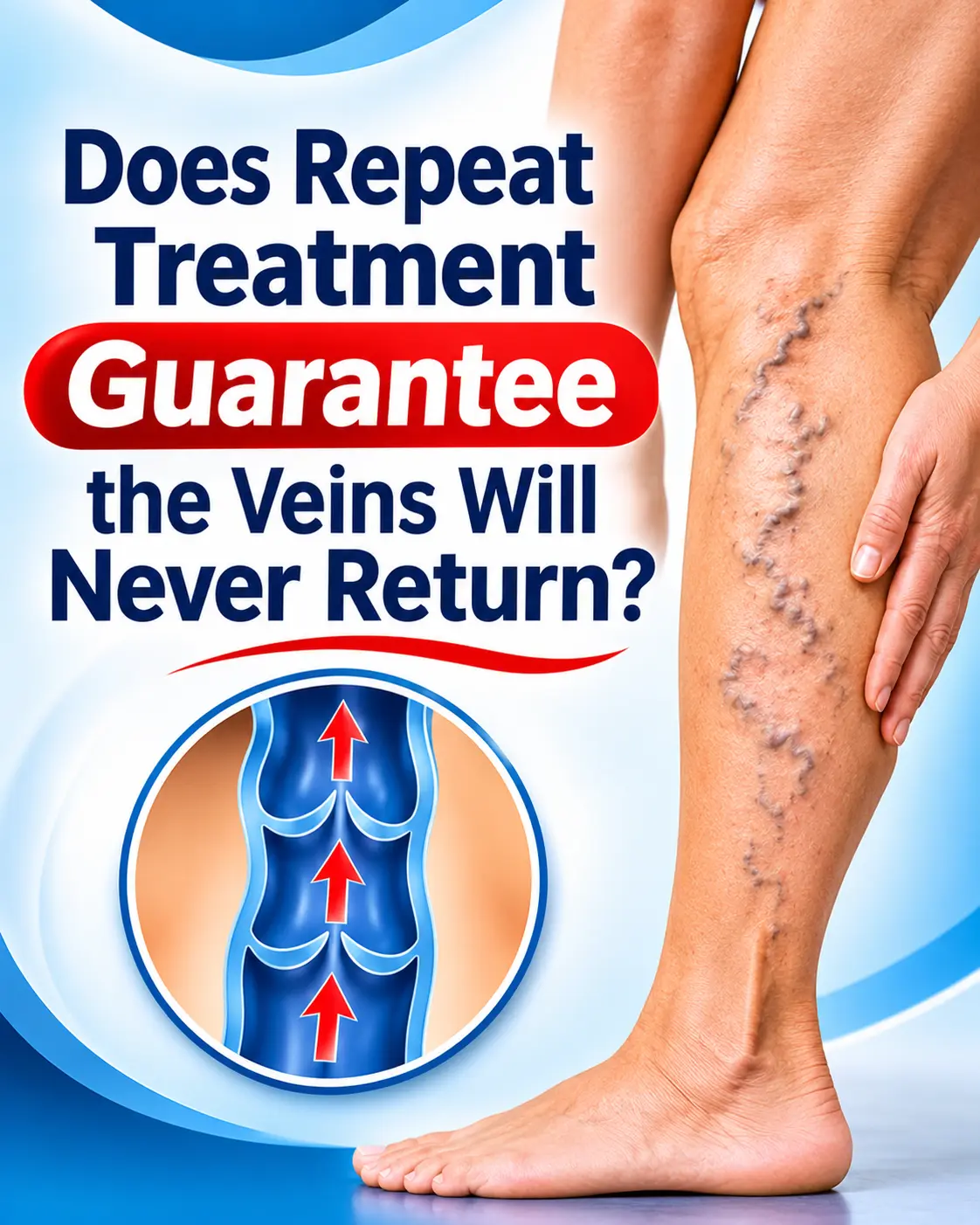
Does Repeat Treatment Guarantee the Veins Will Never Return?
No treatment should be presented as a guarantee that a person will never develop another varicose vein.
Treatment can successfully address identified abnormal venous pathways, but it cannot necessarily prevent every healthy vein from developing valve dysfunction years later.
This distinction is important when discussing long-term expectations.
Treatment addresses current disease. Follow-up and attention to new symptoms remain important because venous disease can evolve.
Can You Reduce the Risk of Future Problems?
Regular walking helps activate the calf-muscle pump and supports venous return. Avoiding very long periods of static sitting or standing may also help with symptom management.
Weight management where appropriate, regular physical activity and compression therapy when medically recommended can form part of ongoing venous care.
However, lifestyle measures cannot guarantee that recurrent reflux will not occur.
If symptoms return, repeating creams, stockings or previous treatments without understanding the new venous anatomy may delay appropriate management.
Recurrent Varicose Vein Treatment in Jaipur
At VascuCare Diagnostics & Interventions, patients with new or recurrent varicose veins can be evaluated clinically and with Colour Doppler when appropriate.
For patients searching for Varicose Vein Laser Treatment in Jaipur, Varicose Vein Doctor in Jaipur, or a Vein Specialist Doctor in Jaipur, the first objective after recurrence should be to identify where the abnormal blood flow is coming from now.
Dr. Rakesh Kumawat – Best Interventional Radiologist and Pain Management Specialist In Jaipur provides minimally invasive image-guided treatment options for appropriately selected venous conditions.
Patients exploring Varicose Vein Laser Treatment In Jaipur can discuss their current venous condition and treatment suitability following a proper evaluation.
For individuals also looking into Knee Pain Treatment In Jaipur or consulting a Knee Pain Doctor In Jaipur, it is important to understand that knee pain and recurrent varicose veins are separate conditions requiring their own assessment.
Recurrent varicose veins do not necessarily mean returning to exactly the same treatment.
They mean returning to the diagnosis.
Re-map the veins, identify the present source of reflux, and then choose treatment according to what the circulation looks like today.
Frequently Asked Questions (FAQs)
1. Why have my varicose veins returned after treatment?
Recurrence can occur because of residual reflux, reopening of a previously treated vein, development of new refluxing pathways or progression of chronic venous disease. Colour Doppler can help identify the cause.
2. Does recurrence mean my previous varicose vein treatment failed?
Not always. The original treatment may remain successful while new veins develop valve dysfunction later. Evaluation is required before deciding whether the previous pathway or a new one is responsible.
3. Can recurrent varicose veins be treated with laser again?
In selected patients, endovenous laser treatment may be possible. Suitability depends on the current venous anatomy, Doppler findings and which veins are causing reflux.
4. How can doctors identify the source of recurrent varicose veins?
Colour Doppler or duplex ultrasound can map venous blood flow, evaluate previously treated veins and identify current refluxing pathways before repeat treatment is planned.
5. Can varicose veins return even after successful laser treatment?
Yes. A successfully treated vein may remain closed while another vein develops reflux in the future. Varicose vein disease can progress over time, so new symptoms should be assessed rather than automatically assumed to represent failure of the original laser treatment.