
- Sep 16, 2026
- Pain Management
- 0 Comments
For many people living with chronic Knee Pain Treatment In Jaipur, the biggest concern is not just the pain—it is the fear that persistent symptoms will eventually lead to knee replacement surgery. However, having knee osteoarthritis or long-term knee pain does not automatically mean that surgery is the immediate next step.
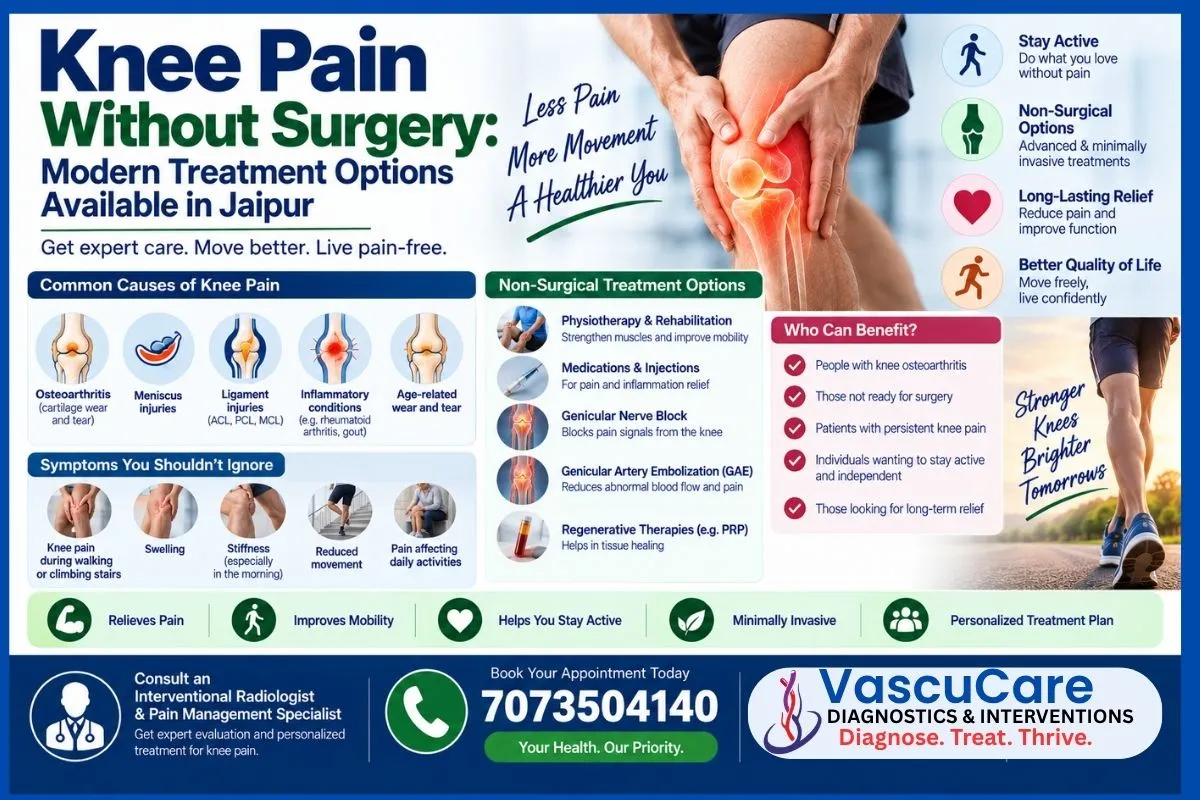
Modern pain management and interventional radiology have expanded the range of knee pain treatment without surgery. Depending on what is actually generating the pain, selected patients may benefit from treatments such as PRP therapy, Genicular Nerve Block, Genicular Nerve Ablation, or Genicular Artery Embolization (GAE).
The important change in modern knee care is that treatment is becoming increasingly targeted. Instead of asking only, “How severe is the pain?”, specialists also consider where the pain is coming from and what mechanism is maintaining it.
The X-Ray Is Only One Part of the Knee Pain Story
Two patients can have similar-looking osteoarthritis on an X-ray but experience very different levels of pain.
One may comfortably manage everyday activities, while another struggles to climb stairs or walk even short distances. This happens because knee pain is influenced by several factors beyond cartilage wear alone.
Inflammation inside the joint, abnormal pain signals through sensory nerves, muscle weakness, mechanical stress, previous injuries, and changes in surrounding tissues can all contribute to symptoms.
This is why modern Knee Pain Treatment in Jaipur should ideally begin with identifying the dominant source of pain rather than selecting a procedure based only on an X-ray report.
First Step: Can Conservative Treatment Still Help?
Non-surgical treatment does not necessarily mean undergoing a procedure.
Depending on the diagnosis, the first stage may include physiotherapy, strengthening exercises, activity modification, appropriate medications, and weight management when relevant.
Strengthening the muscles around the knee and hip can improve support and movement. Some patients obtain adequate symptom control through these measures and never need an intervention.
When pain continues to limit mobility despite an appropriate conservative treatment program, targeted procedures may then be considered.
PRP Therapy: A Biological Approach
PRP therapy (Platelet-Rich Plasma) uses a preparation created from the patient’s own blood. After processing the blood to concentrate platelets, PRP is injected into the targeted area.
Rather than simply numbing pain, PRP is used as a biological treatment approach in selected musculoskeletal conditions.
It may be considered for certain patients with knee osteoarthritis or related problems, but results vary. Age, severity of joint degeneration, symptoms, and overall knee condition influence whether PRP is a reasonable option.
PRP should therefore not be promoted as a universal solution for every painful knee.
Genicular Nerve Block: Is the Pain Coming Through These Nerves?
The knee is surrounded by sensory nerves that transmit pain signals to the brain. These include branches known as the genicular nerves.
A Genicular Nerve Block Treatment In Jaipur involves placing medication around selected genicular nerves under image guidance.
Apart from providing temporary pain relief in some patients, the procedure can have another useful role: it may help determine whether interrupting these particular pain signals improves symptoms.
A positive response can sometimes support consideration of a longer-lasting nerve-targeted treatment.
Genicular Nerve Ablation: Targeting the Pain Signal
If chronic knee pain is being transmitted significantly through the targeted genicular nerves, Genicular Nerve Ablation may be considered in appropriately selected patients.
The procedure uses controlled energy to affect selected sensory nerves responsible for carrying pain signals from the knee.
The objective is not to repair cartilage or structurally rebuild the joint. Instead, the treatment focuses on reducing pain transmission.
That distinction is important because a treatment designed to control pain should not be confused with one designed to treat inflammation or mechanical joint damage.
Genicular Artery Embolization: Targeting Inflammation Instead of Nerves
Genicular Artery Embolization (GAE) represents a different approach to chronic knee osteoarthritis pain.
Research into osteoarthritis has shown that persistent inflammation can be associated with abnormal small blood vessels around inflamed tissues of the knee.
During GAE, an interventional radiologist navigates a very small catheter into selected genicular arteries using real-time imaging. Tiny embolic material is then carefully delivered to reduce abnormal blood flow associated with the inflammatory process.
Unlike Genicular Nerve Ablation, GAE does not primary target pain-carrying nerves. It targets abnormal vascularity associated with inflammation.
This is why determining the mechanism behind a patient’s pain matters.
GAE, Nerve Ablation or PRP: How Is the Right Treatment Chosen?
This is one of the most important questions in modern knee pain management.
There should not be a single procedure offered to everyone.
A patient whose symptoms appear strongly associated with inflammation from osteoarthritis may be evaluated differently from someone whose dominant problem is chronic nerve-mediated pain.
Similarly, a younger patient with earlier joint changes may have different treatment considerations from an older patient with advanced structural degeneration.
Doctors may consider:
• Duration and pattern of knee pain
• Severity of osteoarthritis
• Presence of inflammation
• Previous response to physiotherapy and medicines
• Previous injections or procedures
• Walking and functional limitations
• Medical history
• Imaging findings
• Patient expectations and goals
The goal is to match the treatment to the pain generator.
Can These Treatments Prevent Knee Replacement?
It is more accurate to say that non-surgical treatments may help selected patients manage symptoms and potentially delay surgery rather than claiming that they can permanently prevent knee replacement.
If the joint has severe structural damage, major deformity, significant instability, or advanced functional loss, knee replacement may still be the appropriate treatment.
However, not every person with osteoarthritis has reached that stage.
For patients who are not ready for surgery, are medically unsuitable for it, or have symptoms that may respond to targeted treatment, minimally invasive options can provide another pathway worth evaluating.
When Is It Time to Seek More Than Painkillers?
Occasional knee discomfort after unusual physical activity is different from persistent knee pain.
Consider specialist evaluation when pain repeatedly interferes with walking, climbing stairs, standing from a chair, sleeping, working, or normal daily activities.
Another important sign is dependence on repeated pain medication without understanding why the knee continues to hurt.
Instead of asking only, “Which medicine will reduce my pain?”, the more useful question may be:
“What is actually causing my knee pain, and which treatment targets that cause?”
Modern Knee Pain Treatment in Jaipur
At VascuCare Diagnostics & Interventions, chronic knee pain can be assessed from both pain-management and minimally invasive interventional perspectives.
Dr. Rakesh Kumawat – Best Interventional Radiologist and Pain Management Specialist Doctor In Jaipur evaluates patients to determine whether conservative management, PRP therapy, Genicular Nerve Block, Genicular Nerve Ablation, Genicular Artery Embolization, or another approach may be appropriate.
The objective of modern non-surgical knee care is not simply to avoid surgery at any cost. It is to identify patients who genuinely need surgery and, equally importantly, those who may still have suitable non-surgical options.
For the right patient, a personalized treatment strategy can help improve pain control, mobility, and everyday function while avoiding unnecessary procedures.
Frequently Asked Questions (FAQs)
1. Can severe knee pain really be treated without surgery?
Sometimes. Pain severity alone does not determine whether surgery is required. The cause of pain, degree of structural damage, inflammation, mobility, and previous treatment response all influence the decision.
2. Which non-surgical knee treatment is best for osteoarthritis?
There is no single best treatment for everyone. Physiotherapy, PRP therapy, Genicular Nerve Block, Genicular Nerve Ablation, or GAE may be considered depending on the patient’s condition and pain mechanism.
3. What is the difference between Genicular Nerve Ablation and GAE?
Genicular Nerve Ablation targets sensory nerves transmitting knee pain. Genicular Artery Embolization targets abnormal blood vessels associated with inflammation in osteoarthritis. They treat different components of pain.
4. How do doctors decide whether I need GAE?
Doctors evaluate symptoms, osteoarthritis severity, imaging, inflammatory features, previous treatments, medical history, and vascular factors before determining whether GAE may be suitable.
5. Can GAE rebuild damaged knee cartilage?
No. GAE is not a cartilage-regeneration procedure. Its purpose is to target abnormal vascularity associated with inflammation and potentially reduce osteoarthritis-related pain in selected patients.
6. What happens if a Genicular Nerve Block gives good pain relief?
A good response can suggest that targeted genicular nerves contribute to the patient’s pain. Depending on the overall assessment, a longer-lasting nerve-targeted procedure such as Genicular Nerve Ablation may then be considered.
7. Is PRP better than Genicular Nerve Ablation?
They are fundamentally different treatments. PRP is a biological treatment approach, whereas nerve ablation targets pain transmission. The appropriate option depends on the patient’s diagnosis and treatment goals.
8. Can I choose GAE simply because I don’t want knee replacement?
Not automatically. Wanting to avoid surgery is understandable, but GAE requires appropriate patient selection. Some patients with advanced joint destruction or other conditions may be better served by surgical treatment.
9. At what age should I consider non-surgical knee pain treatment?
There is no fixed age. Treatment decisions should be based on the cause and severity of knee pain, functional limitations, imaging findings, overall health, and previous treatment response rather than age alone.
10. When should I consult a knee pain specialist in Jaipur?
Consider specialist evaluation if Knee Pain Treatment In Jaipur persists despite medicines or physiotherapy, limits walking or stair climbing, repeatedly disturbs sleep, or is affecting your independence and daily activities. An evaluation can help determine whether a targeted non-surgical option is suitable.