
- May 29, 2026
- Pain Management
- 0 Comments
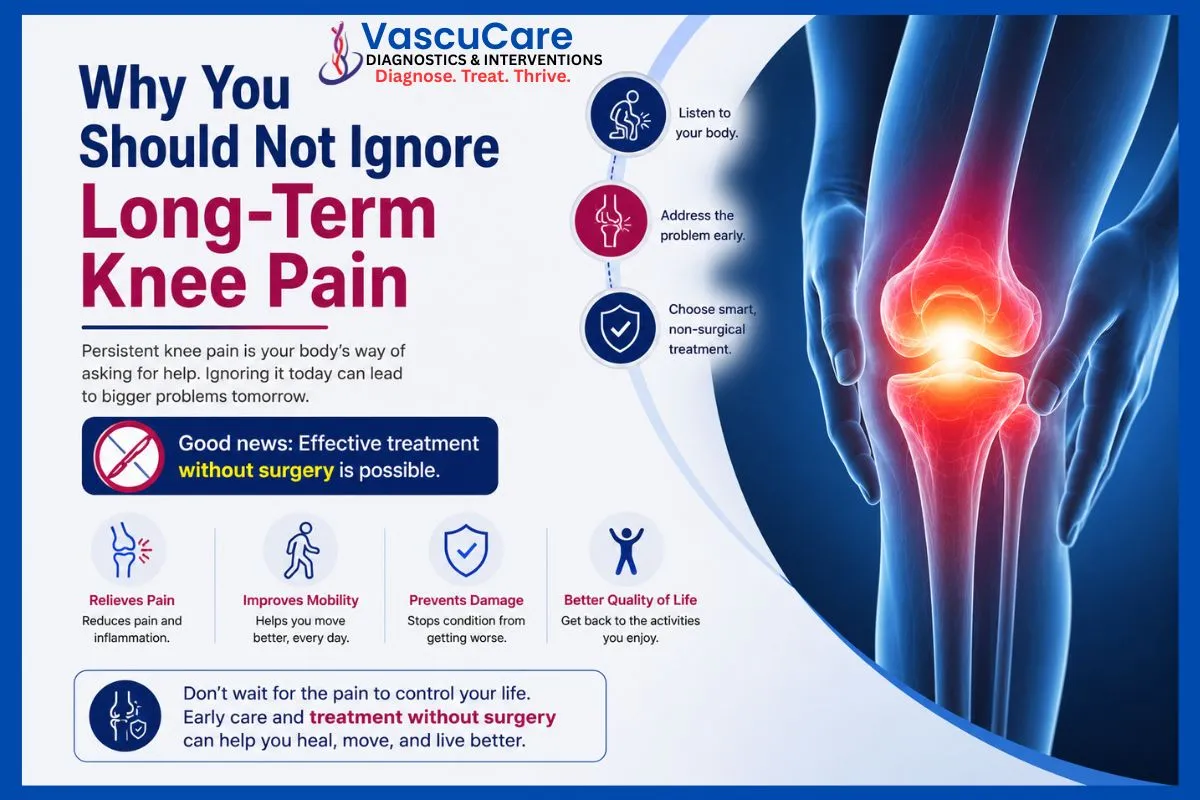
Long-term knee pain Treatment in jaipur is not something you should adjust to or keep managing with painkillers for months. Many people ignore knee pain in the beginning because it comes and goes, but over time it may start affecting walking, stair climbing, sleep, work, and daily movement. In many cases, chronic knee pain is linked to arthritis, cartilage wear, inflammation, nerve-related pain, old injury, or age-related joint degeneration.
The good news is that long-term knee pain does not always mean surgery. Modern non-surgical and minimally invasive treatments such as genicular nerve block, genicular artery embolization, PRP therapy, and genicular nerve ablation can help selected patients get relief and improve mobility.
If you are suffering from persistent knee pain, consulting Dr. Rakesh Kumawat – Best Interventional Radiologist and Pain Management Specialist in Jaipur can help you understand the exact cause of pain and the best treatment option for your condition.
What is Long-Term Knee Pain?
Long-term knee pain means pain that continues for several weeks or months and does not improve properly with rest, home remedies, or basic medicines. It may be constant or may increase during activities such as walking, standing, climbing stairs, bending the knee, or getting up from a chair.
Common symptoms include:
- Pain while walking or climbing stairs
- Swelling around the knee
- Stiffness after sitting for a long time
- Difficulty bending or straightening the knee
- Pain during daily activities
- Crackling or grinding sensation
- Reduced walking distance
- Night pain or disturbed sleep
- Repeated need for painkillers
If these symptoms continue, it is important to get evaluated instead of delaying treatment.
Why Ignoring Knee Pain Can Be Risky
Ignoring knee pain can allow the underlying problem to become worse. Early-stage knee problems may be managed with non-surgical methods, but untreated pain can lead to reduced movement, muscle weakness, joint stiffness, weight gain due to inactivity, and worsening arthritis.
Long-term pain can also affect the way you walk. When you start putting more weight on the other leg to avoid pain, it can create pressure on the hip, back, ankle, and opposite knee. This can turn one knee problem into a larger mobility issue.
Common Causes of Long-Term Knee Pain
Long-term knee pain can happen due to several reasons. Some of the most common include:
- Knee osteoarthritis
- Cartilage wear and tear
- Meniscus injury
- Ligament strain
- Tendon inflammation
- Bursitis
- Previous knee injury
- Post-surgical knee pain
- Nerve-related pain around the knee
- Chronic inflammation inside the joint
Correct diagnosis is important because every knee pain patient does not need the same treatment. Some need physiotherapy, some need injections, some may benefit from nerve procedures, and some advanced cases may need surgical evaluation.
When Should You Consult a Specialist?
You should not ignore knee pain if:
- Pain lasts more than a few weeks
- Pain is increasing with time
- You have swelling or stiffness
- You cannot climb stairs comfortably
- You need painkillers frequently
- Walking distance is reducing
- Pain affects sleep or daily work
- You have already tried medicines and physiotherapy without enough relief
- You want to avoid or delay knee surgery
Early consultation can help identify whether your pain can be managed with non-surgical treatment before the condition becomes more advanced.
Non-Surgical Treatments for Long-Term Knee Pain
Modern pain management focuses on finding the source of pain and treating it with precision. Dr. Rakesh Kumawat – Best Interventional Radiologist andPain Management Specialist in Jaipur offers advanced image-guided and minimally invasive treatment options for suitable knee pain patients.
1. Genicular Nerve Block
A genicular nerve block is a minimally invasive injection procedure used to reduce chronic knee pain. The knee has small sensory nerves called genicular nerves that carry pain signals from the knee joint to the brain. In this procedure, medicine is injected near these nerves to temporarily block pain signals.
Cleveland Clinic describes genicular nerve block as an injection in the knee that can provide temporary pain relief and is used for chronic knee pain, including pain after knee surgery. Results can vary from patient to patient.
This procedure can also help the doctor understand whether the patient may benefit from a longer-lasting treatment such as genicular nerve ablation.
2. Genicular Artery Embolization
Genicular Artery Embolization, also called GAE, is an advanced minimally invasive treatment for knee osteoarthritis-related pain. In arthritis, abnormal small blood vessels may develop around the inflamed knee joint lining. These vessels can contribute to pain and inflammation.
During GAE, the interventional radiologist uses imaging guidance to reach the abnormal blood vessels and safely block them with tiny particles. Cleveland Clinic explains that GAE treats knee osteoarthritis by blocking abnormal vessels near the knee, which can reduce inflammation and relieve pain without surgery.
GAE may be considered for selected patients with chronic knee osteoarthritis pain who want to avoid or delay surgery. It is not suitable for every patient, so proper evaluation is necessary.
3. PRP Therapy
PRP Therapy, or Platelet-Rich Plasma therapy, uses the patient’s own blood to prepare a platelet-rich solution. This solution contains growth factors that may support healing and reduce inflammation in suitable joint and soft tissue conditions.
Johns Hopkins explains that PRP treatment can support healing in joint injuries, and results for joint injections are usually noticed after several weeks rather than immediately.
PRP may be useful in selected patients with early to moderate knee osteoarthritis, cartilage wear, or soft tissue-related knee pain. It is not a guaranteed cure for arthritis, but it may help improve pain and mobility in appropriate cases.
4. Genicular Nerve Ablation
Genicular nerve ablation, also known as genicular radiofrequency ablation, is a minimally invasive treatment used for longer-lasting knee pain relief. It is usually considered when a diagnostic genicular nerve block gives good temporary relief.
In this procedure, radiofrequency energy is used to reduce pain signal transmission from targeted genicular nerves around the knee. Cleveland Clinic pain experts describe radiofrequency ablation as a minimally invasive method used for chronic hip and knee pain management in selected patients.
This treatment does not repair cartilage or reverse arthritis, but it can help reduce pain signals and improve function in suitable patients.
Why Image-Guided Treatment Matters
Image guidance is very important in knee pain procedures. Techniques such as ultrasound, fluoroscopy, CT, or X-ray guidance help the doctor place the needle or catheter accurately near the target joint, nerve, or blood vessel.
This improves precision and helps avoid blind treatment. As an interventional radiologist, Dr. Rakesh Kumawat uses image-guided techniques to plan and perform targeted treatment for knee pain patients.
Benefits of Early Pain Management
Early pain management can help patients:
- Reduce pain and stiffness
- Improve walking comfort
- Avoid repeated painkiller use
- Maintain daily activity
- Strengthen muscles through physiotherapy
- Delay surgery in selected cases
- Prevent worsening disability
- Improve overall quality of life
Ignoring pain for too long can make treatment more difficult later. Early action gives more options.
Why Choose Dr. Rakesh Kumawat in Jaipur?
Dr. Rakesh Kumawat – Best Interventional Radiologist in Jaipur and Pain Management Specialist provides advanced non-surgical and image-guided solutions for chronic knee pain. His treatment approach focuses on accurate diagnosis, targeted pain relief, and personalized care.
Patients can consult him for:
- Long-term knee pain
- Knee osteoarthritis pain
- Genicular nerve block
- Genicular artery embolization
- PRP therapy
- Genicular nerve ablation
- Image-guided knee pain treatment
- Non-surgical pain management options
FAQs
1. When should I worry about long-term knee pain?
You should consult a specialist if knee pain lasts for more than a few weeks, affects walking, causes swelling, limits stair climbing, or requires frequent painkillers.
2. Can long-term knee pain be treated without surgery?
Yes, many patients with early to moderate knee arthritis or chronic knee pain may benefit from non-surgical treatments such as PRP therapy, genicular nerve block, genicular artery embolization, or genicular nerve ablation.
3. What is genicular nerve block?
Genicular nerve block is an injection procedure that targets pain-carrying nerves around the knee to reduce pain signals temporarily.
4. What is genicular artery embolization?
Genicular artery embolization is a minimally invasive procedure that blocks abnormal blood vessels around the knee to reduce inflammation and pain in selected osteoarthritis patients.
5. Does PRP therapy cure knee arthritis?
PRP does not permanently cure arthritis, but it may help reduce pain, inflammation, and stiffness in selected patients with early to moderate knee problems.
6. Who is the best doctor for long-term knee pain treatment in Jaipur?
For image-guided and minimally invasive knee pain treatment, you can consult Dr. Rakesh Kumawat – Best Interventional Radiologist and Pain Management Specialist in Jaipur.