
- May 28, 2026
- Pain Management
- 0 Comments
Knee joint pain is one of the most common problems affecting people in daily life. It can make walking, climbing stairs, sitting on the floor, standing for long hours, or even simple household work difficult. Many patients think that long-term knee pain always means knee replacement surgery, but this is not true in every case.
In many patients, especially those with early to moderate arthritis, chronic inflammation, nerve-related knee pain, or pain that has not improved with medicines and physiotherapy, non-surgical knee joint pain treatment can be a suitable option. Modern image-guided pain management procedures such as genicular nerve block, genicular artery embolization, PRP therapy, and genicular nerve ablation may help reduce pain and improve mobility without immediate surgery.
If you are looking for knee pain treatment in Jaipur, you can consult Dr. Rakesh Kumawat – Best Interventional Radiologist and Pain Management Specialist in Jaipur for advanced image-guided and minimally invasive treatment options.
Understanding Knee Joint Pain
Knee joint pain can happen due to different reasons. The most common cause in middle-aged and elderly patients is knee osteoarthritis, where the cartilage inside the joint gradually wears down. Other causes may include meniscus injury, ligament strain, inflammation, obesity-related joint pressure, previous injury, or post-surgical pain.
Common symptoms include:
- Pain while walking or climbing stairs
- Knee stiffness after sitting
- Swelling around the knee
- Difficulty bending or straightening the knee
- Pain while standing for long periods
- Crackling or grinding sensation
- Reduced walking capacity
- Pain that affects sleep or daily work
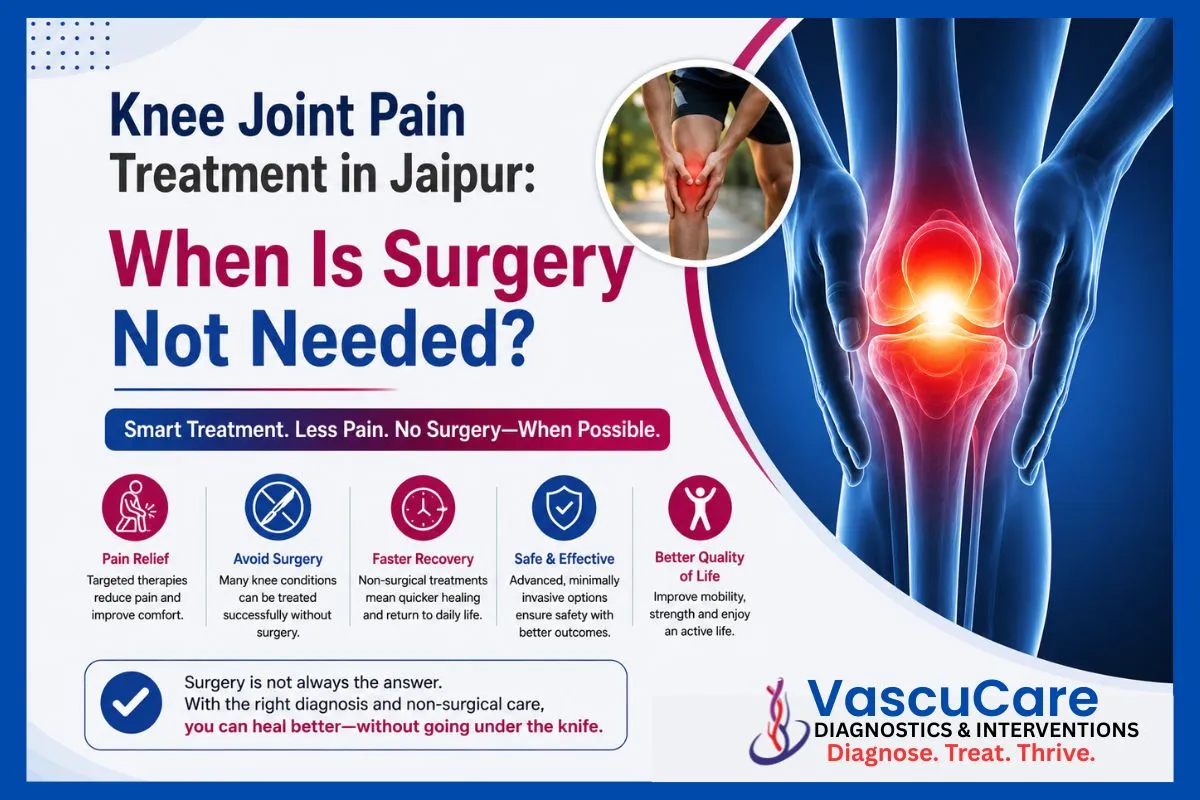
Surgery may be required in advanced cases, but many patients do not need surgery immediately. The right treatment depends on the stage of disease, pain severity, X-ray or MRI findings, age, lifestyle, and overall health condition.
When Is Surgery Not Needed?
Surgery may not be the first choice when the knee joint damage is not very advanced or when the patient can benefit from targeted pain management. Non-surgical treatment may be considered when:
- Arthritis is mild to moderate
- Pain is more than the visible joint damage
- The patient wants to delay knee replacement
- The patient is not medically fit for surgery
- Pain continues even after previous knee surgery
- Medicines and physiotherapy are not giving enough relief
- The patient wants minimally invasive options before surgery
Knee replacement can be highly useful for severe arthritis, but it is not always the first step. Pain management focuses on controlling pain, improving function, and helping the patient remain active for longer.
1. Genicular Nerve Block
A genicular nerve block is a minimally invasive injection procedure that targets the pain-carrying nerves around the knee. These nerves are called genicular nerves. They transmit pain signals from the knee joint to the brain.
In this procedure, medicine is injected near these nerves to temporarily block pain signals. It is commonly used for chronic knee pain, knee osteoarthritis, or persistent pain after knee surgery. Cleveland Clinic explains that a Genicular Nerve Block Treatment In Jaipur is an injection around the knee that can provide temporary pain relief and is used for chronic knee pain and pain after knee surgery.
This procedure is useful because it can also help identify whether the patient may benefit from a longer-lasting treatment like genicular nerve ablation.
2. Genicular Artery Embolization
Genicular Artery Embolization, also known as GAE, is an advanced minimally invasive treatment for knee osteoarthritis-related pain. It is usually performed by an interventional radiologist.
In knee osteoarthritis, abnormal tiny blood vessels may develop around the inflamed knee joint lining. These vessels can contribute to inflammation and pain. During GAE, the doctor uses imaging guidance to reach the abnormal blood vessels and blocks them using tiny particles. Cleveland Clinic describes GAE as a procedure for knee osteoarthritis in which safe material is injected into blood vessels near the knee to block abnormal vessels, reduce inflammation, and relieve pain without surgery.
GAE does not replace the knee joint and does not cure arthritis permanently. However, in suitable patients, it may reduce pain, swelling, and inflammation, helping improve daily function. Research reviews describe GAE as an emerging minimally invasive option for knee osteoarthritis pain, with evidence showing symptom improvement, although the evidence base is still developing.
3. PRP Therapy
PRP Therapy, or Platelet-Rich Plasma therapy, is another non-surgical option for selected knee joint pain patients. In PRP therapy, a small amount of the patient’s own blood is collected and processed to separate platelet-rich plasma. This concentrated plasma is then injected into the affected knee area.
PRP contains growth factors that may support tissue healing and reduce inflammation in suitable cases. It is often considered for early to moderate knee osteoarthritis, sports injury-related pain, cartilage wear, or soft tissue irritation.
PRP is not an instant painkiller and may take time to show results. It also may not work equally for all patients. The American Academy of Orthopaedic Surgeons has reviewed PRP for knee osteoarthritis and notes that evidence varies across studies, so patient selection and treatment planning are important.
For better accuracy, PRP can be given under image guidance so that the injection reaches the correct joint space or affected tissue.
4. Genicular Nerve Ablation
Genicular nerve ablation, also called genicular radiofrequency ablation, is a minimally invasive procedure used for longer-lasting knee pain relief in selected patients. It is often recommended when a diagnostic genicular nerve block gives good temporary relief.
In this procedure, radiofrequency energy is used to reduce pain signal transmission from the targeted genicular nerves. It does not repair cartilage or reverse arthritis, but it can reduce pain signals and help improve walking comfort. A 2022 review described genicular nerve radiofrequency ablation as a minimally invasive intervention for chronic knee pain patients who do not respond well to conservative treatment.
This option may be useful for:
- Knee osteoarthritis pain
- Chronic knee joint pain
- Patients delaying knee replacement
- Patients not fit for surgery
- Pain after knee replacement in selected cases
The effect may last for months in many patients, but results vary from person to person.
Why Image Guidance Is Important
All these procedures work better when the target area is accurately identified. Image guidance such as ultrasound, fluoroscopy, CT, or X-ray helps the specialist place the needle, catheter, or treatment device precisely.
Image guidance helps in:
- Accurate diagnosis
- Safer needle placement
- Better targeting of nerves or vessels
- Reduced chances of misplaced injection
- Personalized treatment planning
- Minimally invasive care
This is where an interventional radiologist plays an important role. Dr. Rakesh Kumawat – Best Interventional Radiologist and Pain Management Specialist in Jaipur uses image-guided techniques to target the exact pain source and provide treatment based on the patient’s condition.
Benefits of Non-Surgical Knee Pain Treatment
For suitable patients, non-surgical knee pain treatment in Jaipur may offer several benefits:
- No major surgical cut
- Minimal downtime
- Day-care treatment in many cases
- Targeted pain relief
- May reduce dependency on painkillers
- Helps improve walking and movement
- Can delay surgery in selected patients
- Useful for high-risk surgical patients
- Personalized approach based on diagnosis
However, it is important to understand that these procedures are not suitable for everyone. Patients with severe bone-on-bone arthritis, major deformity, advanced joint destruction, active infection, or unstable knee injury may still require surgical evaluation.
When Should You Consult a Specialist?
You should consult a knee pain specialist or interventional pain expert if you have:
- Knee pain lasting more than a few weeks
- Pain while walking or climbing stairs
- Swelling or stiffness in the knee
- Pain not improving with medicines
- Repeated need for painkillers
- Knee arthritis diagnosed on X-ray
- Pain after knee replacement
- Desire to avoid or delay surgery
Early consultation helps identify whether your knee pain can be managed without surgery or whether surgical care is necessary.
Why Choose Dr. Rakesh Kumawat in Jaipur?
Dr. Rakesh Kumawat – Best Interventional Radiologist and Pain Management Specialist in Jaipur provides advanced image-guided pain management and minimally invasive treatment options for knee joint pain. His approach focuses on proper diagnosis, precision-based procedures, patient safety, and long-term functional improvement.
Patients can consult him for:
- Knee joint pain treatment
- Genicular nerve block
- Genicular artery embolization
- PRP therapy
- Genicular nerve ablation
- Chronic knee pain management
- Non-surgical pain relief options
FAQs
1. Can knee joint pain be treated without surgery?
Yes, many patients with early to moderate knee arthritis or chronic knee pain can benefit from non-surgical treatments such as PRP therapy, genicular nerve block, genicular artery embolization, or genicular nerve ablation.
2. What is the best non-surgical treatment for knee joint pain?
The best treatment depends on the cause of pain, arthritis stage, imaging findings, and patient health. A specialist may suggest PRP, nerve block, nerve ablation, embolization, physiotherapy, or a combination approach.
3. Is genicular artery embolization safe?
Genicular artery embolization is a minimally invasive procedure used in selected knee osteoarthritis patients. Like all procedures, it has risks, so proper patient selection and expert evaluation are important.
4. How does genicular nerve ablation help knee pain?
Genicular nerve ablation uses radiofrequency energy to reduce pain signals from nerves around the knee. It may provide longer-lasting pain relief in patients who respond well to a diagnostic nerve block.
5. Can PRP therapy cure knee arthritis?
PRP therapy does not cure arthritis permanently, but it may help reduce pain, inflammation, and stiffness in selected patients with early to moderate knee osteoarthritis.
6. Who is the best doctor for knee joint pain treatment in Jaipur?
For image-guided non-surgical knee pain treatment, you can consult Dr. Rakesh Kumawat – Best Interventional Radiologist and Pain Management Specialist in Jaipur.